Gary Epoxy Flooring has spent more than 20 years on epoxy flooring in Alsip and across the south suburbs, and the rooms that test a coating hardest are the ones people cross barefoot and dripping. A locker-room shower, a basement shower stall or a changing area by the back door all ask a floor to be easy to scrub and safe under a wet, soapy foot at the same time.
Those two demands do not point the same way. A slick, glossy film cleans beautifully and grips badly, while a coarse grit grips well and holds soap scum in every low point. This page is about how a seamless resin floor is tuned to sit between them, one zone at a time.
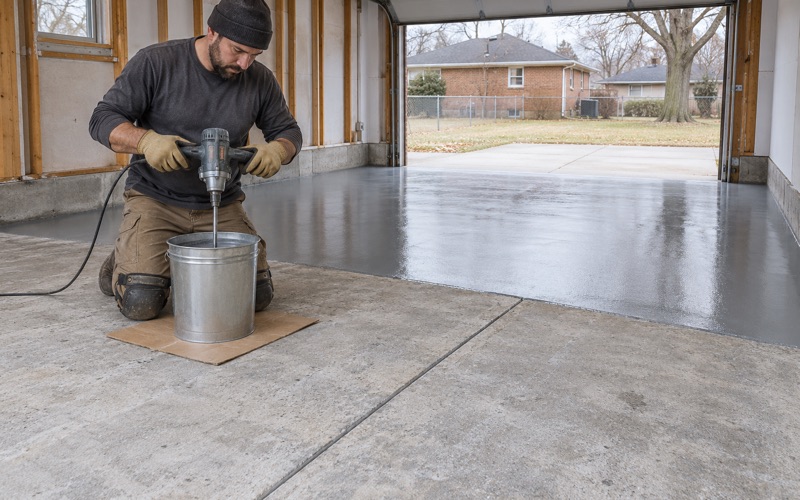
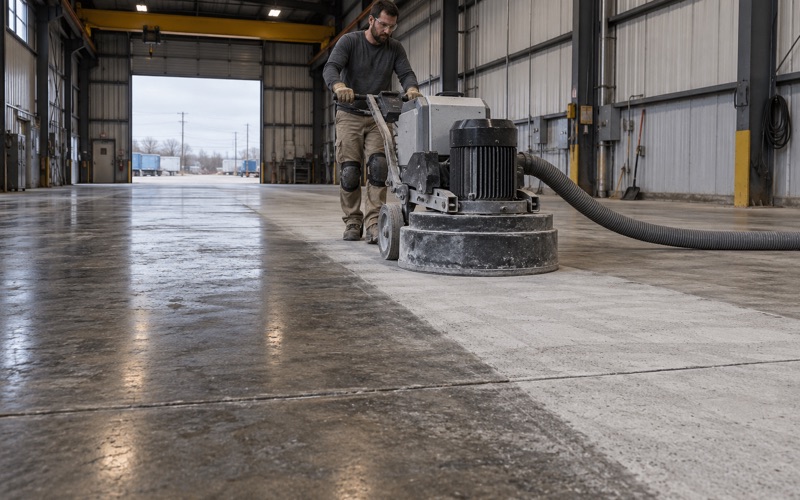
We open every slab with a diamond grinder or a shot blaster before any resin goes down, never an acid etch, and our proposal names the product line, the number of coats and the finished thickness. That paperwork is what lets an owner check the floor that went in against the one that was quoted.
Prairie Junior High’s New Locker Rooms and the Code Sentence Behind Them
A gym complex replacing the 1968/69 building
In August 2022, Alsip, Hazelgreen and Oak Lawn School District 126 described a project at Prairie Junior High, 11900 S Kostner Avenue: a new 17,000-square-foot gymnasium complex replacing the original gym and locker rooms built in 1968/69. The letter lists new bleachers for 700 students, plus locker rooms and bathrooms to support the new space, and a wood floor with one competitive court for the gym itself.
The letter does not say what the new locker-room floors are made of, and we have not seen them. We have no connection to the district or the school; the project simply makes the clearest local example of the problem this page is about.
Alsip is a village of 19,063 people at the 2020 census, a south suburb in Cook County, and the school’s address sits inside the village limits in Worth Township. A room full of wet students after gym class is a floor most homeowners never picture, yet the same tension turns up in a basement shower.
What IBC 1210.2.1 actually says
The International Building Code, in the 2021 edition as published for Illinois, has a short section on toilet and bathing rooms. Section 1210.2.1 says that in other than dwelling units, toilet, bathing and shower room floor finish materials shall have a smooth, hard, nonabsorbent surface, with a base of the same kind extending at least 4 inches up the wall.
Section 1210.2.3 adds that shower compartments must be finished with a smooth, nonabsorbent surface to at least 72 inches above the drain inlet. Those are walls rather than floors, but they show the intent: every surface water touches should shed it and wipe clean.
We quote this as model-code text. Illinois public schools build under the state board’s own rules in 23 Ill. Adm. Code 180, and we have not read which code or review body governed this project, so nothing here says what any authority required of the school.
Looking for epoxy-flooring closer to Lowell? See Epoxy-Flooring Services in Lowell.
Smooth Enough to Scrub, Textured Enough for a Wet Foot
Where the code and the foot disagree
Read literally, smooth, hard and nonabsorbent describe a glossy floor: no pores for water to soak into, nothing for mildew or soap residue to cling to, a surface a squeegee clears in one pass. For hygiene, that is exactly right.
It is also the surface a wet, soapy heel slides on. A bare foot has no tread, and a thin film of water and soap between skin and a polished coating behaves like a lubricant, so the gloss that keeps a shower room clean works against the person standing in it.
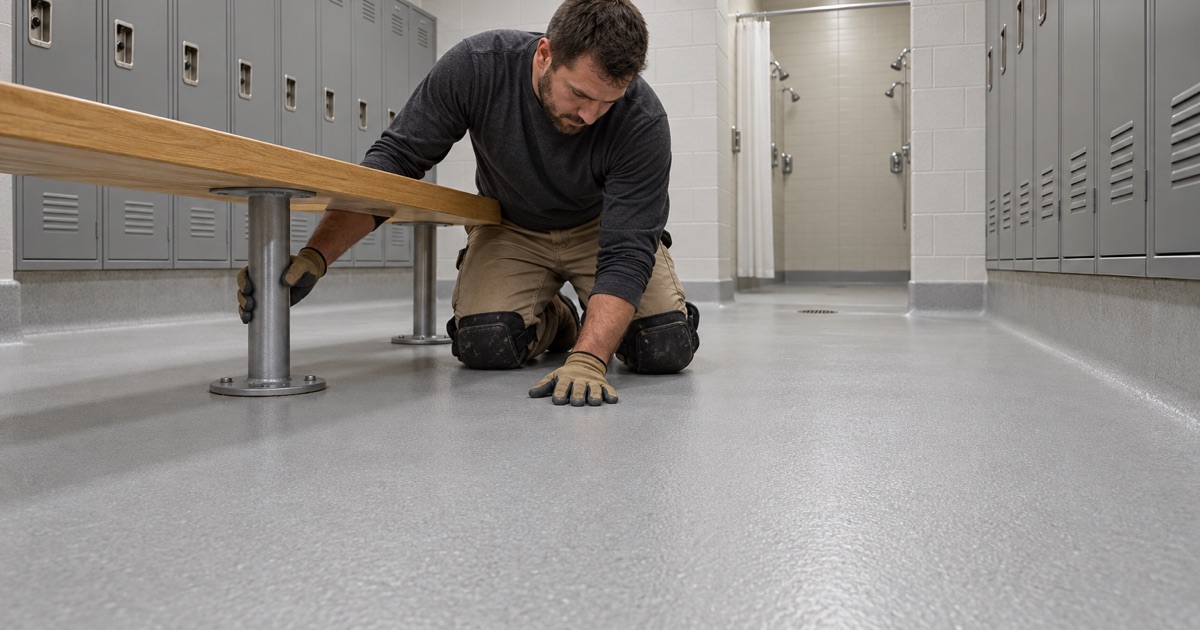
The way through is to read smooth as continuous and closed rather than polished. A resin floor can be nonabsorbent and free of seams while still carrying a fine, even texture locked under the topcoat, which keeps it scrubbable and gives a foot something to hold.
Grading texture by zone
We do not treat a locker room as one floor. The dry aisle between benches can stay nearly smooth, the drying area outside the showers gets a fine texture, and the shower floor itself gets the most grip a cleaning crew can still mop without shredding the mop head.
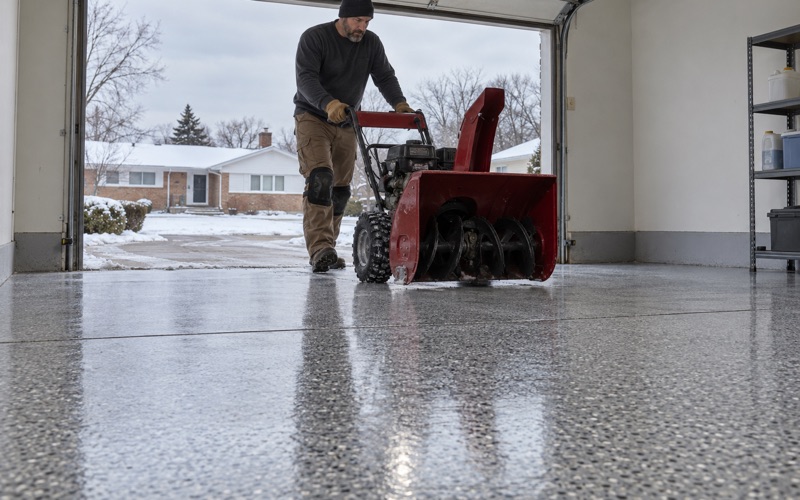
Texture comes from a quartz aggregate broadcast into the body coat and sealed with a polyaspartic or polyurea topcoat. Grit size, broadcast rate and topcoat thickness decide how sharp the finished surface feels, so the proposal names all three for each zone instead of promising a slip-resistant floor in general terms.
The barefoot ramp test, used as a guide only
The most useful reference for wet barefoot areas is a German test, DIN 51097. A barefoot person walks a wetted ramp that tilts until slipping starts, and that angle sorts the surface into group A at 12 degrees or more, group B at 18 degrees and group C at 24 degrees.
Most guidance built on it puts changing rooms and nearly dry barefoot passages in group A and shower areas in group B, while one vendor recommends C for walk-in showers. The groups describe a test result, not the slope of a floor.
It is a European test, not a US code, and we found no Illinois rule adopting it. We borrow its zoning logic when choosing texture, and we never describe one of our floors as rated or certified to it.
Grout Lines, the 4-Inch Base and an Integral Cove
Why tile struggles in a locker room
Glazed ceramic tile meets the smooth, hard, nonabsorbent wording on its face, which is why so many locker rooms are tiled. The weak point is everything between the tiles: cement grout is porous, it sits slightly below the tile face, and in a room that is wet every day it collects soap film and darkens.
Each grout line is also a joint where water can work under the tile over the years. Owners end up scrubbing, sealing and regrouting a surface that met the wording on day one but gets harder to keep that way.
One film from floor to wall
A seamless resin system removes the grid. The body coat and topcoat run across the whole room as a single film, so there is no grout to stain and no line for water to follow below the surface.
At the wall, an integral cove carries the same resin up over a formed radius, which answers that 4-inch base with no seam between floor and base. A mop follows the curve instead of catching on a rubber base or a tile cove joint.
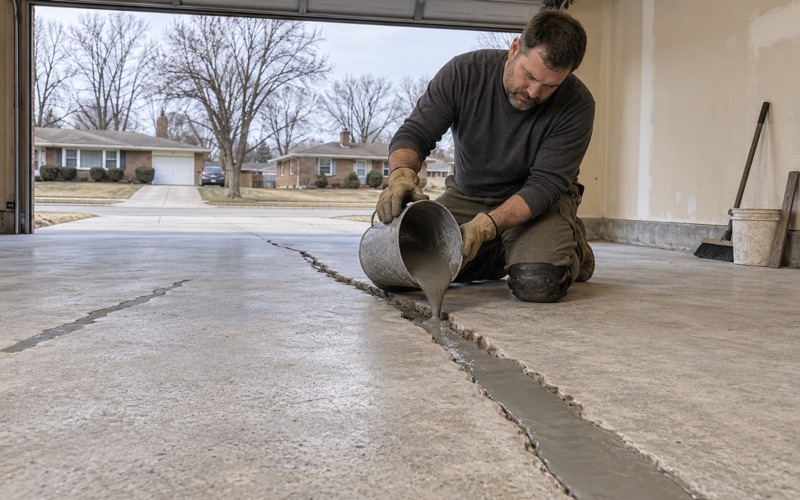
Where a locker room has saw-cut control joints or cracks, we map them before pricing. Joints that can be filled are filled and leveled so the film runs over them; a joint that still moves gets a flexible filler and is named in the proposal, because a rigid coat laid over movement cracks along it.
Prep that holds up to daily water
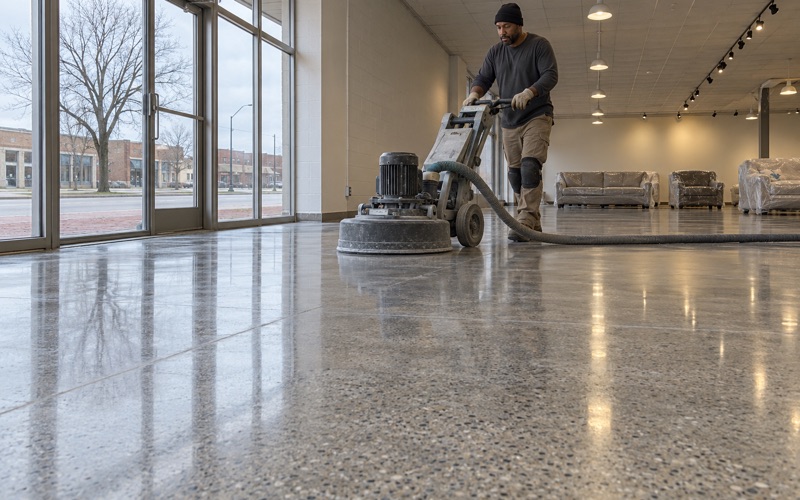
A floor that is wet every day is only as good as its bond. We grind or shot-blast to the ICRI concrete surface profile the product’s data sheet calls for, and the dust is pulled into a vacuum at the machine rather than rinsed toward a drain.
Moisture comes next. Before a price is final, the slab is tested with ASTM F2170 in-situ relative humidity probes or ASTM F1869 calcium chloride, and the proposal records the method and the reading it has to pass; a high reading adds a moisture-mitigation primer to the scope.
When a slab is too broken for any of that, we say so in writing. Some floors need repair or partial replacement before a coating should go down, and coating over the problem only hides it for a season.
Basement Showers and Pool-Gear Mudrooms in Alsip Homes
The houses behind the question
Most of the village is residential, and most of its housing went up between the 1950s and the 1990s, with the 1970s the busiest decade and almost nothing built since 2010. A home floor here is a retrofit over a slab that has been in place for decades, sometimes in a basement where a shower was added long after the house was built.
The code section above excludes dwelling units, so it does not ask a homeowner for a smooth, hard, nonabsorbent shower floor. The same physics still apply to a family stepping out of a basement shower or kids coming in wet from a summer swim.
Basement showers
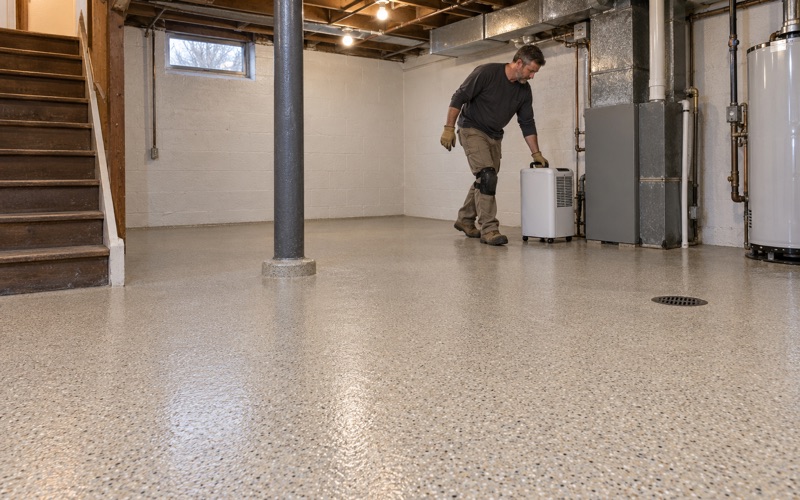
In a basement shower or the floor just outside it, we apply the same zoning as a locker room on a smaller scale: a finer texture on the dry side, more grip where water lands, and a cove up the wall so the joint at the bottom of the stud wall never sits in standing water.
Below grade, moisture is the first thing we test and the first warranty exclusion we explain. We never sell a coating as waterproofing or flood protection; if water is coming through the slab or the wall, that source has to be dealt with before any floor goes down.
Changing areas and back entries
A back-door landing where swimmers drip, a laundry corner with a utility sink, or a mudroom where wet gear comes off all ask for the same thing: a closed surface that wipes clean, a texture that holds a bare foot, and no seams for water to sit in. A thin quartz broadcast under a clear polyaspartic topcoat suits most of them.
Before booking any Alsip job, we check the village’s contractor license requirements, and we follow the Village of Alsip Building Department on whether the work needs a permit. For a home job, the contract is written and signed before grinding begins.
A school locker room behind bleachers for 700 students and a single family’s basement shower put the same two readers on one floor: the person scrubbing it and the person standing on it wet. We settle that disagreement with texture chosen zone by zone and written into the proposal, never with a bare promise that the floor will not slip.
- 20+ Years Coating Concrete
- Written Moisture Testing
- Free Estimates