
Gary Epoxy Flooring installs basement floor epoxy in Gary, IN, serving surrounding cities including Lake Station, Griffith, Highland, Hobart and East Chicago. We have spent 20+ years grinding and coating concrete, and in basements we have learned to answer one question before anything else: what is the moisture in this slab doing?
A basement slab sits below grade against damp soil, often with no vapor retarder underneath and sometimes with groundwater not far below. Vapor moving up through that concrete is the most common reason basement coatings blister and peel, and no amount of careful rolling on top will fix a moisture problem underneath.
That is why a moisture test is part of every written basement proposal before the price is final. The proposal names the test method, the reading the slab has to pass, the system we will install, the number of coats and the finished thickness. When the slab is not ready for a coating, we say so plainly.
The Moisture Question Comes First
Testing a Basement Slab
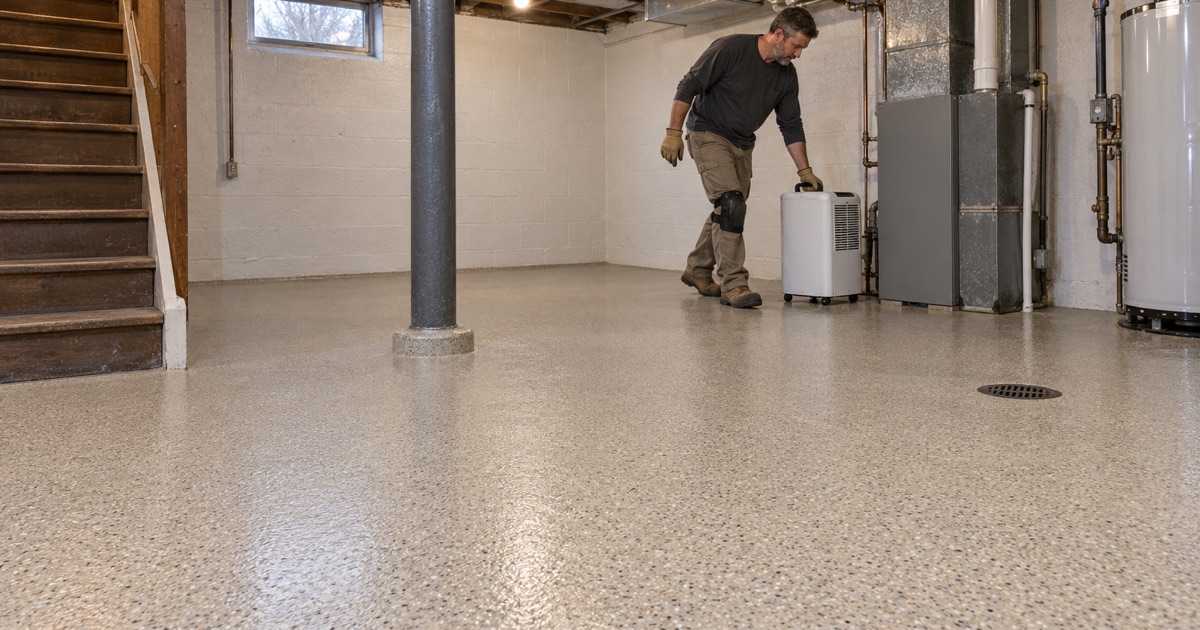
We test basement floors with ASTM F1869 calcium chloride kits, which measure the moisture vapor emission rate from the slab surface, or with ASTM F2170 relative humidity probes placed in drilled holes. Those readings are compared with the coating manufacturer’s limits and with the ASTM F710 guidance flooring installers use.
A plastic sheet taped to the floor under ASTM D4263 can show obvious moisture, and we sometimes use it for a quick read. It is not precise enough to decide a coating system on its own, so the written proposal relies on the measured tests.
Sandy Soil and a High Water Table
Much of Gary is built on dune sand and muck soils, with groundwater close to the surface in low areas near the lake and the rivers. Slabs poured on that ground in older houses often have no under-slab vapor retarder, so moisture can move through the concrete year round.
This is soil context, not a prediction for any single house. Two basements on the same block can test very differently, which is exactly why we measure every slab rather than assuming.
Hydrostatic Pressure and Active Water
When groundwater pushes up against the bottom of a slab, it creates hydrostatic pressure that can force water through cracks and lift coatings off the floor. Coating warranties nearly always exclude this, because no floor coating is designed to hold back liquid water under pressure.
If we see signs of active water, such as wet cracks, standing water after rain, or a sump that runs constantly, we recommend drainage or foundation work before any coating. A coating installed over an active water problem fails, and it fails at the owner’s expense.
Older Basements and What They Hide
Pre-1970 Slabs, Paint and Patching
Most of Gary’s houses predate 1970, and their basements often carry decades of history: layers of floor paint, old sealers, tile adhesive, patched trenches and stains from past leaks. A new coating cannot bond reliably to any of that, so we grind the floor back to clean, sound concrete.
Older adhesives, especially black mastic under old floor tile, need care during removal, and we discuss what we find before grinding through it. Once the slab is bare, we map cracks and damaged areas so the repair scope is clear.
Efflorescence and White Powder
White, powdery deposits on a basement floor are efflorescence: mineral salts carried to the surface by water moving through the concrete. They tell us moisture is active in the slab, and coating over them is a common cause of failure.
We grind efflorescence away, test the slab and specify the system to match. Where readings are high but there is no liquid water, a moisture-mitigation primer is usually the answer.
Cracks, Settlement and When to Replace
Shrinkage cracks and small spalls are normal in older basements and are repaired as part of the job, chased out and filled with a rigid repair material. Cracks that are wide, offset, or still moving tell a different story, often settlement or water pressure.
When a basement slab has heaved, sunk in sections or broken into pieces, we will tell you that it needs repair or replacement before coating. Coating a floor that is moving only hides the problem for a few months.
Building a Basement Floor System
Moisture-Mitigation Primers
When vapor readings exceed what a standard epoxy is rated for, a moisture-mitigation primer goes down first. It forms a vapor-resistant layer bonded to the ground slab, and the rest of the system bonds to it rather than directly to the damp concrete.
Mitigation primers add cost, but they are far less expensive than grinding off a failed floor. The proposal shows the primer as its own line, with the reading that triggered it, so the reason for the cost is clear.
Warranties are tied to these numbers as well. Nearly every coating warranty excludes moisture coming up through the slab, and we name that exclusion first when we explain the written warranty, so you know exactly what the mitigation primer protects against and what remains outside any coating’s coverage.
Base Coat, Broadcast and Topcoat
Over the ground and repaired slab, we install a 100% solids epoxy base coat, which levels minor imperfections and builds thickness. A vinyl flake or quartz broadcast can go into the wet base coat for texture and color, or the floor can stay a solid color for a clean, simple look.
A polyaspartic or urethane topcoat seals the floor and resists scuffs from furniture, exercise equipment and laundry spills. In a basement with daylight windows, an ultraviolet-stable topcoat keeps the color from ambering.
Sump Pits, Drains and Transitions
Sump basins, floor drains and perimeter drain tile have to keep working after the floor is coated. We grind and coat right to the rim of each opening, protect it during the work and slope the finish so water still runs to the drain.
Where the coated floor meets carpet, stairs or a finished room, we plan clean transitions. A coved base up the wall is possible in laundry and mechanical areas to make cleanup easier.
Using a Coated Basement
Laundry, Workshop and Gym Spaces
A coated basement floor handles washer leaks, dropped tools and gym equipment better than bare concrete or carpet. We add texture in laundry areas, a tougher topcoat in workshops and a surface that works well under rubber mats in home gyms.
Furniture and equipment go back on the floor only after the coating has cured enough to take the load, and we leave written times for light use and for heavy items. Felt pads under furniture legs and mats under weight racks keep the topcoat looking new far longer than bare metal feet dragged across it.
Bringing a Vacant House Back
Gary has a high share of long-vacant houses, and their basements often need the most work during a rehab. Once drainage and moisture are addressed, a coated floor gives the next owner or tenant a clean, sealed surface that is easy to maintain.
Vacant basements often show the full range of problems at once: old paint, efflorescence, standing water marks and cracks from years without heat. We test and scope each of those separately, so an investor or new owner sees which costs come from the coating and which come from repairs the house needed anyway.
What a Coating Is Not
A basement floor coating is not waterproofing, not flood protection and not radon mitigation, and we never sell it as any of those. Radon work in Indiana requires a state license, and water problems need drainage solutions. We coat floors and point you to the right specialist for everything else.
- 20+ Years Coating Concrete
- Written Moisture Testing
- Free Estimates