Gary Epoxy Flooring brings more than 20 years of slab work to epoxy flooring in Bridgeview, and coating plants raise a question few other buildings do: what happens when the chemical beside the line is made to destroy the material on the floor? A shop that applies coatings for a living often removes them too. That single fact decides where a resin floor belongs and where it does not.
We plan these floors in zones. Most of a coating plant takes a ground, sealed resin floor well, but the area around a stripping tank is a separate problem, and treating one system as the answer for both is how a new floor ends up blistered at the one spot that matters. Our proposal draws that line on the floor plan before anyone talks about color.
Every slab we coat is opened with a diamond grinder or a shot blaster rather than an acid etch, and a moisture test, with its method and the number it must pass, is written into the scope before the price is final. What follows explains how the rest of the job changes in a shop that strips coatings.
Powder Coating and Chemical Stripping on South 77th Avenue
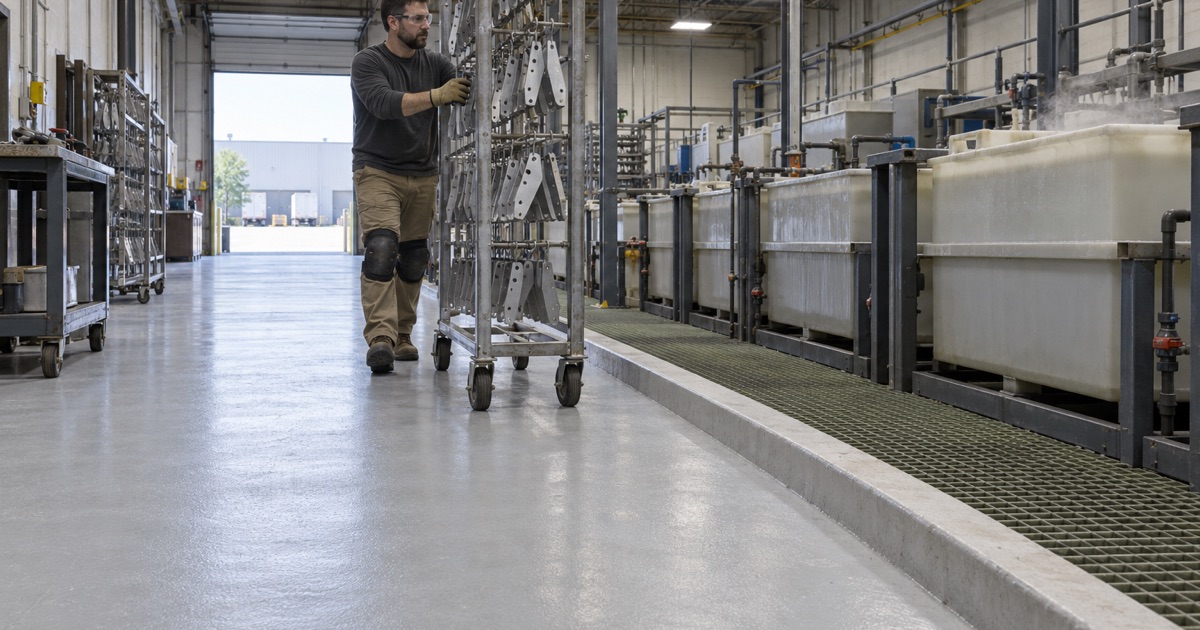
What the Shop at 8585 S. 77th Avenue Lists
Bridgeview, a village of 17,027 people about 15 miles southwest of the Chicago Loop, has a plant that shows the problem clearly. Micron Metal Finishing, at 8585 S. 77th Avenue, describes itself as a full service large volume custom electrostatic powder coating job shop. It runs three conveyorized powder coating lines with Nordson spray booths that use reclaim technology, inside a 75,000-square-foot facility with five shipping and receiving docks.
Among the value-added services it lists is chemical stripping, and its facility page names a Stripping Operation. We have never worked there and do not know what is on its floor or which stripping chemical it buys. It appears here because its published services describe a floor zone that most coating sales pitches skip.
Epoxy and Polyester on the Part and on the Floor
Thermoset powders are built on three generic resin families, epoxy, polyester and acrylic, according to a trade article attributed to the Powder Coating Institute’s executive director. Those are the same families floor coatings are made from. An epoxy floor or a polyester-urethane topcoat is a chemical cousin of the film on a rejected part.
So a stripper designed to dissolve cured powder has no way to tell a part from a floor. One maker’s product, the Columbia Coatings Power Pro Chemical Stripper, is described on its technical sheet as specially designed to remove powder coating from ferrous and non-ferrous metals. A chemical that lifts a cured film off steel deserves the same respect anywhere it can reach a resin slab.
None of that makes every resin floor in a coating plant a mistake. It means the floor plan has to know where the stripper sits, where it travels on wet parts and where it gets rinsed away.
Looking for epoxy-flooring closer to Hickory Hills? See Epoxy-Flooring in Hickory Hills.
The Strip Tank, the Lift-Out Drips and the Rinse Area
A Heated Immersion Bath
The Power Pro sheet calls for immersion or dip application and says the stripper is most effective when heated to 180-195 degrees Fahrenheit. It also tells users to keep the stripping tank or drum covered while parts are in it. A heated chemical bath is where the zone we plan around begins, not a spill that might happen someday.
Heat matters because a hot, aggressive bath is opened every time a rack goes in or comes out. Whatever splashes at the rim lands on the floor near full strength, so the slab beside the tank meets the stripper much as the part does. That is not a condition a general-purpose garage or warehouse coating was ever chosen for.
The Drip Path of Lifted Parts
A part lifted out of a dip tank carries stripper with it. The route from the tank to the rinse station becomes a line of drips, and it runs wherever the hoist, the cart or the operator goes. We walk that route with the shop’s own people, because it is often longer and wider than the drawings suggest.
Drips also travel on boots and wheels. A forklift or cart that crosses a wet patch near the tank carries a thin film out into the main floor, so the edge of the zone is set by traffic as much as by distance from the tank.
Rinse Water Across the Slab
The same sheet says a stripped project should be rinsed with water to neutralize the chemical. That rinse carries diluted stripper and loosened coating, and it sheets toward a drain or sump. A floor that takes rinse runoff every shift is the third piece of the zone, and the one most often left off a floor plan.
Rinse areas also mean wet concrete. Where a slab beside a rinse station is to be coated, the moisture test in our scope is run there specifically, with the method and the pass number written down, because a slab that stays damp underneath can push a coating off from below.
Taken together, the tank, the drip path and the rinse area are the one part of a coating plant where we tell an owner that a standard resin floor is the wrong answer. Everywhere else in the building, the conversation changes.
Curbs, Drip Pans and the Stripper Maker’s Own Data
Containment Comes Before Coating
In the strip zone the floor is protected rather than relied on. A curbed tank holds a spill or overflow in place, drip pans and trays catch what falls off parts on the way to the rinse, and the rinse station drains where the shop’s process sends it. Those are equipment decisions, and they come ahead of any coating choice.
When a shop asks us to coat inside that curb, we say plainly that a coating does not replace containment. At best it is a second line of defense, and it has to be chosen for one specific chemical rather than for a brochure.
Reading the Stripper Maker’s Compatibility Data
A label that says chemical resistant tells us nothing about a heated powder stripper. Before we price any coating in that zone, we ask the shop for its stripper’s safety data sheet and technical sheet, then look for the stripper maker’s own compatibility data on floor materials. If the maker cannot say a material holds up, we do not guess.
That review can end with no coating inside the curb at all, leaving the pans and the tank curb to do the work. We would rather write that into a proposal than sell a finish that has never been matched to the bath it sits beside.
The same caution applies at home on a smaller scale. A can of paint stripper or degreaser set down on a coated garage floor can soften or stain the finish where it drips, so we suggest keeping those cans on a shelf or in a tray rather than on the floor itself.
Where the Strip Zone Meets the Main Floor
The edge of the zone gets extra attention. We end the main resin floor at the curb with a keyed edge rather than feathering it into the splash area, so a drip that gets past the pans meets a defined termination instead of a thin margin that can start to lift.
Our proposal names the product line, the number of coats and the finished thickness for each zone separately. A shop can then check the floor it received against the quote area by area, instead of trusting one figure for the whole building.
Powder Dust on the Rest of the Floor
What OSHA 1910.107 Asks of Floors
Away from the strip tank, the main floor of a powder plant has a housekeeping problem rather than a chemical one. OSHA 29 CFR 1910.107(l)(4) says all areas shall be kept free of the accumulation of powder coating dusts, floors included, and that surfaces shall be cleaned so as to avoid scattering dust or creating dust clouds. The paragraph names no floor material.
What it favors in practice is a floor that vacuums clean. Bare, dusting concrete holds fine powder in its pores, and a broom on a rough slab is how a cloud starts. A smooth, sealed resin floor lets a vacuum lift powder instead of pushing it around, which is a cleaning advantage and not a compliance certificate; the rule stays with the shop’s own housekeeping.
Grinding, Repairs and Texture in a Dust-Conscious Plant
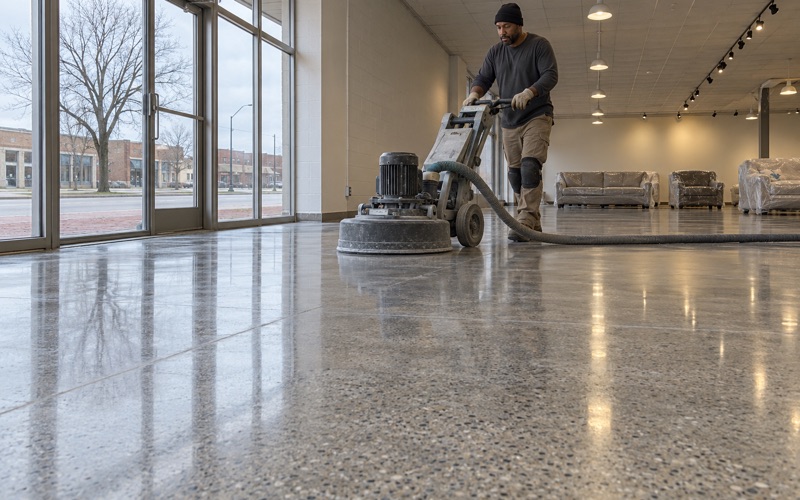
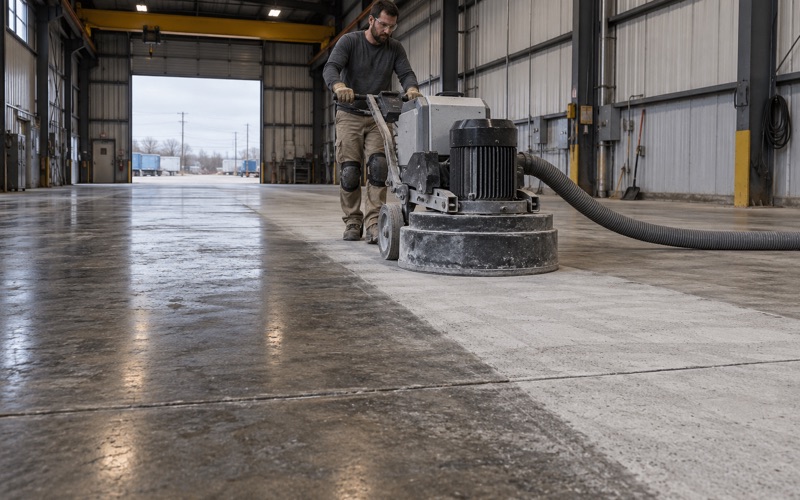
Grinding dust is captured at the machine with a vacuum, which matters in a building already working to keep fine dust off its floors. Cracks, spalls and old coatings are mapped before the quote, and if a section of slab needs repair or replacement first, we say so.
Texture is a trade-off in a powder plant. A heavy broadcast gives grip but holds powder, so around booths and lines we specify a finer broadcast and topcoat combination that gives useful slip resistance and still vacuums clean. The proposal names that texture by its materials rather than promising it as a slogan.
Shifts, Permits and What the Warranty Leaves Out
Coating lines and docks keep running, so we phase work around shifts, with overnight and weekend windows for areas that cannot close. Cure schedules follow slab temperature and the dew point at the surface, not the calendar.
The Village of Bridgeview Building Department at 7500 S. Oketo Avenue issues no permit without drawings, and it asks applicants for a contractor’s license, a $10,000 surety bond and a certificate of insurance. We check what a given job needs before booking it. Before any job is sold we also explain what the coating warranty excludes, starting with moisture.
In a shop that strips coatings, a sound floor plan is mostly about knowing where resin should stop. Get the tank, the drip path and the rinse area right, and the rest of the plant can carry a floor that is simple to keep free of powder.
- 20+ Years Coating Concrete
- Written Moisture Testing
- Free Estimates