Gary Epoxy Flooring brings more than 20 years of epoxy flooring in Cedar Lake and across Lake County to one question homeowners rarely ask until moving day: when can the boxes, the heirlooms and the framed photographs go back into the room? The honest answer is later than most people expect, and it depends on what you own as much as on what we put down.
A coated floor that takes foot traffic the next morning has only proven it is hard enough to walk on. Vapors can keep leaving a fresh coating and its primer after that, and some of them react with silver, copper, old prints and stored fabric. We plan a basement or garage job around the contents that will live there, and we write that plan into the proposal.
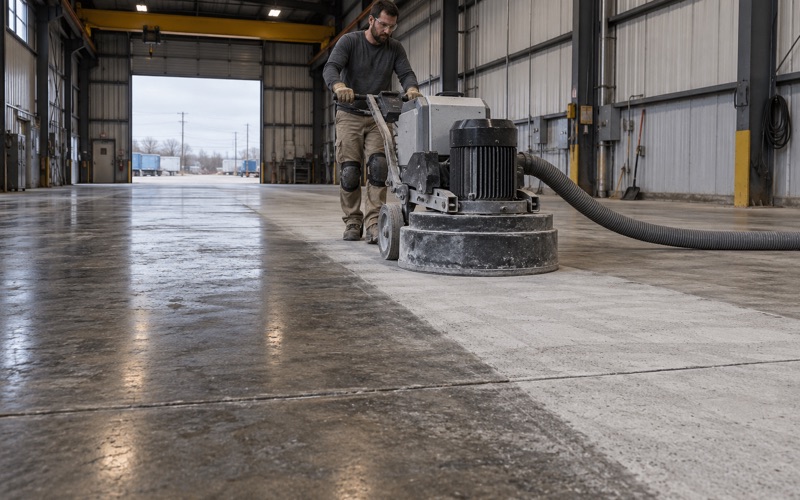
The prep side of the proposal is just as specific. We open every slab by diamond grinding or shot blasting instead of acid etching, put a named moisture test and its passing number in writing before the price is final, and list the product line, coat count and finished thickness so the result can be checked against the quote.
Lassen’s 1921 Resort Hotel and the Floor Rule Museums Follow
Cedar Lake keeps its own history in a building that has outlived its first purpose. The Museum at Lassen’s Resort occupies the former Lassen’s Resort Hotel, which opened in 1921 with 65 rooms and is the last remaining hotel building from the height of the town’s resort era, roughly the 1880s through the 1930s.
The hotel was listed in the National Register in 1981, and the all-volunteer Cedar Lake Historical Association, founded in 1977, saved it and has run it as a museum since 1986. Visitors find it at 7408 Constitution Avenue, and in May 2026 the Taylor family’s 1947 ice truck, from the Taylor Ice Company, was dedicated with a new pavilion next door.
We bring the museum up for what conservators know about rooms like it, not because of any connection to it. We have never worked on the Lassen building, we have no tie to the historical association, and we have not seen how its floors are finished.
Walkable Is Not the Same as Finished
Museums treat a new floor as something the collection has to be protected from. The National Park Service’s Conserve O Gram 1/11, written in 2001 for exhibit galleries and visitor centers, warns that volatile organic chemicals from floor products can react with objects and cause accelerated deterioration, and in some cases irreversible damage.
Its planning advice is direct: allow at least four weeks for off-gassing and relative humidity equilibration in the space before artifacts are installed. That is guidance for collection spaces, not a building code and not a cure time printed on any can, but the reasoning behind it applies to a family basement too.
Three Clocks Start When the Topcoat Goes Down
We explain three separate milestones on every job. Walk-on time is when socks and light foot traffic will not mark the surface, and with many systems that comes within a day. Full cure is when the resin reaches the hardness and chemical resistance the manufacturer rates it for, and typical epoxy data sheets put that at 7 to 14 days or longer, depending on temperature and humidity.
The third clock is the one museums watch: how long the room needs before the air has settled enough for sensitive things to come back. In the museum guidance it is the longest of the three, and nobody can read it off a label, which is why we plan around it rather than promising a date.
Looking for epoxy-flooring closer to Homewood? See Homewood Epoxy-Flooring.
How Cure Vapors Tarnish Silver and Copper and Stain Textiles
The museum guidance gets specific about which gases do the harm. Its first table, adapted from a Canadian Conservation Institute bulletin, lists formaldehyde at 0.005 parts per million as enough to tarnish copper alloys and silver, ammonia at 0.001 ppm as enough to tarnish copper alloys, and nitrogen oxides at 0.001 ppm as enough to stain textiles and discolor pigments.
Those are tiny concentrations. A second table traces all three gases to polyurethane adhesives and backings, which is a reminder that the chemistry of a floor system, not just its look, decides what it can release into a closed room.
Silver, Brass and Copper Collections
Tarnish is the most visible result. A box of family flatware, a brass lamp, a copper kettle or a tray of coins stored in a freshly coated room can dull and darken faster than the same pieces kept upstairs, and polishing tarnish off removes a little metal each time.
Brass is a copper alloy, so it falls under the table’s copper alloys line. Anyone who keeps a collection in the basement, whether it is militaria, old tools or a grandparent’s silver service, has a reason to ask how long that room should sit empty.
Photographs, Quilts and Stored Fabric
Textiles are on the table too, through the nitrogen oxides that stain fabric and discolor pigments. Wedding dresses in garment bags, quilts in plastic bins and framed needlework leaned against a wall all sit in whatever air the new floor gives off.
Photographs and paper are not listed in the table rows we cite, so we will not quote a threshold for them. We do treat old prints, albums and documents with the same caution, because the NPS warning about volatile chemicals and objects is written broadly, and the safest step costs nothing beyond time.
Low-VOC Is a Legal Floor, Not a Clearance
Indiana’s 326 IAC 8-14 caps floor coatings at 250 grams per liter of VOC and industrial maintenance coatings at 340 g/L, and it binds whoever applies them. Cedar Lake’s Town Hall sits in Center Township, outside the Lake County townships named in the Chicago 2015 ozone nonattainment area, but that changes nothing about the statewide limit, and we choose products inside it on every job.
A product that meets the limit has still not been tested against your silver. Low VOC content narrows what a coating releases, but it is not an off-gassing clearance for a room full of heirlooms, and we do not describe any system as free of emissions.
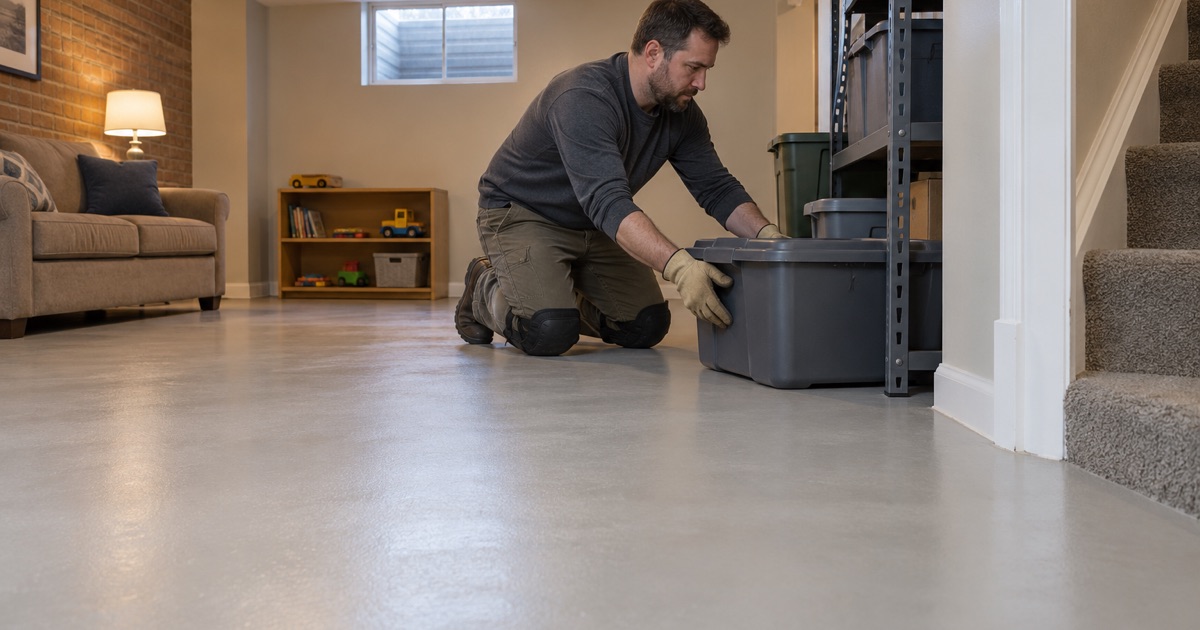
Moving Belongings Back Into a Coated Cedar Lake Basement or Garage
About 85.2 percent of occupied homes in Cedar Lake are owner-occupied, and owners tend to keep what matters to them close. When a basement or a garage storage room gets a new floor, everything in it has to go somewhere for the job and then come back, and the order it comes back in is worth planning.
Sturdy Things First, Sensitive Things Last
We suggest sorting the contents before we arrive. Tool chests, shelving, holiday bins and the second refrigerator can return once the floor has reached the cure the data sheet calls for under load, while silver, brass, photographs, documents and stored fabrics wait in a room that was not coated.
How long they wait is the owner’s call, not ours. A household is not a museum gallery, and the four-week figure was written for collection spaces, but an owner with irreplaceable pieces may decide that borrowing the museum’s patience is cheap insurance.
Garage Storage Rooms and Slower Cures
A garage adds a complication: cold slows cure. A respondent on an American Alliance of Museums forum advised waiting more than two weeks before returning objects to a cold or humid space, and our own cure schedules follow slab temperature, not the calendar.
An unheated garage in the middle of winter is a room we tell to wait. Resin laid on a slab that is too cold cures slowly and can bond poorly, and that slow cure stretches every clock described above.
Lakeside Houses and Newer Subdivisions Alike
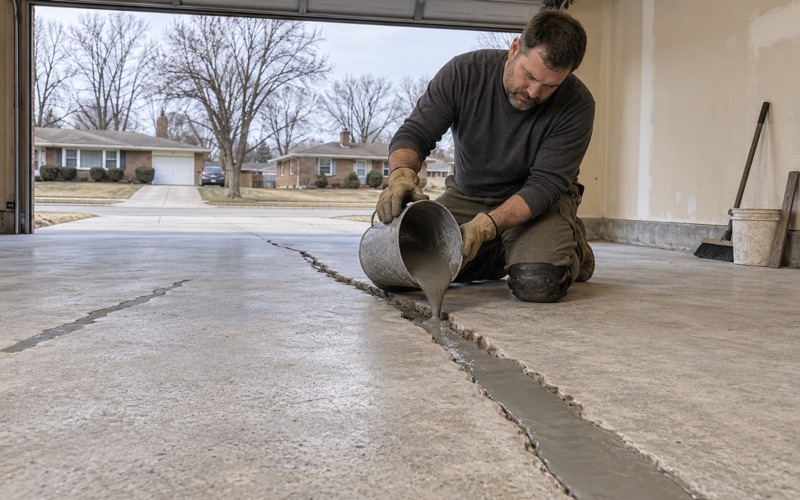
Cedar Lake’s housing is mostly young, with 58.1 percent of units built in 1990 or later, alongside an older layer where 14.8 percent predate 1950. Whatever the age, we map cracks, spalls and old paint before anything else, and when a slab needs repair or replacement before it should be coated, the proposal says so.
Grinding is the dustiest stage of the job, and dust is the last thing a storage room full of keepsakes needs. We capture it at the machine with a vacuum, so the boxes staged in the next room are not coated in fine concrete powder when they come back.
Ventilate, Read the Data Sheet, Then Load the Room
The label on a can is short by necessity. The product’s technical data sheet is where the manufacturer states full cure at given temperatures, recoat windows and ventilation needs, and it is the document we hand an owner who wants to plan the return of their belongings. The museum forum respondent said the same thing: check the technical data sheet, not the can.
Moving Air Through the Room
Fresh air is the plain tool for the weeks after a floor goes down. In a basement that can mean a window fan pulling air out and a door left open upstairs, and in a garage it can mean the overhead door cracked whenever someone is home, as long as conditions stay inside the range the data sheet allows.
The NPS planning figure covers relative humidity equilibration as well as off-gassing. A room that has just been ground, coated and closed up needs time for its air to come back to normal before paper and fabric go back on the shelves, and that waiting is part of the job, not a delay in it.
What the Proposal and Warranty Say
Home jobs in Cedar Lake get a written contract carrying the items Indiana’s Home Improvement Contracts Act lists, signed before any grinding starts. The town’s building permit form says all contractors must be licensed with the Town of Cedar Lake, and we check that, along with bond and insurance rules, before a job is booked.
Before the sale we also go through what the coating warranty leaves out, starting with moisture, and we never pitch a floor coating as radon reduction, waterproofing or flood protection. A coating seals and protects the slab’s surface; it does not stop water or soil gas from below.
Cedar Lake trusts its own past to a 1921 hotel run by volunteers. The belongings in a freshly coated basement deserve the same patience, and we would rather move a return date back a few weeks than see a silver service go dark on a new shelf.
- 20+ Years Coating Concrete
- Written Moisture Testing
- Free Estimates