Gary Epoxy Flooring brings more than 20 years to epoxy flooring in Chesterton, IN, and the question we answer most carefully here is where a resin floor should stop. Not every slab in a working building is a good candidate for coating, and telling an owner so before a price is set is part of the job.
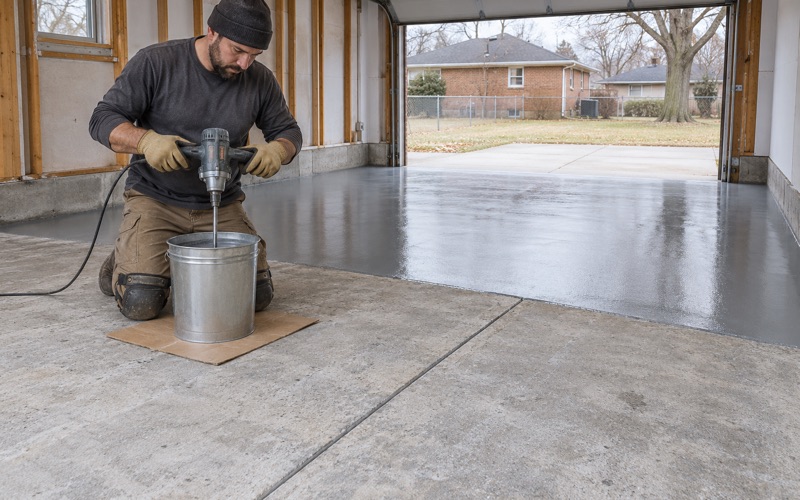
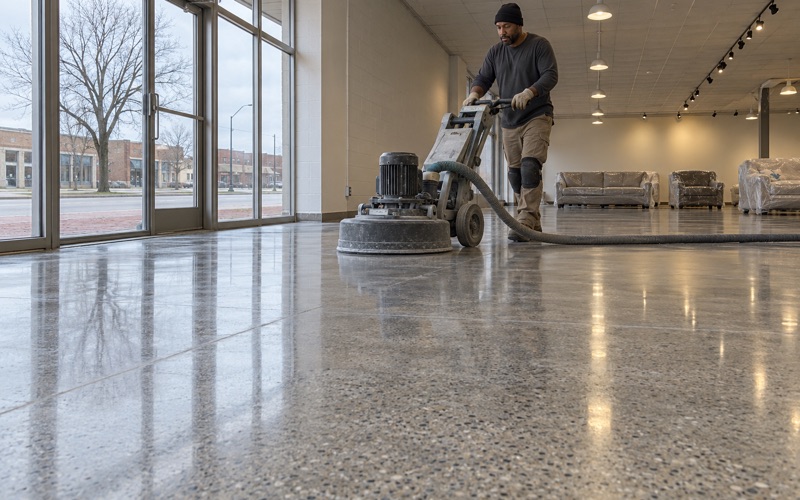
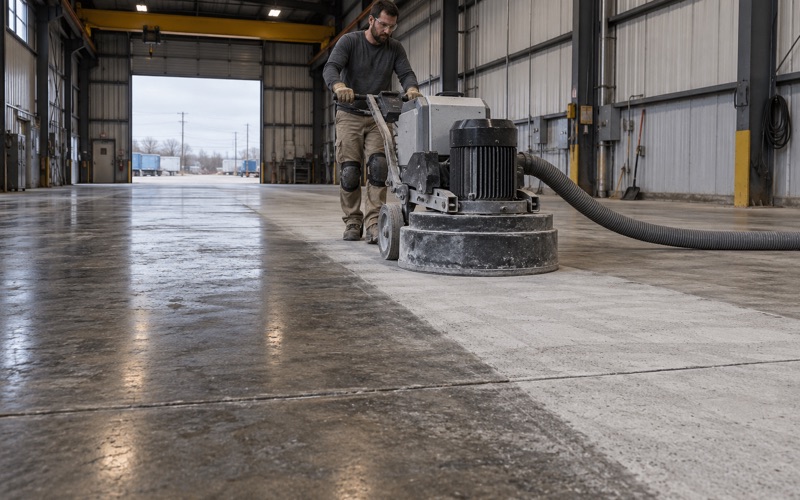
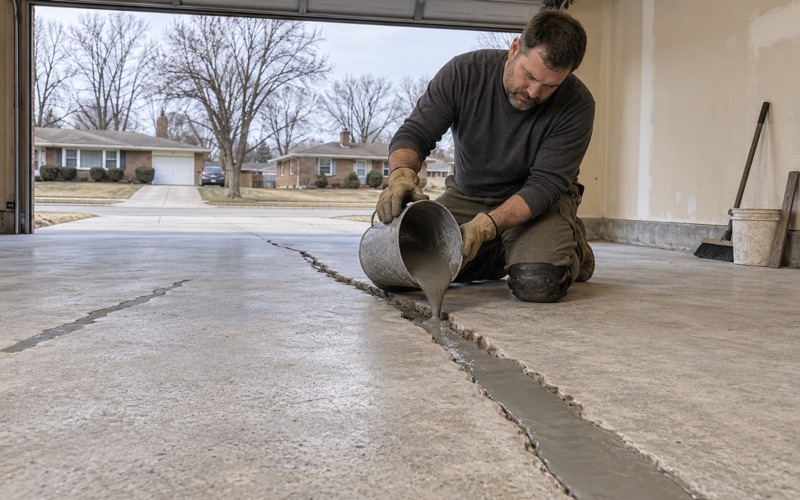
Where a coating does belong, we open the concrete with a diamond grinder or a shot blaster, never an acid wash, so the resin bonds to a real surface profile. Cracks, spalls and old paint are mapped on the first visit, and if part of the slab needs repair or replacement before it should be coated, we say that in writing. The proposal names the product line, the number of coats and the finished thickness, so the floor can be checked against the quote once it is down.
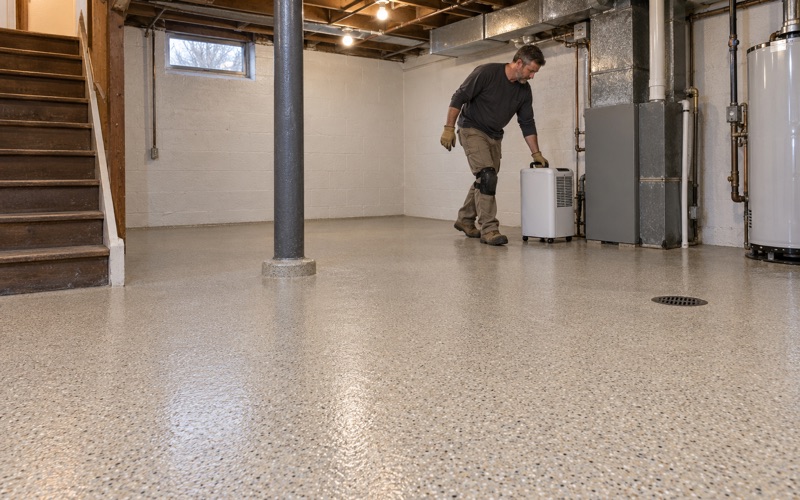
A moisture test is written into the scope before the price is final, with the method and the passing number both named. For a slab on grade that usually means ASTM F2170 in-situ relative humidity probes or ASTM F1869 calcium chloride testing.
Two Foundries on Cutting Edge Drive and the Heat a Resin Floor Can Take
Stainless and bronze poured inside town limits
Chesterton, IN has metal being melted and poured inside its own boundaries. Urschel Laboratories, a food processing equipment manufacturer founded in Valparaiso in 1910, moved to a 525,000-square-foot plant on 160 acres along Cutting Edge Drive in 2015. A Modern Casting profile from April 2025 describes two captive foundries there: an investment foundry and a nobake sand foundry.
The investment foundry pours five stainless alloys, including 303, 304, 316-L and 17-4. The nobake side pours about 123,000 pounds of 303 stainless and 112,000 pounds of 304 a year, plus roughly 51,000 pounds of bronze. Heat treat, grinding and peening happen in the same building.
The town’s own records reflect the plant’s size. Redevelopment Commission minutes from 2022 describe a $46 million expansion of about 115,000 square feet, and in February 2026 the Building Department issued Urschel a permit for an office buildout at 1200 Cutting Edge Drive.
We have no connection to Urschel, have never been inside the plant and know nothing about its floors. We mention it because a working foundry in town makes a useful marker. It shows, more plainly than any brochure, the kind of floor that a resin coating should never be asked to be.
What the data sheets say about dry heat
Epoxy floor systems carry heat ratings, and they are modest. One manufacturer’s data sheets for its Sikafloor MultiDur epoxy floor systems list permanent dry-heat exposure at 50 degrees Celsius, or 122 degrees Fahrenheit. Short-term limits run to 80 degrees Celsius (176 degrees Fahrenheit) for up to seven days and 100 degrees Celsius (212 degrees Fahrenheit) for up to 12 hours.
The same sheets add two conditions. Moist heat is acceptable only occasionally, up to about 80 degrees Celsius, as with steam cleaning, and chemical or mechanical exposure must not coincide with heat exposure. Another maker rates its epoxy floor to 100 degrees Celsius for dry heat but warns that color and gloss can change from 60 degrees Celsius, or 140 degrees Fahrenheit.
Those are one product family’s numbers, not a universal limit for every epoxy, and not a rating we attach to our own work. What they show is scale. Floor resins are rated in tens of degrees, while molten stainless steel pours at temperatures far beyond anything on those sheets.
Looking for epoxy-flooring closer to Riverdale? See Riverdale Epoxy-Flooring.
Where the Coated Floor Ends in a Metal Plant
The floor that stays concrete, refractory or plate
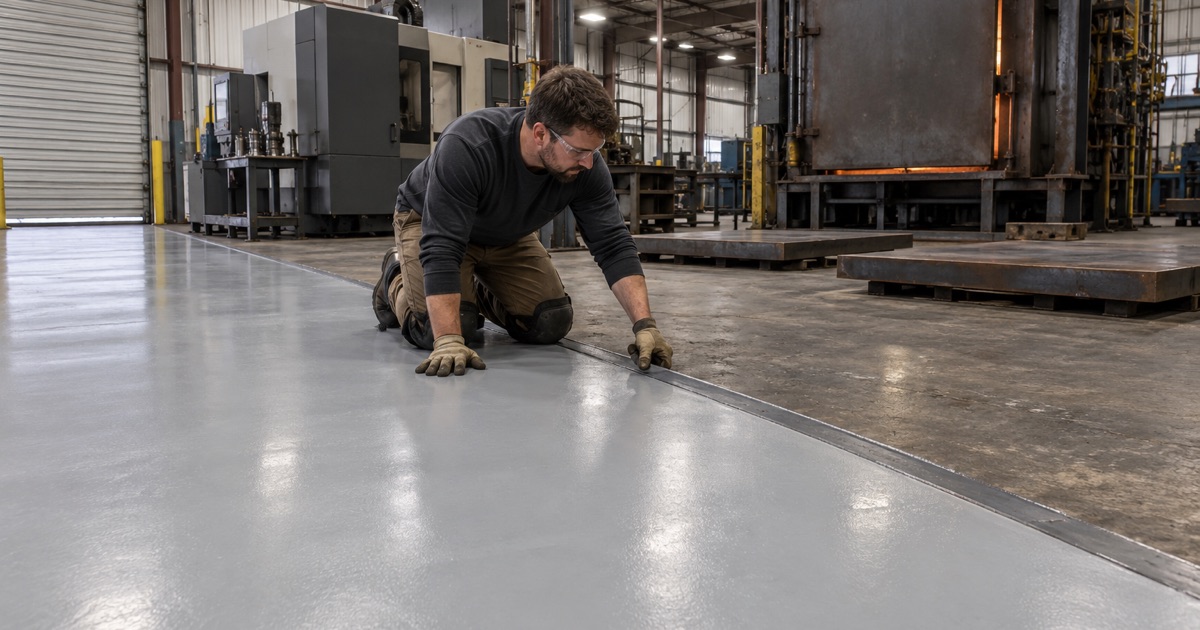
In any foundry, the melt area, the pour line and the hot side of heat treat are places we would not put resin. Spatter, hot castings and loads coming out of a furnace run far past any resin floor rating. Those zones belong to bare concrete, refractory or steel plate, and no coating we know of changes that.
So when a metal shop asks about coating the whole building, our answer is no. A resin floor that softens, blisters or discolors beside a hot process has failed on its first day, and repairing it means shutting that area down.
No resin floor is rated for molten metal, and we will not quote one for a melt or pour area under any product name. If a supplier’s literature suggests otherwise, we read the temperature table before the marketing page.
Drawing the boundary where heat and spatter stop
The line between bare and coated floor is not a property line or a wall. It is wherever heat and spatter stop reaching the slab, and in most plants that sits some distance out from the hot process itself. We walk it with the people who run the area, because they know where castings are set down to cool.
At the boundary itself, we finish the coating with a clean, sealed edge rather than letting it feather out onto bare concrete. A feathered edge lifts first. A ground-in termination with a saw-cut key holds, and it gives the plant a visible line that says where hot work stays.
Heat that travels is the hard case. A rack of parts leaving heat treat, or a casting moved before it has cooled, carries the hot zone with it, so the route it takes can matter as much as the furnace. Where hot loads cross a floor, we either keep that path bare or ask that loads cool before they reach coated concrete.
Machining, assembly, shipping and offices
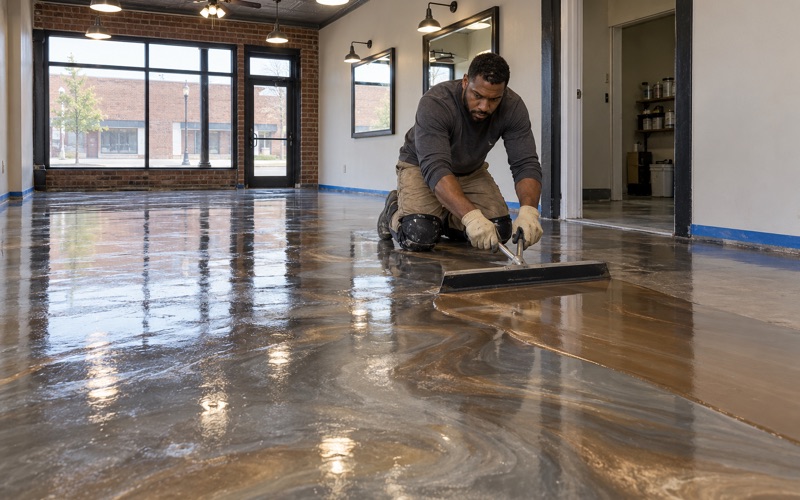
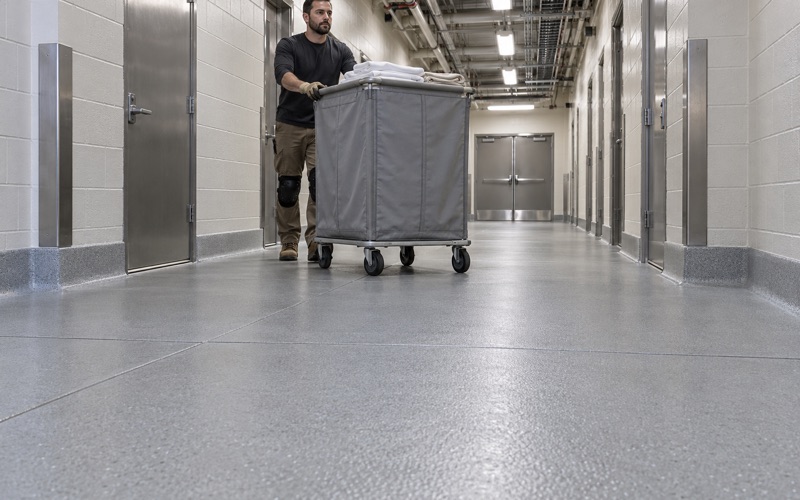
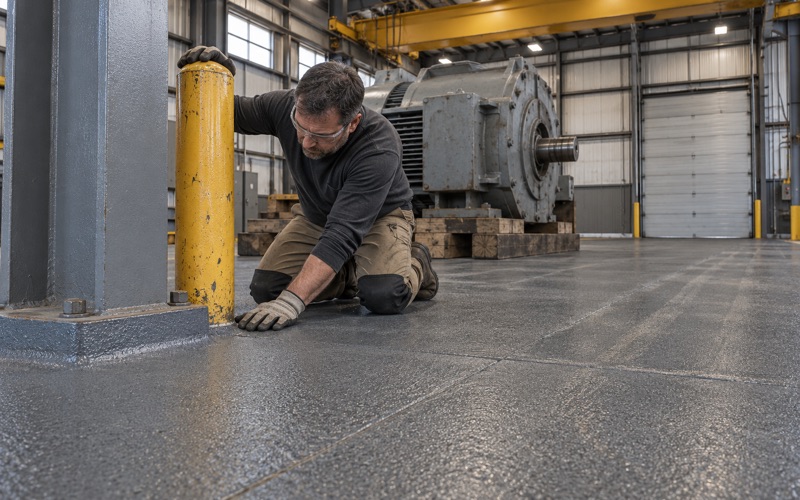
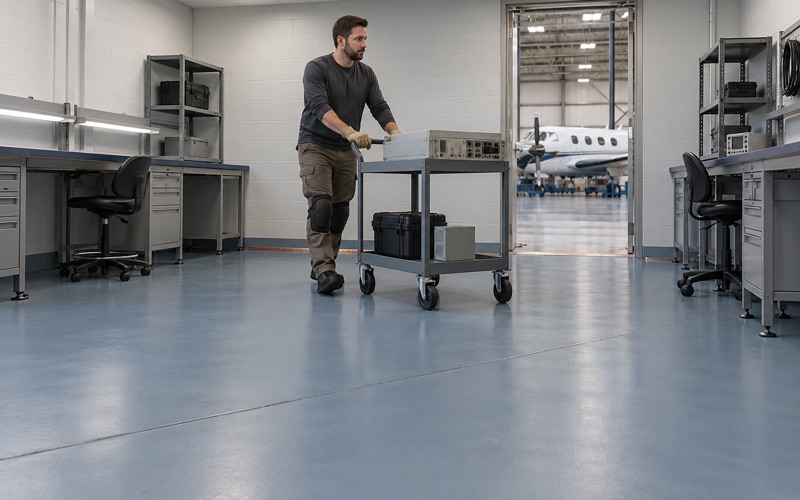
Away from the heat, a metal plant has plenty of floor that a coating suits well. Assembly bays, machining areas, shipping docks, inspection rooms, tool cribs and the aisles between them see traffic and dust rather than fire, and a seamless floor there is easier to sweep, brighter under the lights and simpler to stripe. Office space inside the plant can take a thinner, more decorative system.
Plants rarely close for a floor. We phase the work around shifts, coat one bay at a time and use overnight and weekend windows when production cannot stop, with grinding dust captured at the machine by vacuum instead of being rinsed toward a floor drain.
Welding Benches, Forges and Kilns in a Chesterton Home Shop
A small version of the same line
Chesterton is largely a town of owner-occupied houses: 75.1 percent of its occupied homes are owned, and 87.5 percent of those are detached. Plenty of those garages double as workshops, and some hold a welding bench, a forge or a kiln. The reasoning that applies to a foundry applies here at home scale.
A garage floor coating is still a resin with the same kind of heat rating. Welding spatter, a hot workpiece dropped from the anvil or a kiln shelf set down too early can mark, soften or scorch it in one spot. That damage is local, but it stays until the area is ground out and recoated.
Leaving the hot corner bare
Our usual answer is to leave the hot corner uncoated. We stop the coating short of the welding bench, the forge stand or the kiln, finish it with a sealed edge, and leave bare concrete or a steel plate where sparks and hot metal land. How far out that goes depends on the work, so we ask what you weld, how big the forge is and where pieces are set to cool.
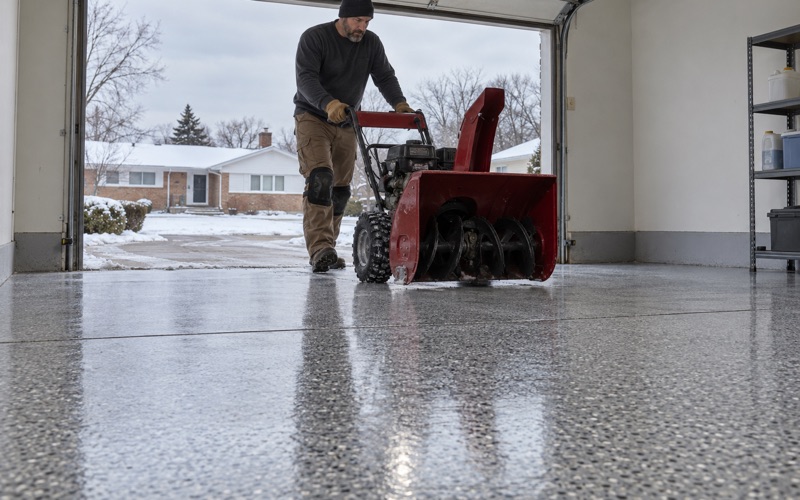
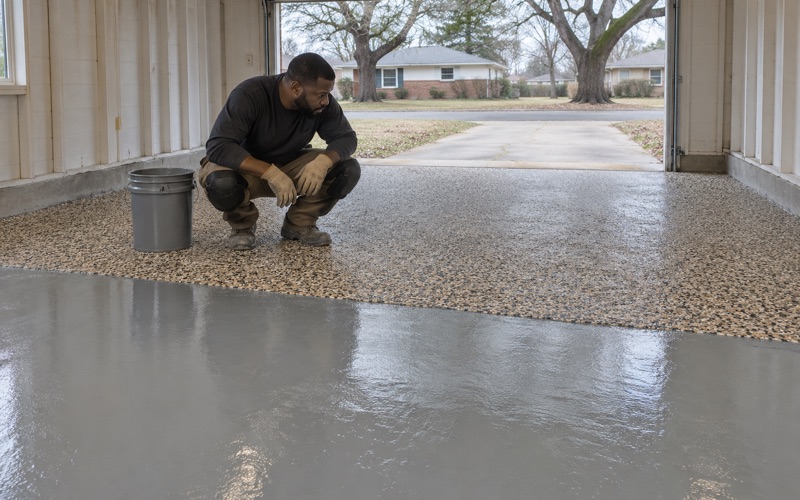
The rest of the garage can take a full system. A 100% solids epoxy body coat with a vinyl flake or quartz broadcast and a polyaspartic topcoat handles parked cars, and we choose garage systems to stand up to the brine and rock salt that ride in on tires all winter. The finished texture is set by the broadcast and the topcoat we specify, and the proposal names both.
Older garages and newer ones
Chesterton’s housing runs both ways: 43.9 percent of homes date from 1990 or later, and 33.6 percent were built before 1970. An older slab is more likely to need repair first, while a newer one may have been poured over a vapor retarder that changes how moisture behaves.
In a garage that has held a workbench for decades, oil and solvent can soak deep enough near the bench that a coating will not bond over them. We map those spots with the cracks and old paint and price the extra grinding, or the repair, before work starts.
Air Rules, Paperwork and Timing in Porter County
Ozone rules that cover all of Chesterton
Chesterton sits in Porter County, not Lake County, and its three townships, Westchester, Jackson and Liberty, are all listed in the Porter County part of the Chicago 2015 ozone nonattainment area. That area has been classified Serious since January 16, 2025. Coatings give off volatile organic compounds as they cure, so product choice matters here.
Indiana’s statewide rule, 326 IAC 8-14, caps floor coatings at 250 g/L and industrial maintenance coatings at 340 g/L, and it binds whoever applies the product. We pick materials inside those limits for plant floors and garages alike, which is one more reason 100% solids epoxy shows up so often in our proposals.
Contracts and local rules
Indiana has no state license for flooring or coatings contractors that we have found, and the Attorney General notes that licensing varies by community. So before a Chesterton job is booked, we check the town’s own contractor, bond and insurance requirements with the Town of Chesterton Building Department.
Home jobs get a written contract that carries the items Indiana’s Home Improvement Contracts Act lists, signed before any grinding starts. We also explain what the coating warranty leaves out before anything is sold, and moisture is the first exclusion we name. A floor coating is never sold as radon reduction, waterproofing or flood protection.
Curing on the slab’s schedule
Cure times follow slab temperature and dew point, not the calendar. Before coating, we measure the spread between the slab surface and the dew point, because a cold, damp surface invites amine blush and a weak bond. An unheated garage in deep winter is told to wait, and a plant bay gets its window when the slab is ready.
Timing also matters for the hot corner of a home shop. A fresh coating needs its full cure before a welder, forge or kiln is run nearby, and we give you the date that applies to the product and conditions we used rather than a general rule.
- 20+ Years Coating Concrete
- Written Moisture Testing
- Free Estimates