Gary Epoxy Flooring has handled epoxy flooring in Chicago Ridge and around the south suburbs for more than 20 years, and the hardest floor to schedule is not the biggest one. It is the floor under a business whose doors almost never close, where a contractor cannot simply lock up for a week and come back to a finished room.
That kind of job turns on one fact most owners have never been told: a coating that feels dry underfoot is still curing. The choices that follow, from how the room is split into zones to which resin goes down, all come from planning around that gap.
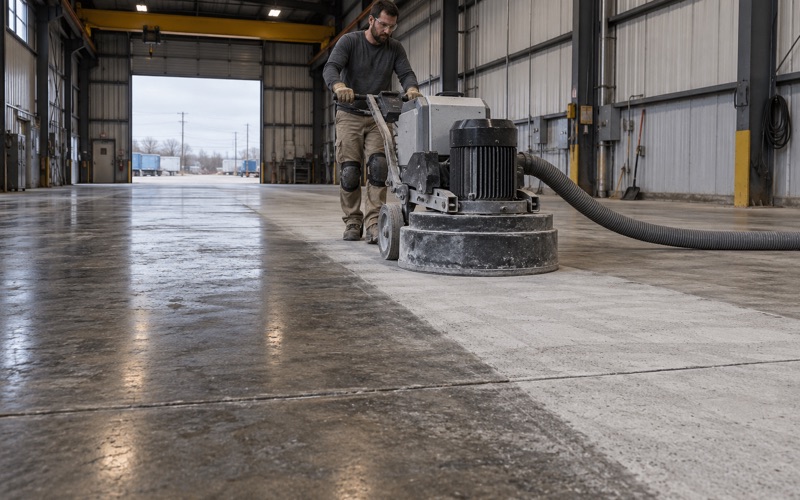
Our part starts with the slab. We open it with a diamond grinder or a shot blaster rather than an acid etch, pull the dust into a vacuum at the machine, and write the product line, coat count and finished thickness into the proposal so the floor can be checked against the quote.
A Ridgeland Avenue Coffeehouse That Barely Closes
Qamaria Yemeni Coffee at 9970 Ridgeland
The Village of Chicago Ridge business directory lists Qamaria Yemeni Coffee Co. at 9970 Ridgeland Avenue, describing it as specialty Yemeni coffee and pastry. The chain says it sources its coffee from Haraz, Yemen, and the address sits inside the village limits in Worth Township, Cook County.
What makes it useful here is the clock. Yelp and Apple Maps list hours of 7:00 a.m. to midnight, and the chain’s own social feed has described its Chicago Ridge shop as open around the clock. Whichever listing is current, the cafe closes for a few hours a night at most.
Ridgeland Avenue is where much of Chicago Ridge does its shopping and eating, between the mall at 95th Street and the Commons of Chicago Ridge strip center at 99th. For a village of 14,433 people at the 2020 census, it carries a great deal of commercial floor.
We have no tie to the cafe and have not seen its floor, and nothing here suggests it plans any floor work. It stands in for a whole class of Chicago Ridge businesses, from late-night counters to restaurants near the mall, where a closed week is not on the table.
Dry Is Not Cured
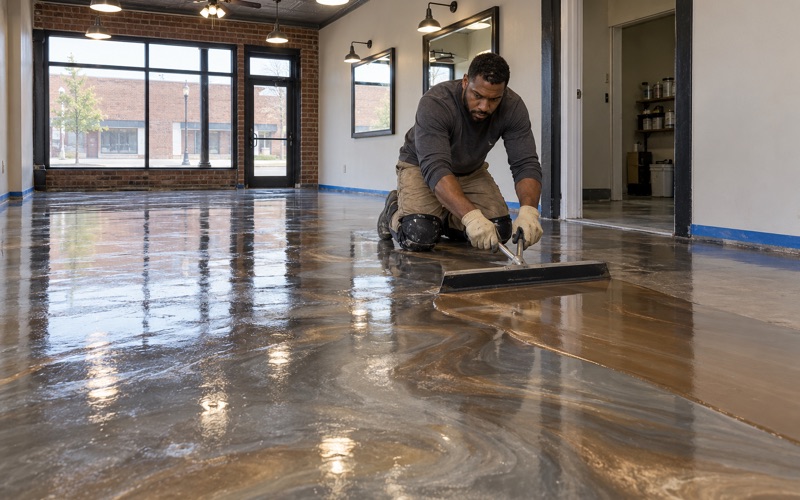
Epoxies and polyurethanes harden by a chemical reaction between resin and hardener, and that reaction keeps running long after the surface stops feeling tacky. A floor can take foot traffic and look finished while the film underneath is still building its strength.
Coatings makers say this plainly. A November 2025 technical note from Dulux Protective Coatings states that even epoxies and polyurethanes are only partly cured several days after application, though they appear quite dry, and that often a week or more passes before the crosslinking reactions run to effective completion.
The exact timing belongs to each product and to the slab temperature, so we never promise a fixed number of hours. What the note settles is the shape of the risk: the first days after a coat goes down are when a floor is most easily marked, softened or stained.
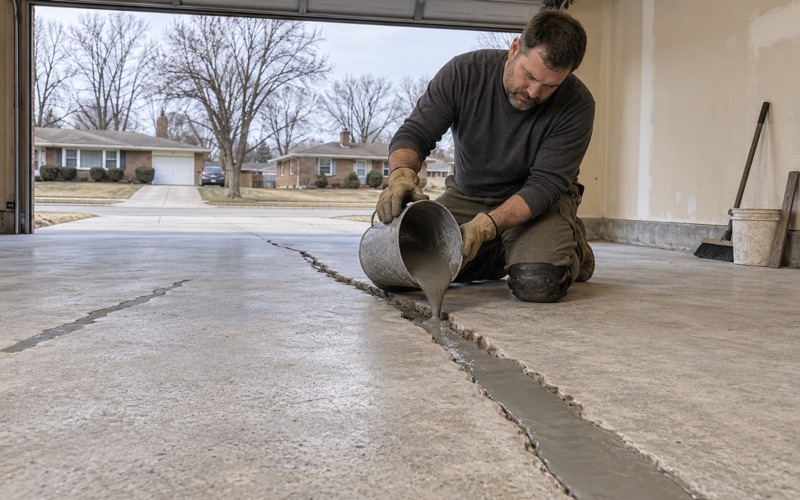
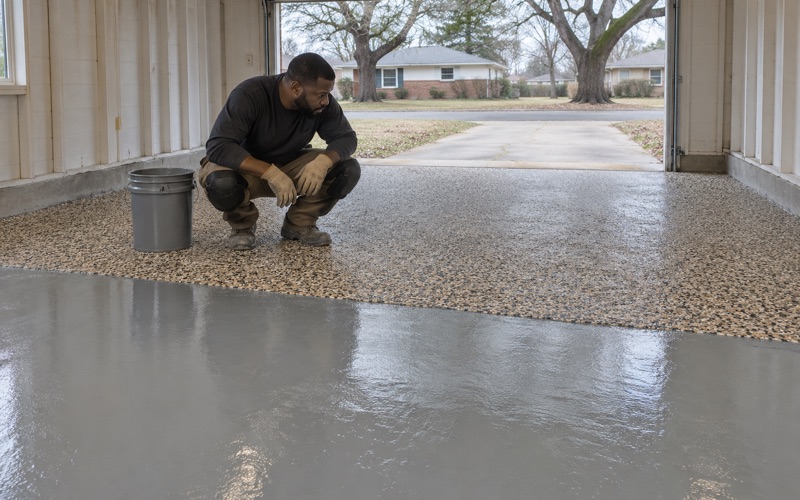
For a garage, that gap is easy to absorb: the car stays on the driveway a few extra days. For a cafe pouring hot drinks from early morning to late night, the same gap decides how the whole job is laid out.
Looking for epoxy-flooring closer to Palos Heights? See Palos Heights Epoxy-Flooring.
Splitting an Open Floor Into Zones and Short Closures
Phasing by Zone
When a space cannot close, we divide it. A typical plan treats the back-of-house prep area, the counter run, the seating floor and the restrooms as separate zones, then coats one while the others stay in use behind a barrier.
Before any zone is opened, we map cracks, spalls and old paint or sealer across the whole floor, not just the first phase. A problem found in zone three after zone one is finished can force a change of product or a repair that should have been priced at the start, and some slabs need repair or replacement before they should be coated at all.
Each zone needs a clean edge where the new system meets the old floor or the next phase. We place those seams at doorways, under thresholds or along a counter base, where a joint line reads as deliberate and is not ground up by every footstep.
Customers and staff still need a path to the door, the restroom and the register while a zone is closed. We draw that route on the floor plan before work starts, so the open side of the room keeps working and nobody steps onto a coat that is tacky or still curing.
Grinding is the loud, dusty step, so it is usually scheduled into the quietest hours even when the coating itself goes down later. With seating a few feet away, the barrier has to hold dust as well as people, and it stays up until the zone is ready to walk on.
A Short Planned Closure Instead
Sometimes a single planned closure works better than weeks of rolling zones. A small cafe may choose to shut for a set window so the whole floor goes down in one sequence, with no seams between phases and a single cure to manage.
That window has to cover more than the coating. It includes the grind, any crack and spall repair we mapped beforehand, each coat’s recoat interval and enough time afterward for the floor to reach light service, all of which we lay out in the schedule before a date is set.
Permits and Registration in the Village
The Village of Chicago Ridge permit sheet says all construction or remodeling work on or in any building needs a building permit, completed by the contractor doing the work, and it does not list floor coating as exempt. Every contractor also registers at Village Hall first; a general contractor pays a $100 fee and posts a certificate of insurance and a $10,000 surety or performance bond. We confirm that registration and the permit question with the Building Department before booking, because a phased job that stalls halfway for paperwork leaves a business with a half-finished floor.
Return-to-Service Time Decides the System
What Return to Service Means on a Quote
Return to service is the point at which a floor can carry its normal use again, and it comes in stages. Light foot traffic arrives first, carts and furniture later, and spills, hot liquids and cleaning chemicals last, when the film is closest to full cure.
Our proposals list each of those stages for the specific product, read from its data sheet at the slab temperature we expect on the day. An owner can then plan staffing, deliveries and seating around real milestones instead of one vague ready date.
Fast-Turn Chemistry and Its Trade-Offs
Polyaspartic and polyurea topcoats reach foot traffic far sooner than a conventional epoxy topcoat, which is why they show up so often on jobs with tight windows. They also leave less working time, so they suit a crew that plans each zone carefully and does not overreach.
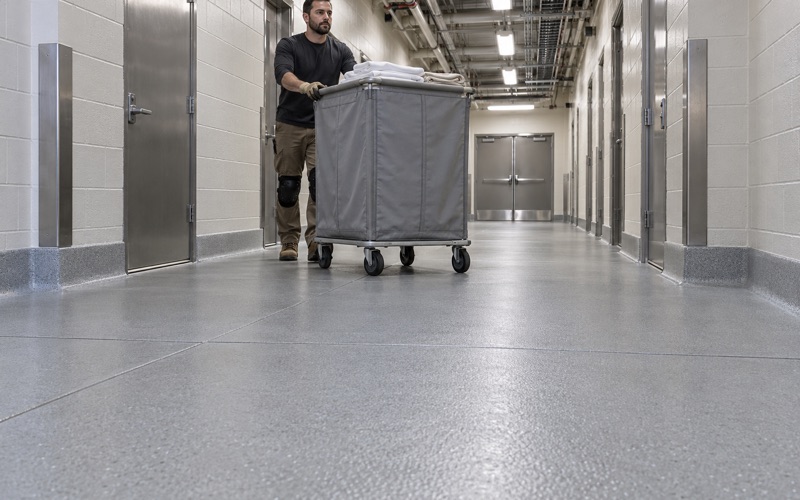
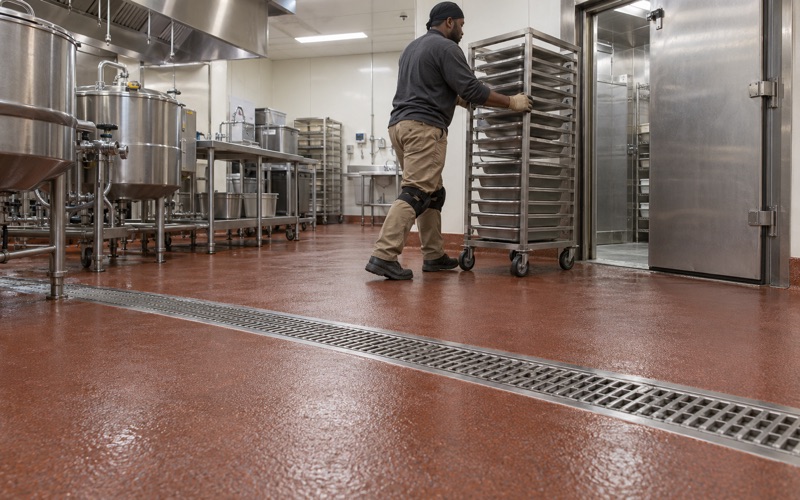
A 100% solids epoxy body coat still has a place under them, building thickness and carrying a vinyl flake or quartz aggregate broadcast for texture. In a wet prep area, urethane cement is the other candidate, valued for tolerating heat and wash-down, though its own return-to-service times are set by the maker and have to be read, not assumed.
Texture is part of the system choice too. Behind a counter where drinks spill and floors are mopped wet, we specify slip resistance by the broadcast grit and the topcoat over it, finer where staff need to clean quickly and coarser where water sits.
Moisture and Temperature Still Come First
A fast system laid on a damp or cold slab is not fast at all. Before the price is final we test moisture with ASTM F2170 in-situ relative humidity probes or ASTM F1869 calcium chloride, and the proposal names the method and the reading the slab must pass. Moisture is also the first exclusion we explain in any coating warranty, before the job is sold.
Cure also tracks slab temperature, not the clock on the wall. Overnight work in a building that cools after hours can slow a coat or leave amine blush on an epoxy surface, so we check conditions at the start of each phase rather than once for the whole job.
Hot Coffee, Milk Tea and Mop Water on a Young Floor
The First Week Behind the Counter
A coffee counter puts some of the hardest early tests on a new floor. Hot coffee and sweet milk tea land near the espresso machine and the pickup line, sugar dries into a sticky film, and staff mop the same strip many times a shift.
On a film that is only partly cured, heat and moisture sitting on the surface can soften or blush it, and a strong cleaner can dull or etch it. That is why we treat the first days as the riskiest stretch of the whole job rather than the finish line.
An Early-Days Plan for Staff
We hand the owner a short written plan for the zone that just reopened. It covers wiping spills at once instead of letting them sit, mild neutral cleaners and plain water until the data sheet allows the usual chemicals, and carts and chairs lifted rather than dragged across it.
Where the schedule allows, the counter zone gets the longest protected cure, often by doing it in the short closure while the seating floor is phased around open hours. Seating sees mostly feet and the odd dropped cup, so it can come back into use sooner.
The Same Rule in a Chicago Ridge Home
Homes face a smaller version of the same problem. A basement bar, a kitchen-adjacent mudroom or a garage that doubles as a laundry area may not close for long, and a spilled mug or a bucket of mop water in the first days does the same harm there.
For a homeowner, the practical version is simple: keep drinks, buckets and household cleaners off the new floor for the stretch the product’s data sheet calls for, and move nothing heavy back in early. We put those dates in writing for home jobs the same way we do for a business.
A coffeehouse on Ridgeland Avenue listed as open until midnight makes the point more plainly than any data sheet. A floor is ready when its chemistry says so, not when it looks dry, so we plan the job around that difference, one zone and one reopening at a time.
- 20+ Years Coating Concrete
- Written Moisture Testing
- Free Estimates