
Gary Epoxy Flooring installs commercial epoxy flooring in Gary, IN, serving surrounding cities including Lake Station, Griffith, Highland, Hobart and East Chicago. Over 20+ years of coating concrete, we have learned that commercial floors are less about the coating and more about planning: which areas can close, when, for how long, and what each part of the floor will face once the business reopens.
Retail stores, offices, auto repair shops, clinics, gyms and venue back-of-house areas all need different things from a floor. A showroom wants gloss and easy cleaning, a repair bay wants chemical resistance and texture, and a clinic corridor wants a seamless surface that stands up to disinfectants all day. We specify each area separately rather than coating the whole building with one product.
Every commercial proposal names the surface preparation method, the moisture test and its passing number, the product line, the number of coats and the finished thickness for each area, along with the phasing plan and the cure time before each section returns to use.
Commercial Floors by Space
Retail Stores and Showrooms
Retail and showroom floors take constant foot traffic, rolling carts and display fixtures being moved around. A seamless epoxy system with a durable polyaspartic or urethane topcoat cleans easily, resists scuffs, and can be finished in solid colors, flake or metallic to suit the brand.
In stores that open to Northwest Indiana winters, salt and grit come in on every pair of shoes. We recommend satin topcoats that hide fine scratches better than high gloss, plus walk-off mats at entries to keep that grit from wearing the finish.
Offices, Lobbies and Common Areas
Office lobbies, break rooms and corridors benefit from a floor that looks clean with little maintenance. Epoxy and polished concrete both work well here, and we help choose based on the slab, the look you want and how much downtime the space can tolerate.
Chair casters and rolling carts concentrate wear in specific lanes, so we choose topcoats rated for that abrasion and explain how a periodic recoat keeps those lanes looking new. A recoat costs far less than a new floor when it is done before wear reaches the base coat.
Auto Repair, Fleet and Service Bays
Service bays face hot tires, motor oil, brake fluid, solvents and road brine tracked in all winter. We use chemical-resistant epoxy over a ground profile with a polyaspartic or urethane topcoat, adding texture where floors get wet and sloping the finish toward trench drains.
Lift posts, drains and floor transitions get special attention, because fluids collect there first. We coat around anchors and drain rims carefully so the floor stays sealed at its most vulnerable points.
Clinics, Gyms and Back-of-House
Clinics and Medical Offices
Medical and dental clinics clean floors all day with disinfectants that can dull or stain weaker finishes. We install seamless, chemical-resistant coatings with coved bases where walls meet floors, eliminating seams where dirt and bacteria can collect.
Work is phased around patient areas and scheduled after hours, and we choose low-odor systems in occupied buildings so care can continue while each section cures. Dust is captured at the grinder so nothing drifts into treatment rooms.
Gyms and Fitness Centers
Locker rooms, shower areas and gym entries need slip resistance and moisture tolerance. A quartz broadcast system gives strong grip and stands up to constant cleaning, while weight areas typically take rubber flooring over a sealed slab.
Shower and locker areas also benefit from a coved base, which carries the coating a few inches up the wall so water and cleaning chemicals cannot sit in the joint between floor and wall. Floor drains are coated to the rim and the surface is sloped so water reaches them instead of pooling under benches.
Casino, Hotel and Venue Back-of-House
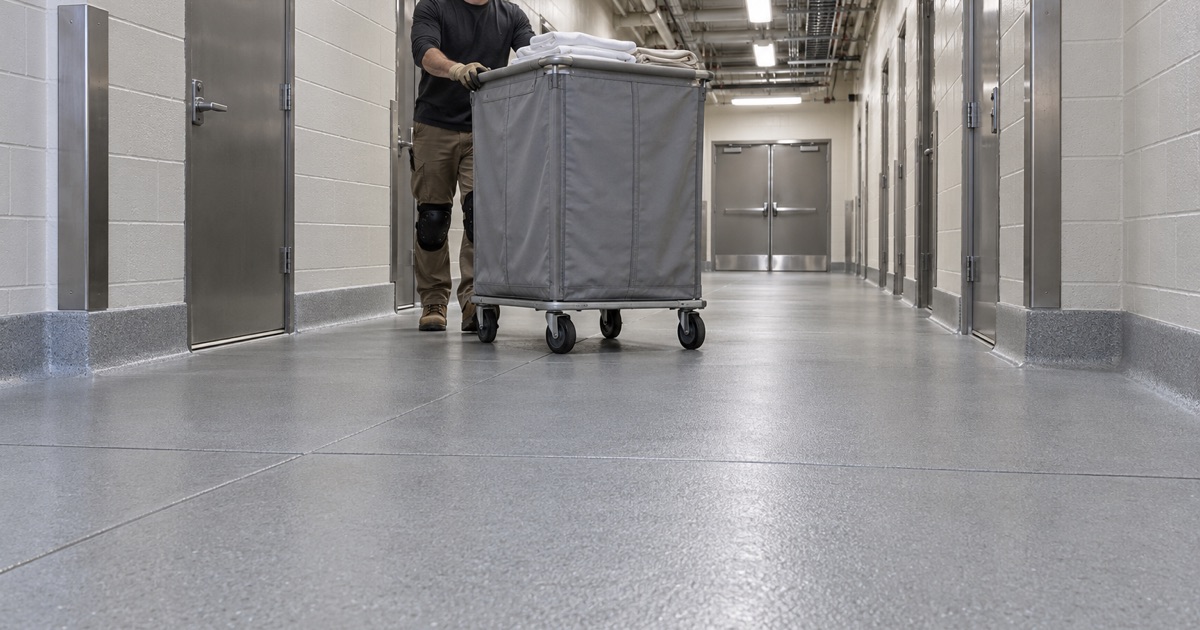
Back-of-house areas in casinos, hotels and event venues, such as loading docks, service corridors and storage rooms, run around the clock. We phase those floors in short overnight windows and use fast-return polyaspartic topcoats so service routes reopen quickly.
Gary’s own casino and hospitality properties are large, continuously operating spaces, and floors in their service areas are typically worked in sections rather than closed at once. We plan around deliveries, shift changes and events from the first site walk.
Slab Conditions in Commercial Buildings
Moisture in Older Commercial Slabs
Many older commercial buildings in and around Gary sit on slabs with no vapor retarder, sometimes on sandy, damp ground. Moisture moving up through those slabs is the leading cause of coating failure, so we test with ASTM F1869 calcium chloride kits or ASTM F2170 relative humidity probes before pricing.
Where readings run high, a moisture-mitigation primer is specified, and its cost appears on its own line with the reading that triggered it. Moisture is also the first exclusion we name when explaining the coating warranty.
Old Coatings, Tile and Adhesive
Commercial spaces often have layers of old coatings, vinyl tile and mastic from earlier tenants. We grind or shot blast down to sound concrete, repair cracks and spalls, and fill joints before coating, because a new system bonded over old material is only as strong as the old bond.
Tenant improvements are a common moment to redo a commercial floor, and the landlord, tenant and general contractor often each have a say. We provide a clear written scope, product data and moisture results that all parties can review, so the floor is approved once rather than argued over after it is installed.
Compliance and Scheduling
Indiana VOC Limits
Indiana’s 326 IAC 8-14 caps floor coatings at 250 g/L and industrial maintenance coatings at 340 g/L, and the rule binds whoever applies the coating. Gary’s Calumet Township also sits in the Chicago ozone nonattainment area. We choose compliant products and never thin them on site.
Licensing, Insurance and Bonding
The City of Gary licenses flooring subcontractors and requires insurance and a surety bond recorded with the Lake County Recorder. Neighboring towns and Illinois suburbs have their own requirements, and we confirm them before a commercial job is booked.
Night, Weekend and Phased Installs
We build the phasing plan around your operation, closing one area at a time and scheduling grinding during off-hours. Dust is captured at the machine with industrial vacuums, so adjoining spaces can keep working while each section is completed.
- 20+ Years Coating Concrete
- Written Moisture Testing
- Free Estimates