
Gary Epoxy Flooring installs commercial kitchen flooring in Gary, IN, serving surrounding cities including Lake Station, Griffith, Highland, Hobart and East Chicago. Restaurant, bakery and food service floors take some of the hardest punishment of any floor we coat, and after 20+ years on concrete we know that the wrong system fails fast in a kitchen: hot water, grease, cleaners and constant traffic find every weakness within months.
Most commercial kitchens we work in are better served by urethane cement than by standard epoxy. It handles hot washdown, thermal shock, fats, oils and sanitizers, it tolerates more moisture in the slab, and it can be installed with an integral coved base that carries the floor seamlessly up the wall.
Our proposals for kitchen floors name the surface preparation method, the moisture test and its passing reading, the product line, the number of coats and the finished thickness, along with the cove height, the texture for each zone and the overnight or closed-day schedule.
What a Kitchen Floor Has to Survive
Hot Water, Steam and Thermal Shock
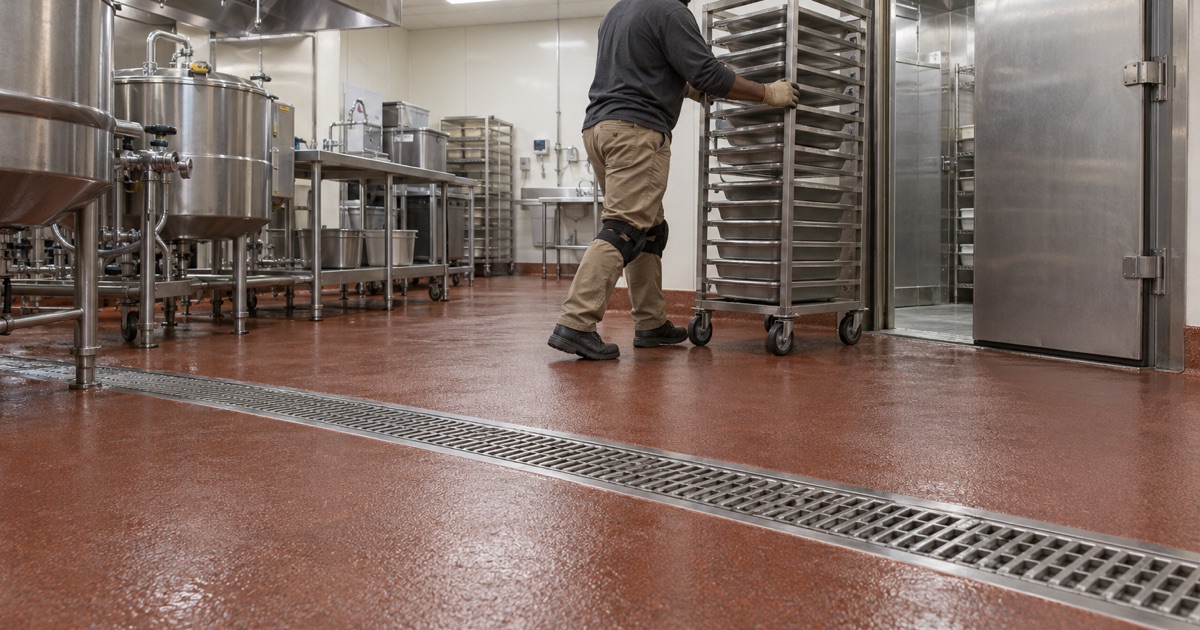
Kitchen floors are hosed down with hot water, hit with steam cleaners and splashed with boiling liquid from kettles and fryers. Rapid temperature swings expand and contract the floor surface, and standard epoxy can crack, soften or lose its bond under that thermal shock.
Urethane cement is formulated to move with those temperature changes and keep its bond. In areas around kettles, dish machines and fryers, where heat exposure is highest, we specify thicker urethane cement systems.
Grease, Fats and Sanitizers
Animal fats, cooking oils, sugars, acids from food and daily sanitizers all attack floors in different ways. Organic acids from dairy, citrus and vinegar can etch weaker coatings, and grease that soaks into bare concrete becomes a permanent slip hazard and odor source.
A seamless urethane cement floor keeps fats and acids on the surface where they can be cleaned away. That is also why we grind out old grease-soaked concrete before installing a new system.
Constant Traffic and Rolling Loads
Carts, racks, pallet jacks bringing in deliveries and staff moving fast all day wear kitchen floors in predictable lanes. A thick urethane cement system stands up to that abrasion and impact far better than a thin coating or sealed concrete.
Doorways between the kitchen and the dining room, loading dock thresholds and the path to the walk-in take the heaviest wheel traffic. We thicken the system at those transitions and finish the edges cleanly where the kitchen floor meets a different floor, so carts roll over without catching a lip that chips over time.
Meeting the Food Code
Smooth, Durable and Cleanable Floors
The FDA Food Code, the model most state and local food codes follow, calls for food service floors that are smooth, durable and easily cleanable. Section 6-201.11 also allows slip-resistant floor surfaces in areas subject to moisture, which is why textured systems are accepted in cook lines and dish areas.
We balance texture and cleanability for each area. Too smooth is a slip hazard, and too rough traps food debris and becomes hard to clean.
Coved Floor and Wall Junctures
Where water flush cleaning is used, the Food Code under 6-201.13 calls for coved, sealed junctures between floors and walls. A trowel-applied urethane cement cove base runs a few inches up the wall as part of the floor itself, removing the seam where water, grease and bacteria collect.
Coves are built around equipment bases, door frames and corners, and they are shaped so a mop or squeegee moves cleanly along them. That is a detail inspectors notice and one that older tile floors often lack.
Drains, Slopes and Grease Interceptors
Kitchen floors need to move water to floor drains and trench drains, and they must work with plumbing that leads to the grease interceptor. We protect drains during the work, coat to the drain rims and restore slopes so water does not pool under prep tables or in walk-ins.
Grinding debris and wash water are collected dry and never rinsed into drains, because that material does not belong in an interceptor or sewer line. Drain covers go back on only after the floor around them has cured.
Installing Around a Working Kitchen
Removing Old Tile and Failed Coatings
Many older kitchens have quarry tile with failing grout, or coatings peeling around drains and equipment. We remove old tile and coatings, grind the slab to sound concrete and repair damaged areas before installing the new system.
Where the slab has soaked up grease over years of use, we grind deeper and clean thoroughly, because oil left in the concrete will release any new floor. A water drop test after cleaning shows whether the slab is ready.
Moisture in Kitchen Slabs
Kitchen slabs often carry high moisture from years of washdown and from damp ground beneath older buildings. We test with ASTM F1869 calcium chloride kits or ASTM F2170 relative humidity probes, and urethane cement’s higher moisture tolerance is one reason it suits these floors.
Overnight and Closed-Day Installs
Restaurants lose revenue every day the kitchen is closed, so we plan installs overnight, on closed days or in sections. Fast-cure urethane cement systems can often take foot traffic and equipment the following day.
We coordinate equipment moves, ventilation and odor control with the kitchen manager, and we choose systems within Indiana’s 326 IAC 8-14 VOC limits for floor coatings. Low-odor products are used where the dining room or neighboring tenants stay open.
Other Food Service Spaces
Walk-In Coolers and Freezers
Walk-in coolers and freezers stay cold, which slows resin cure and affects which systems can be used. Urethane cement formulations rated for low temperatures work in these spaces, and we plan installs around shutting down and restarting refrigeration.
Bakeries, Breweries and Food Prep
Bakeries, breweries and food production spaces face sugars, flour, acids and frequent washdown. We specify systems for the specific exposure in each room and add coves and drains where needed.
Breweries in particular combine hot caustic cleaning, standing water and heavy kegs, and their floors often need the thickest urethane cement systems we install. Every food space gets the same written scope, and we explain what the coating warranty excludes, starting with moisture, before the job is sold.
- 20+ Years Coating Concrete
- Written Moisture Testing
- Free Estimates