
Gary Epoxy Flooring provides concrete grinding in Gary, IN, serving surrounding cities including Lake Station, Griffith, Highland, Hobart and East Chicago. Surface preparation is the part of a floor job nobody sees once the coating is down, and after 20+ years on concrete we consider it the part that decides whether a floor lasts. Most coating failures trace back to a slab that was never properly opened.
We prepare slabs mechanically, with walk-behind diamond grinders, hand grinders at the edges and shot blasters on large open floors. Acid etching is never part of our process. Every proposal names the preparation method and the surface profile the chosen coating requires, so the prep can be checked rather than assumed.
Grinding is also how we find out what a slab is hiding. Old paint, sealers, oil, soft patches and cracks show up once the surface is cut, which is why we map cracks, spalls and old coatings before pricing and tell owners when a slab needs repair or replacement before it should be coated.
Diamond Grinding and Shot Blasting
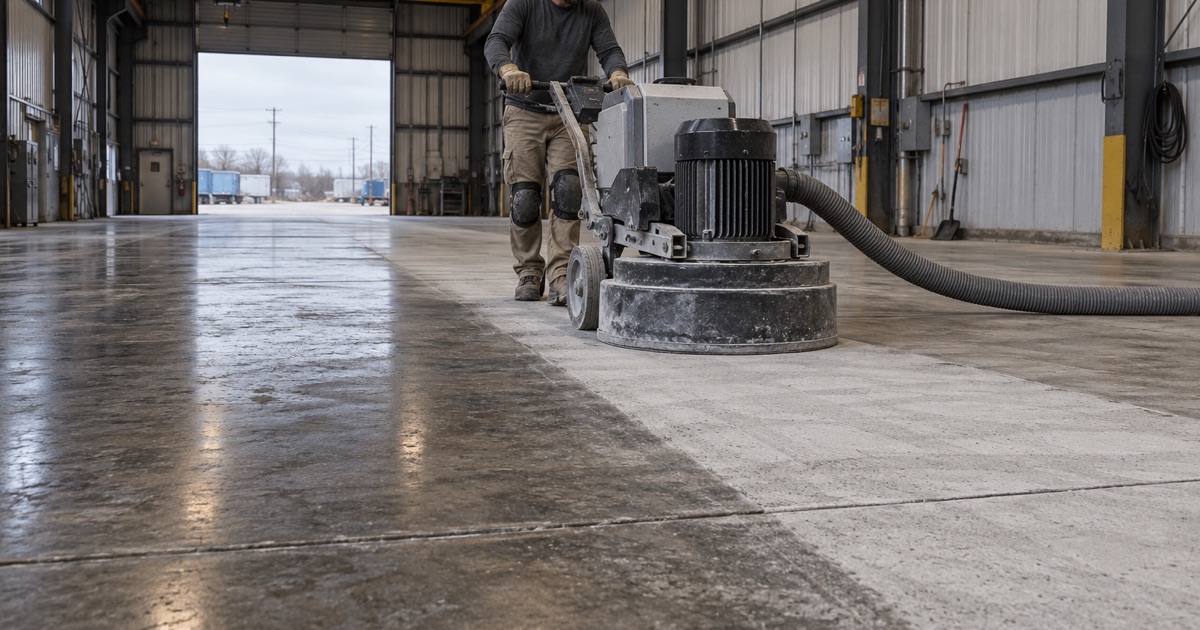
Walk-Behind and Edge Diamond Grinding
Diamond grinding uses rotating heads fitted with metal-bond or resin-bond diamond segments to cut the top of the slab. It removes laitance, the weak, cement-rich skin left on most concrete, along with coatings, adhesives and stains, and it flattens ridges and trowel marks.
We grind the field of the floor with walk-behind machines and finish edges, corners and around drains with hand grinders. Edges are where many coatings fail first, so they get the same attention as the open floor.
Shot Blasting on Large Slabs
Shot blasting throws steel shot at the slab and recycles it through a vacuum, leaving a uniform textured profile at high production rates. It suits warehouse, plant and parking structure floors where the coating system is thick enough to fill the profile it leaves.
Shot blasting is less effective on thick, soft coatings and leaves a pattern that thin coatings may show, so we often combine it with grinding. Any loose shot left on a floor rolls underfoot, and we collect it fully before anyone walks the slab.
Matching the Profile to the Coating
ICRI CSP Ratings Explained
The International Concrete Repair Institute describes surface profiles on a scale from CSP 1 to CSP 10, with reference chips for comparison. Thin sealers and coatings need a light profile, while high-build epoxy, broadcast systems and urethane cement need progressively rougher ones.
We check the specified range on the coating’s data sheet and prepare to it. Too smooth leaves the coating without enough grip, and too rough can leave peaks poking through a thin system.
Removing Old Coatings and Adhesives
Many floors we prepare carry old epoxy, floor paint, sealers, carpet glue or black mastic. All of it has to go, because a new coating bonded to an old one is only as strong as the old bond.
We test a small area to see how a coating responds to grinding, then choose the tooling. Some old adhesives need care during removal, and we discuss anything unusual we find before grinding through it.
Oil, Grease and Contaminated Concrete
Garage, shop and plant floors often have oil soaked deep into the concrete. Grinding removes surface contamination, but deeper oil can wick back up and release a coating, so we grind contaminated areas deeper, degrease them and test the result before coating.
A simple water drop test tells a lot after grinding: clean, open concrete darkens as it absorbs water, while contaminated concrete beads it up. Where water still beads after degreasing, we keep working the area or recommend an oil-tolerant primer, rather than coating over a spot that is already telling us it will not bond.
Cracks, Spalls and Joints Found During Grinding
Grinding exposes cracks and hollow spots that were hidden under paint or dirt. We chase cracks open with a diamond blade, fill them and grind the repairs flush, and we sound the slab for delaminated areas that need to be cut out and rebuilt before any coating goes down.
Control joints are either kept open or filled, depending on the coating system and how the floor is used. In warehouses, joint edges that have been chipped by forklift wheels are rebuilt as part of the preparation.
Dust Control and Clean Work
Capturing Dust at the Machine
Concrete dust contains crystalline silica, and dry grinding without collection fills a building with it. Our grinders and shot blasters run tied to industrial vacuums that capture dust at the source, and we seal doorways and air returns in occupied homes and businesses.
In attached garages and finished basements, that matters for the household upstairs. In plants and shops, it keeps dust off equipment and inventory.
No Slurry Down the Drain
Wet grinding and rinsing create slurry that does not belong in floor drains, sump pits or storm inlets. Gary’s sewer system is combined, sending stormwater and wastewater through the same pipes, so we vacuum up dust and debris dry instead of washing it out the door.
The Gary Sanitary District’s combined system overflows to the Little Calumet and Grand Calumet rivers in heavy rain, and grinding dust washed into a street inlet ends up there. Collecting everything dry at the machine is simply the clean way to work, and it leaves the slab dry for testing and coating.
Grinding Before Other Floors
Flattening for Tile, Vinyl and Wood
Tile, luxury vinyl and engineered wood all need a flat, clean slab. We grind high spots, lippage at joints and leftover adhesive so the next installer starts on a sound surface rather than a floor that telegraphs every bump.
We can also remove trip edges where slab sections have shifted, grinding the high side down so walkways and garage entries are even again. When a section has settled badly, grinding alone will not fix it, and we tell you that before starting.
Moisture Testing After Grinding
Grinding opens the slab, which makes it the right moment to test for moisture. We run ASTM F1869 calcium chloride tests or ASTM F2170 relative humidity probes and record the results, so the next layer, ours or someone else’s, is chosen with the real moisture condition in hand.
- 20+ Years Coating Concrete
- Written Moisture Testing
- Free Estimates