Gary Epoxy Flooring brings more than 20 years of work on epoxy flooring in Country Club Hills and the south suburbs to one practical question: when something breaks or spills on a floor, can a broom and a mop clear all of it? On some floors the answer is yes. On others, slivers settle into joints and liquid creeps into textured pockets where no cleaning tool reaches.
This page follows that question through a room where federal rules already spell out the answer, a blood-draw station, and then back to the garages and basements of the city’s single-family houses. The thread running through both is a floor with no open seams, no coarse grit and no absorbent surface for a spill to soak into.
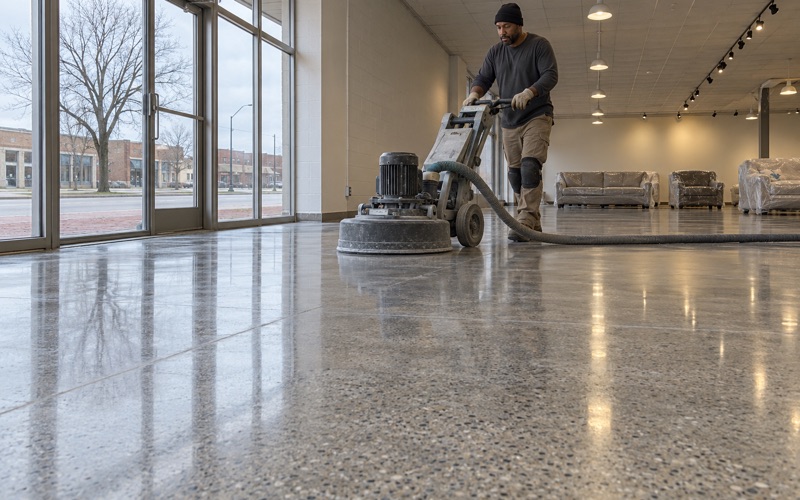
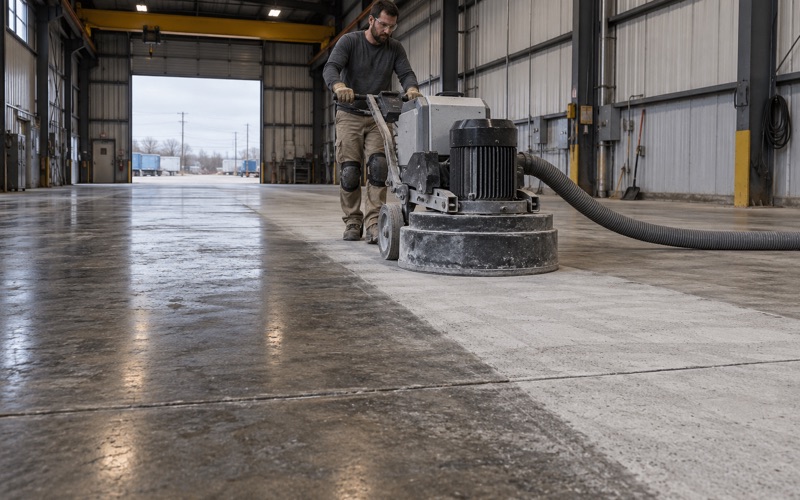
Every slab we coat is opened by diamond grinding or shot blasting rather than acid etching, and the written proposal lists the product line, the coat count and the finished thickness. The same habits apply whether the floor is a garage, a basement or a room where cleanup is regulated.
A Blood-Draw Station Inside the 167th Street Walmart
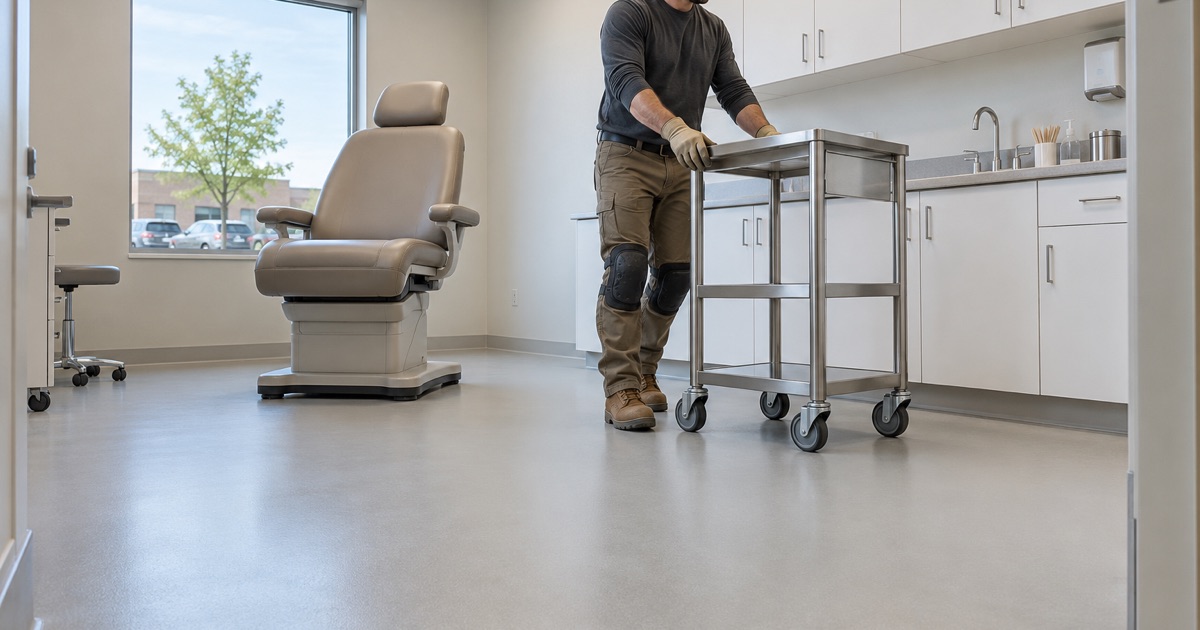
Weekday mornings on 167th Street
Quest Diagnostics runs a patient service center inside the Country Club Hills Walmart at 4005 167th Street, an address in the city’s Bremen Township section of Cook County. It collects samples for lab work a doctor orders or a patient buys directly, and it is open from 7:30 a.m. on weekdays until 4:00 p.m., plus Saturdays until 2:00 p.m.
We bring it up because a draw room is a place where the rules for cleaning work surfaces and floors are written down in federal regulation. We have never worked for Quest or Walmart and have not been inside that room, so nothing below describes its floor, its cleaning routine or how often anything breaks there.
Most collection tubes in use today are plastic, which matters for the glass discussion further down. The point is the rule, not a claim about this particular site.
What 1910.1030 asks of a surface
OSHA’s bloodborne pathogens standard, 29 CFR 1910.1030, requires employers to keep the worksite clean and sanitary under a written schedule. The cleaning and decontamination method in that schedule is to be based on the location within the facility, the type of surface to be cleaned, the type of soil present, and the tasks performed in the area.
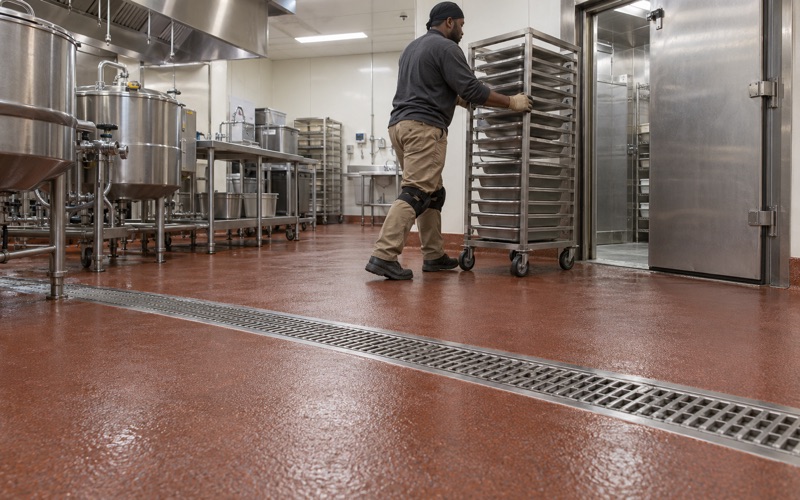
In plain terms, the floor itself shapes the cleaning plan. A surface that sheds liquid and leaves nothing in its seams supports a short, repeatable method, while grout, open joints or a rough profile push that method toward extra steps.
The same section says surfaces are to be decontaminated immediately or as soon as feasible when they are overtly contaminated or after any spill of blood. Speed only helps if the floor gives the spill nowhere to go, which is the job a closed, non-absorbent coating is laid to do.
None of that turns a coating into infection control. A floor does not disinfect anything and cannot make a workplace meet the standard; it only affects how hard the employer’s written method is to carry out.
Looking for epoxy-flooring closer to Midlothian? See Epoxy-Flooring in Midlothian.
Brush and Dust Pan, Never Bare Hands
The broken glassware rule
One line in 1910.1030 has a direct bearing on floors, even though the sentence never uses the word: “Broken glassware which may be contaminated shall not be picked up directly with the hands.” It must be cleaned up by mechanical means, and the regulation names them, a brush and dust pan, tongs, or forceps.
Glass that breaks in a room usually ends up on the floor, so in practice the rule plays out on floors. Tongs pick up the large pieces; the brush and pan are what clear the small ones, and they only work as well as the surface under them allows.
We make no claim that glass breaks often at any draw station, this one included. The rule exists for the occasional accident, and a floor that serves that rare moment also handles everyday grit well.
What the broom needs from the floor
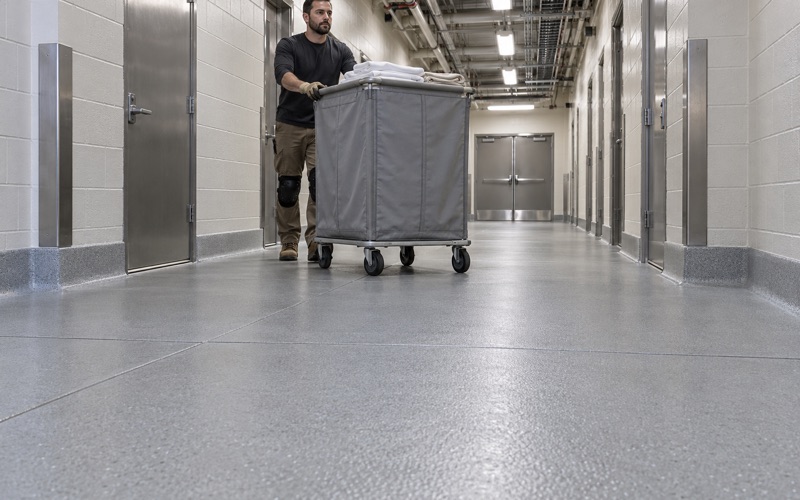
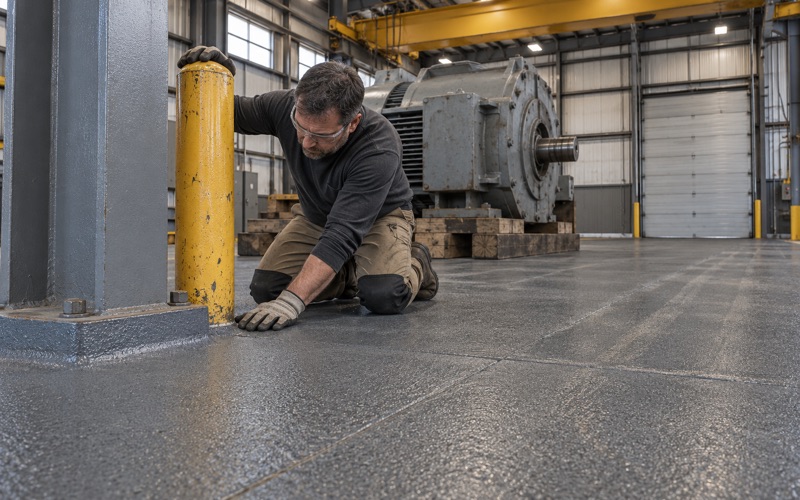
A brush clears a surface when its bristles can reach every low spot. On a smooth, continuous coating, a sliver has nowhere to lodge, so one or two passes carry it into the pan and a wipe confirms the area is clear.
Bare or worn concrete is different. Its pores, surface cracks and broken paste edges catch fine fragments, and a dusting slab sheds its own grit into the pan along with whatever was dropped, which makes it hard to tell when the job is done.
Vinyl tile and sheet goods sit between the two. They sweep well in the field, but every seam, edge and lifted corner is a line where a fragment or a spill can slip underneath.
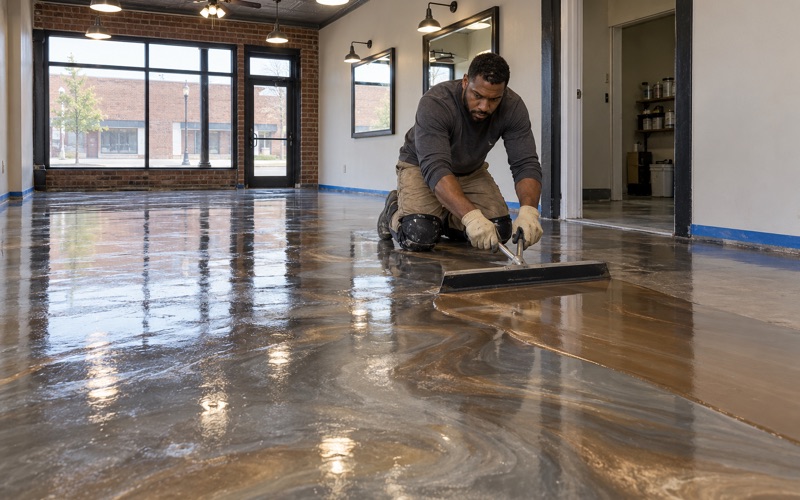
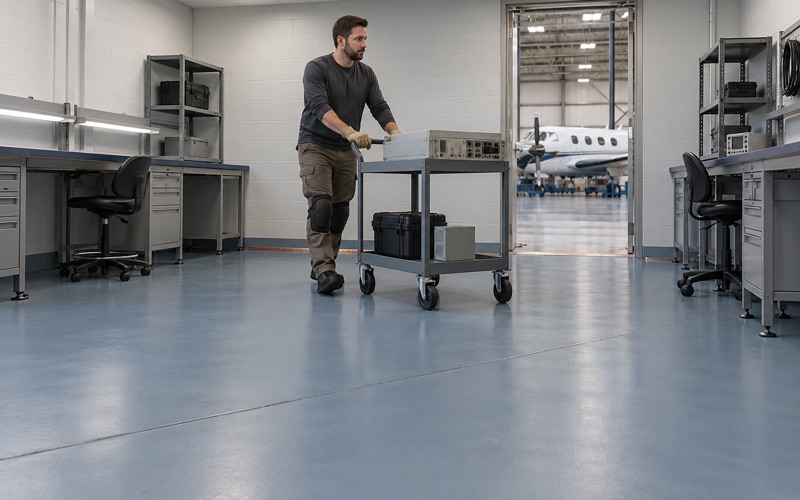
For rooms where cleanup has to be complete, we usually propose a 100% solids epoxy body coat under a polyaspartic or polyurea topcoat, laid as one film. That build bonds to a ground slab and cures into a hard, closed surface that a brush passes over cleanly.
Joints, Grit and Gaps Where Slivers and Fluid Hide
Saw cuts and cracks
Most interior slabs carry saw-cut control joints, and many have cracks that run between them. Left open under a coating, each one is a narrow channel where a glass splinter can wedge and a liquid can pool below the reach of a mop.
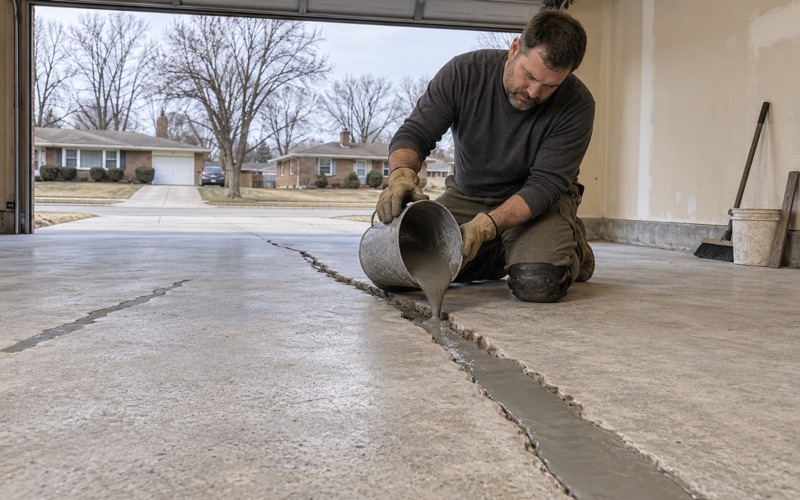
We map every crack, spall and patch before quoting, then fill and level the joints that can be filled so the coating runs across them as one surface. A joint that still moves gets a flexible filler and is named in the proposal, because a rigid coat laid over movement will crack along that line.
When a slab is too broken for that, we say so. Some floors need repair or partial replacement before any coating should go down, and we would rather lose the job than coat over a problem that will show through.
Texture that still sweeps
Grip and cleanability pull against each other. A coarse quartz aggregate broadcast gives a wet floor plenty of traction, but its peaks and valleys also hold slivers, shred mop heads and keep a film of liquid in the low points.
Where a broom has to finish the job, we lean toward a fine broadcast locked under the topcoat, so the texture is felt underfoot without forming pockets. The slip resistance is specified by the exact broadcast and topcoat in the proposal, and a sample board lets the owner sweep it before deciding.
Decorative vinyl flake floors follow the same logic. A full flake broadcast scraped and sealed under a clear topcoat sweeps smoothly; a light scatter left proud of the surface does not.
The edge at the wall
The last weak spot is where floor meets wall. Where a rubber base meets the floor, a hairline gap often forms along its bottom edge, and fragments swept toward the wall tend to wedge there.
An integral cove, the coating carried a few inches up the wall over a formed radius, removes that seam so the brush and pan can follow the curve. We price it as an option wherever a room’s walls allow it.
Broken Jars and Spills in Country Club Hills Garages and Basements
Away from clinics, the same floor logic applies to the houses that make up most of the city. About 74 percent of occupied units here are owned, roughly three in four units are detached houses, and the 1970s were the busiest building decade, so the typical home floor is a garage or basement slab that has carried decades of use.
Garage joints, glass and salt
A garage floor sees its own broken glass: a dropped box of light bulbs, a bottle knocked off a workbench, a glass jar slipping from a grocery bag. The control joint or crack running across a typical garage slab is where those slivers settle, and it is also the line a floor jack or creeper rolls over every week until the edges chip.
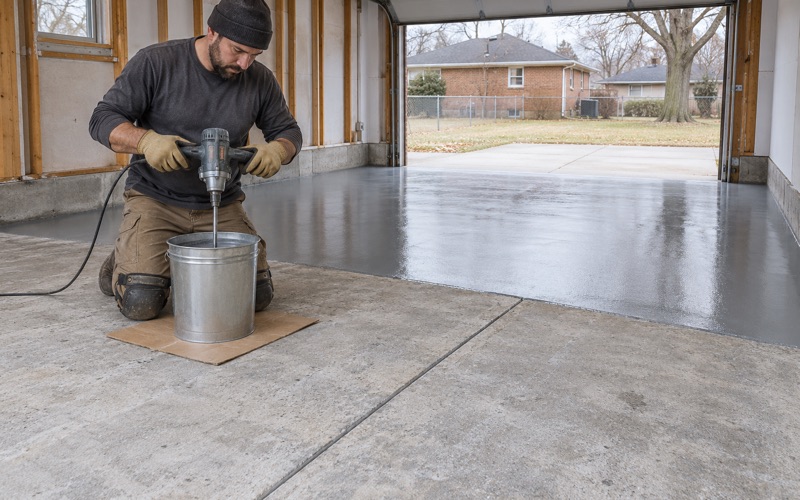
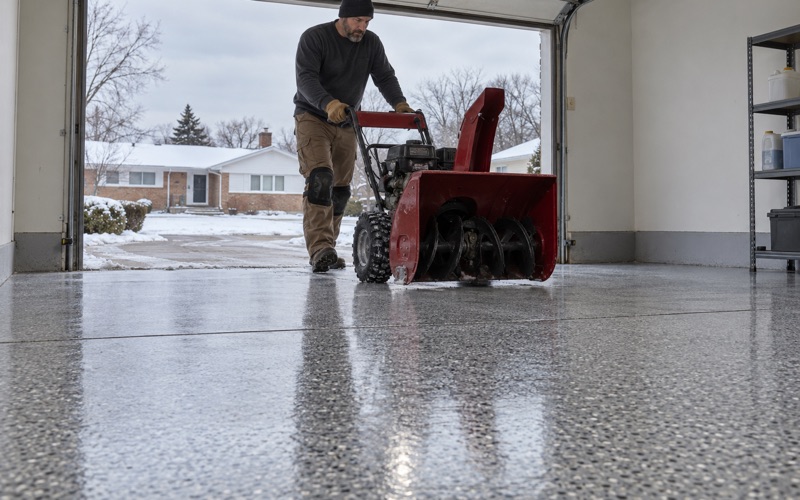
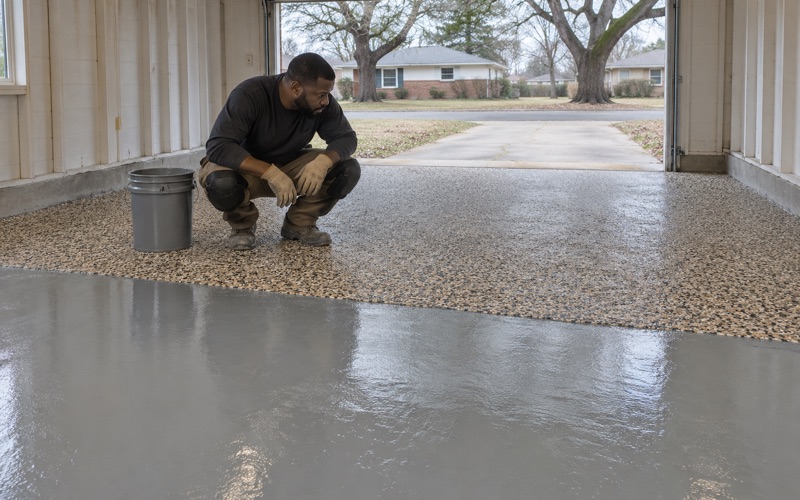
So a garage coating here starts by filling and leveling those joints rather than rolling over them. The system is a base coat built to avoid hot tire pickup, then a vinyl flake broadcast under a polyaspartic topcoat chosen to resist the brine and rock salt tires carry in all winter.
We schedule the cure by slab temperature and dew point, not by date. If the garage is unheated and it is the middle of winter, we tell the owner to wait, because a coating that cures cold can develop amine blush or stay soft.
Basement moisture and city paperwork
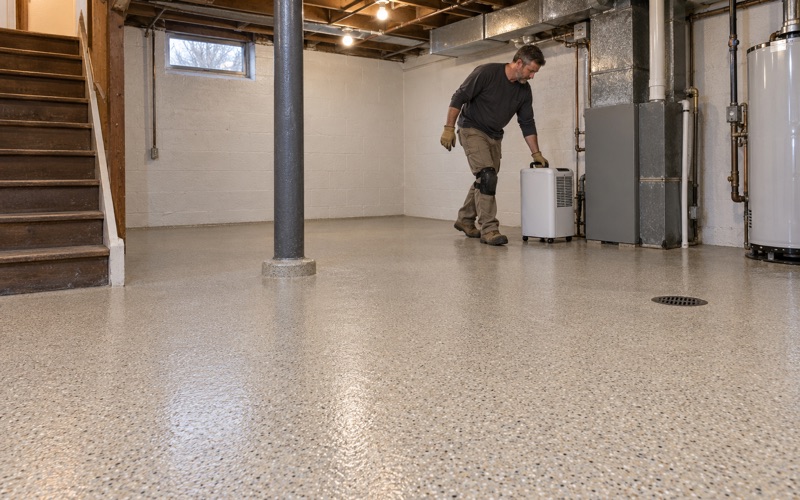
Before a basement price is final, the slab is tested for moisture, and the proposal states the method and the reading it must pass: an ASTM F2170 in-situ relative humidity probe, ASTM F1869 calcium chloride, or an ASTM D4263 plastic sheet as a first look. A high reading adds a moisture-mitigation primer to the scope, and moisture is the first warranty exclusion we explain.
We never sell a coating as waterproofing, radon reduction or flood protection. The city records one repetitive-loss property, so flooding is not its defining problem, but a basement that takes on water needs that source fixed before any floor goes down.
Paperwork is local too. Country Club Hills requires every contractor to hold a city Contractor’s License, a $10,000 surety bond and a certificate of insurance, and we confirm all three before a job is booked.
The city’s permit handout says additions, alterations and repairs need a permit while normal maintenance and repairs do not, so we ask the Community Development and Building Department at City Hall, 4200 W. 183rd Street, which side a floor coating falls on. Applications are handled at City Hall’s lower level, and emailed or faxed permits are not accepted.
Whether the room is a draw station on 167th Street or a two-car garage off a side street, we judge a floor the same way: picture something breaking on it, then ask whether a brush and a pan can take every piece away. A slab that fails gets joint filling, crack repair or a fresh grind written into the scope first, never left to chance.
- 20+ Years Coating Concrete
- Written Moisture Testing
- Free Estimates