Gary Epoxy Flooring has spent more than 20 years on epoxy flooring in Dyer and the rest of Lake County, and the jobs we find most interesting are the ones where the floor does real work. In a warehouse, a shop or a garage full of gear, the slab touches the stock every day, and whatever comes off it ends up on the things people sell or use.
Every floor we coat starts with a diamond grinder or a shot blaster rather than an acid etch, which gives the resin a true profile to hold. A moisture test is written into the scope before the price is settled, and the proposal states the method and the reading the slab must reach.
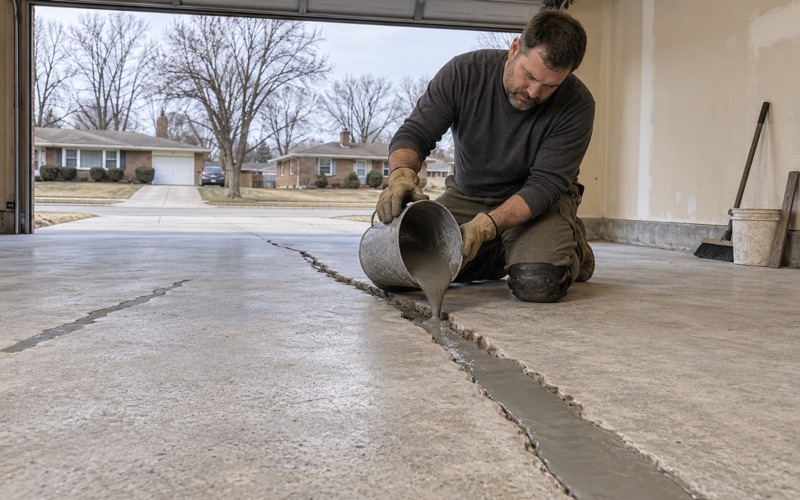
That same proposal lists the product line, the coat count and the finished thickness, so the floor can be held up against the quote once it is done. Cracks, spalls and old paint get mapped before anything else, and when a slab needs repair or replacement first, we tell the owner so.
A Wire Rope Warehouse on Matteson Street in Dyer, IN
Dyer, IN has a small industrial pocket on Matteson Street and Sheffield Avenue, north of US 30, and one business there makes a useful case study for anyone thinking about warehouse floors. Elite Sales, Inc., a wholesale wire rope, cable, chain and industrial hardware distributor based in Miami, lists a Chicagoland warehouse at 412 Matteson Street.
The company’s Indiana page says it just opened a new warehouse “in your neck of the woods,” located just 20 minutes from Chicago and 10 minutes from the Illinois border. It sells wholesale only and says it carries more than $30 million in stock at all times.
What a Rigging Distributor Handles
Its catalog runs from wire rope and cable to chain, stainless steel hardware, tie-down and cargo control gear, and Green Pin products. Wire rope is the item where the floor matters most, because it usually carries a lubricant and is handled in lengths rather than in boxes.
In a rope warehouse, coils get rolled and rope gets pulled out to be measured, and the floor is the surface it travels across. That puts the slab in the middle of rope care, whether anyone planned it that way or not.
A Local Example, Not a Customer
We name Elite Sales because it is a real operation on a real Dyer street, not because we work for it. We have never coated a floor there, and we have not seen how the company stores, unreels or cuts rope, or what its slab looks like.
What it shows is a kind of building where the floor is part of how the product is handled. Any shop on Matteson or Sheffield where cable, chain and rigging spend time on bare concrete faces the same questions, at whatever scale.
Looking for epoxy-flooring closer to Chesterton? See Epoxy-Flooring Services in Chesterton.
Rolled Along the Floor: Grit and a Lubricated Rope
At least one rope maker writes about floors in plain terms. The handling manual from Katradis, a maker of mooring wire rope, tells crews to roll a coil along the floor and let the rope trail behind, or to mount it on a turntable and pull the free end away in a straight line.
What the Manual Warns Against
The same manual says that when uncoiling outdoors, the rope should not be rolled through grit, sand or other abrasive material. It lists a dusty, gritty or sandy environment among the conditions it counts as improper storage.
This is one foreign maker’s manual for one class of mooring rope, not a US standard, and we do not present it as a rule any Dyer warehouse has to follow. It is still a plain statement of what one rope maker wants kept away from its product.
A Dusting Slab and a Lubricated Rope
Bare concrete wears. Forklift traffic, pallet drags and years of sweeping break down the surface paste, and a slab that has started to dust leaves a fine powder of cement and sand on top no matter how often it is swept.
A lubricated rope tends to hold onto that powder rather than shed it. Roll a coil across a dusting floor or drag a length out to measure it, and the slab is feeding the exact kind of abrasive the manual warns about straight into the rope’s outer layers.
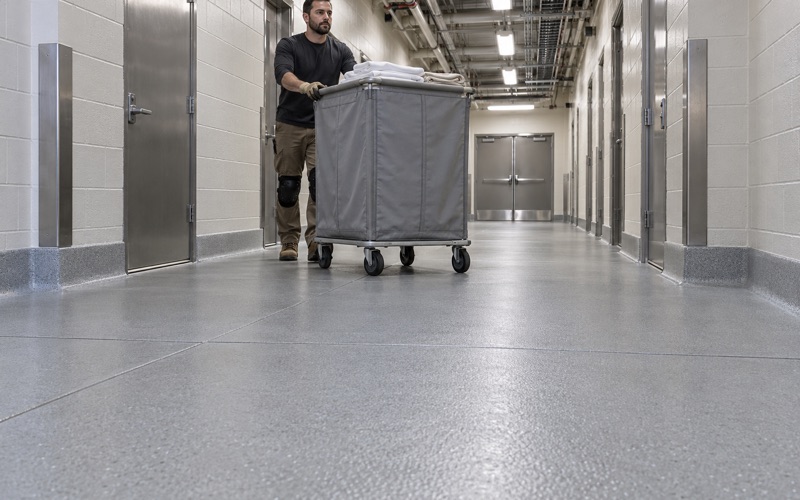
Sealing the slab is how we take that grit source away. A coated floor has no loose surface paste to wear off, and what does land on it, from pallets or boots, sits on top where a broom or an auto scrubber can collect it.
Our Own Dust Stays at the Machine
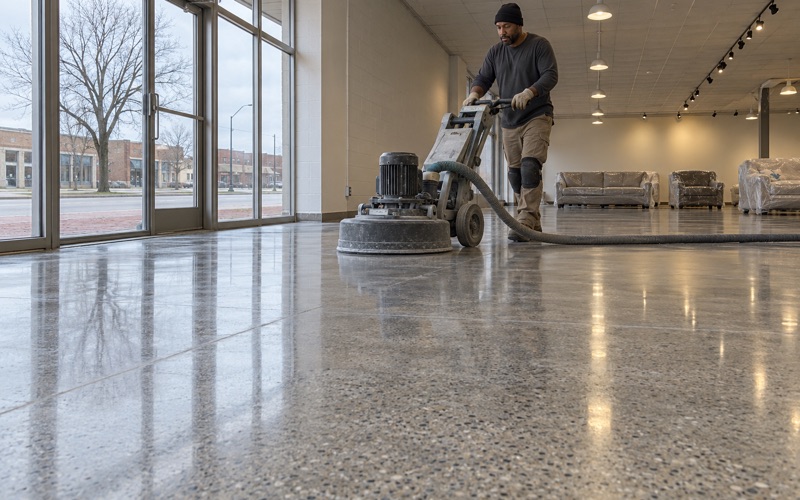
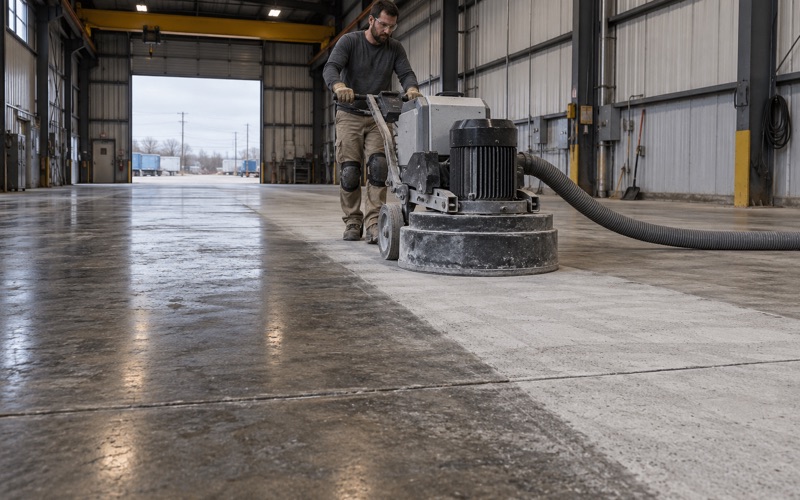
Prep is the dustiest part of any coating job, which matters in a building full of stock. We capture grinding dust at the machine with a vacuum shroud and dust collector, and we work in sections so stored stock can be covered or moved before the grinder reaches it.
Warehouses that cannot close get phased work around shifts, with overnight and weekend windows. Rope racks and reel stands can stay in service in one bay while the next bay is ground, coated and cured.
Lubricant That Drains Out of Stored Reels
Wire rope lubricant protects the rope, but it does not always stay put. The Katradis manual tells users to keep rope away from steam or hot water pipes, heated air ducts and any other heat source, because heat can thin the lubricant and cause it to drain out of the rope.
Where Drained Lubricant Ends Up
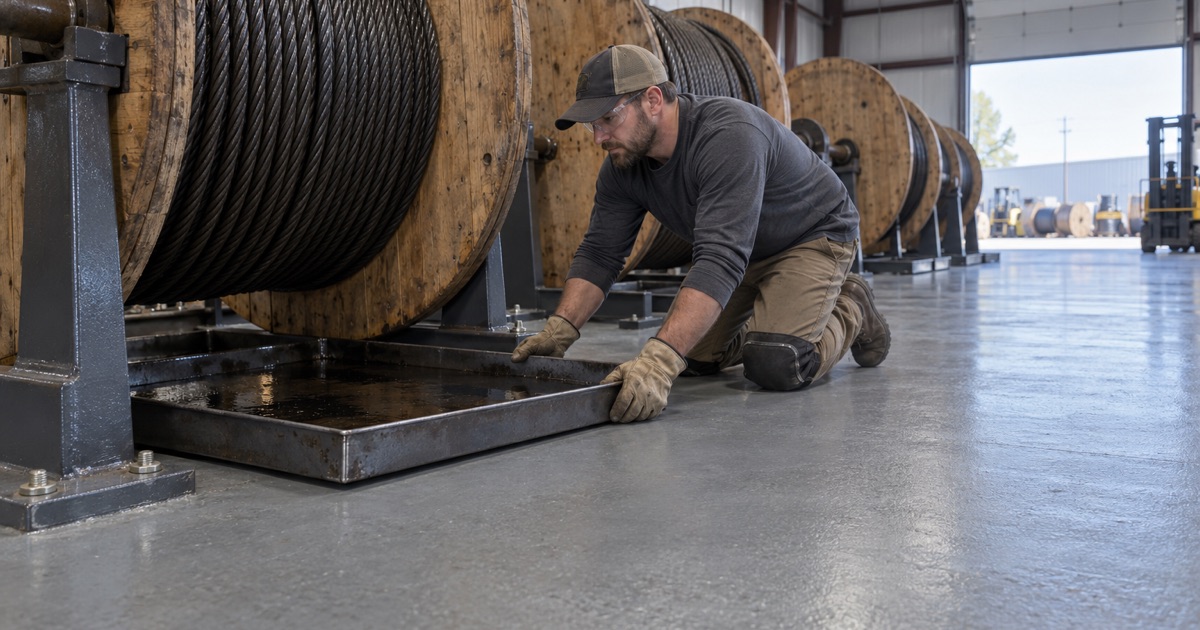
Lubricant that leaves a reel has one place to go, and that is the floor under it. A reel stored near a unit heater, a sunny dock door or a run of heated duct can leave a ring of thinned lubricant on the slab beneath it over a season.
On bare concrete, that lubricant soaks in and darkens the slab, and it keeps wicking back to the surface long after the reel has moved. It also leaves the spot slick in a way that is hard to clean, because the stain is inside the concrete rather than on top of it.
A Smooth Floor Under a Slick Film
Coating the slab solves the soaking problem but creates a different one. A smooth, glossy epoxy under a film of drained lubricant can be slicker than the bare concrete was, which is the wrong trade in an aisle where people pull rope by hand.
That is why we treat reel positions as their own zone on the drawing. Those areas get a textured finish, and the owner gets a plain recommendation to wipe up drained lubricant promptly, because no texture keeps working under a standing film.
The rest of the floor can stay smoother for easy sweeping. Splitting it this way gives the aisles a surface that releases dust to a broom and gives the reel stands traction where lubricant is most likely to collect.
Resin That Can Live With Lubricant
Not every coating handles long contact with rope lubricants equally well. For reel areas we look at 100% solids epoxy built to a stated thickness, with a chemical-resistant polyaspartic or urethane cement layer where the lubricant in use calls for it, and we check resistance data from more than one manufacturer.
Sealed, Non-Dusting and Textured Where Reels Stand
How We Build a Rope-Room Floor
The job starts with mapping. We mark cracks, spalls, old paint and worn joints, and where a section of slab is too far gone to hold a coating, the proposal says so before anything is ground.
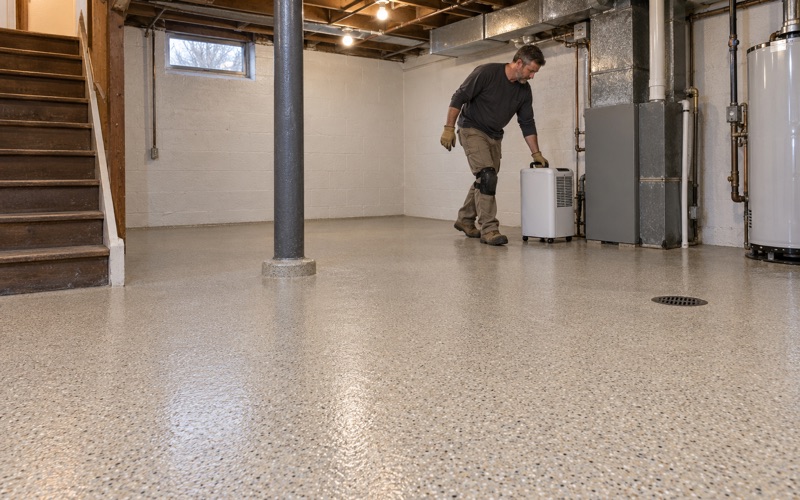
Next comes moisture. We test by ASTM F2170 in-situ relative humidity probes or ASTM F1869 calcium chloride, as the proposal specifies, and a slab that reads high gets a moisture-mitigation primer before the build coats go down.
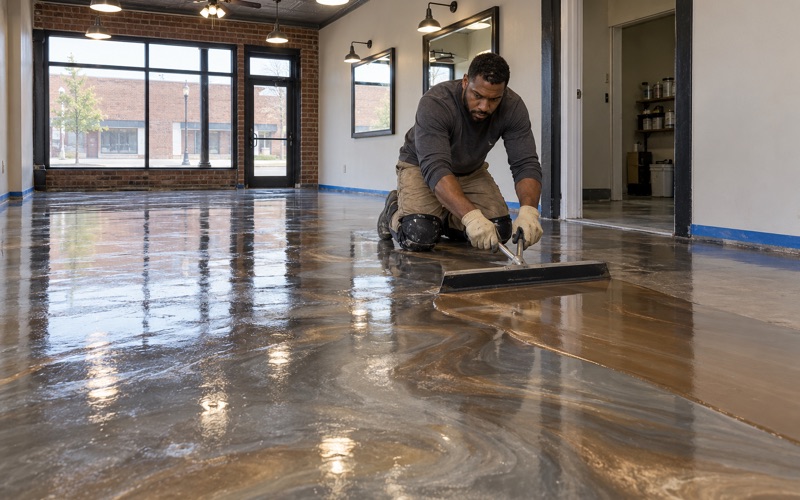
After grinding or shot blasting to the ICRI concrete surface profile the system calls for, the build we usually propose for a rope room is a primer, a 100% solids epoxy body coat broadcast with quartz aggregate, and a polyaspartic topcoat, with a finer broadcast in the aisles than at the reel stands. The broadcast size and topcoat build set the texture, so slip resistance is specified in the proposal rather than promised as a slogan.
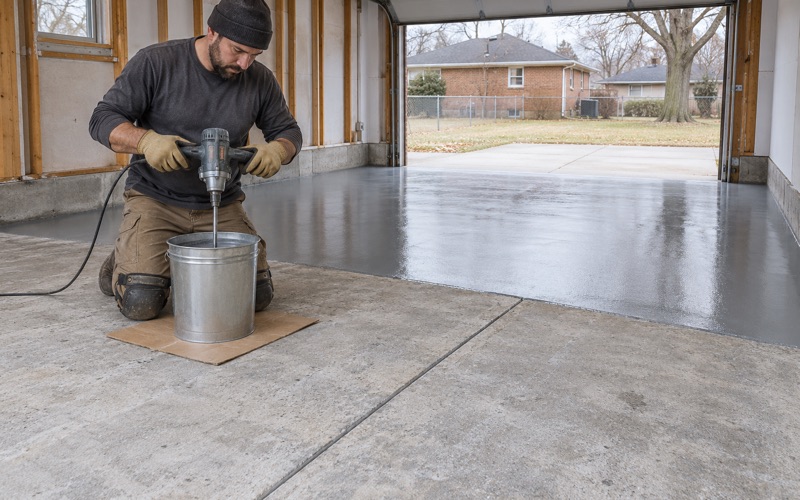
Cure follows slab temperature and the dew point spread at the surface, not the calendar. A warehouse bay that sits unheated through deep winter is told to wait, because a coating cured too cold can show amine blush and a weak bond.
Rules That Travel With a Dyer Job
Every contractor working in Dyer registers with the Town of Dyer Building Department each year. The registration carries a $50 fee, a $5,000 bond recorded at the Lake County Government Center in Crown Point, at least $500,000 in liability insurance naming the town, and proof of workers’ compensation, and it expires December 31.
We confirm that registration is current before a job is booked, and we schedule work to begin within 90 days of the permit, since a Dyer permit lapses if it does not. Home jobs also get a written contract carrying the items Indiana’s Home Improvement Contracts Act lists, signed before any grinding starts.
St. John Township, which includes Dyer, sits inside the Lake County part of the Chicago 2015 ozone nonattainment area, and Indiana’s 326 IAC 8-14 caps floor coatings at 250 g/L and industrial maintenance coatings at 340 g/L. The rule binds the applicator as well as the seller, so we pick products inside those limits from the first quote.
We also explain what the coating warranty leaves out before the job is sold, and moisture is the first exclusion we name. A coating protects the slab’s surface, and we never sell one as waterproofing.
Home Garages With a Winch and Chain
Rope care is not only a warehouse concern. A Dyer, IN garage that holds a truck winch, tow straps and lengths of chain faces the same logic on a smaller scale, since a dusting slab puts grit on every cable laid across it.
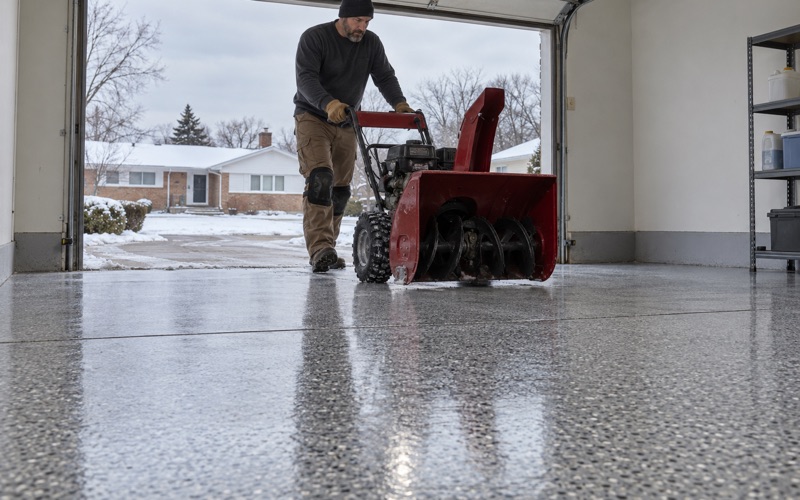
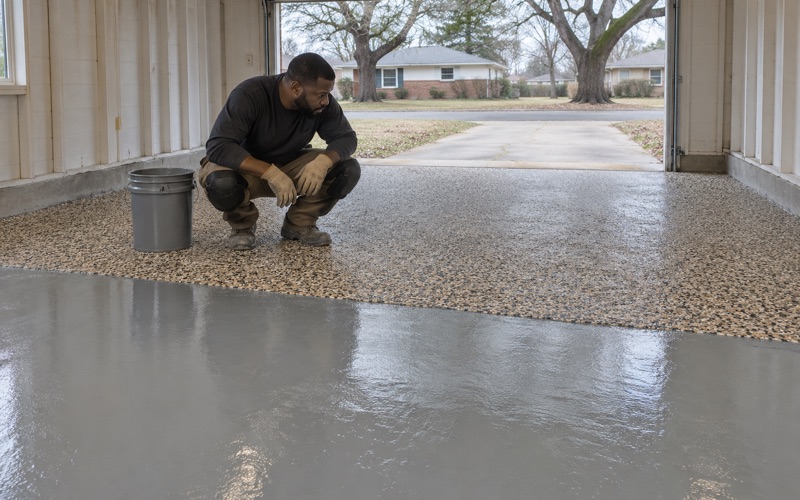
Dyer’s housing is young for the region, with 56.0 percent of units built from 1990 on, though we still test and map every garage slab before calling it ready to coat. For these jobs we usually propose a vinyl flake broadcast with a polyaspartic topcoat that resists hot tire pickup and gives a winch cable a clean surface to lie on.
Whatever the space, a coating from us is never sold as radon reduction or flood protection. It is a sealed, non-dusting wear surface, and in a room where rope, cable and chain meet the floor every day, that is exactly the job it is there to do.
- 20+ Years Coating Concrete
- Written Moisture Testing
- Free Estimates