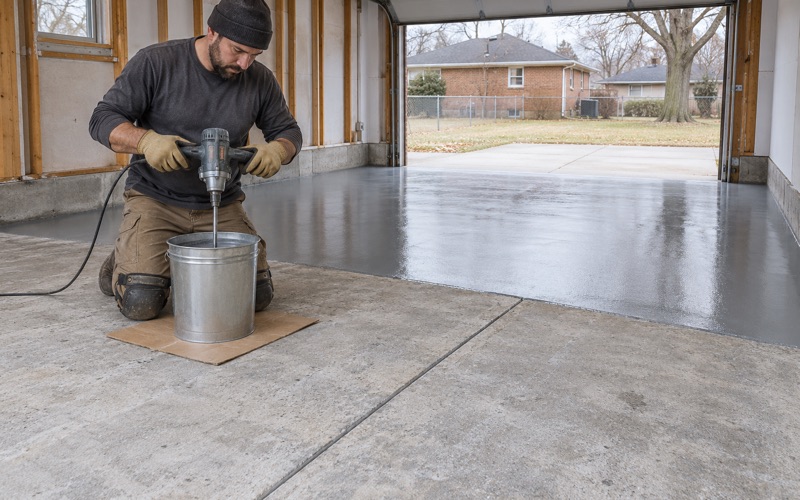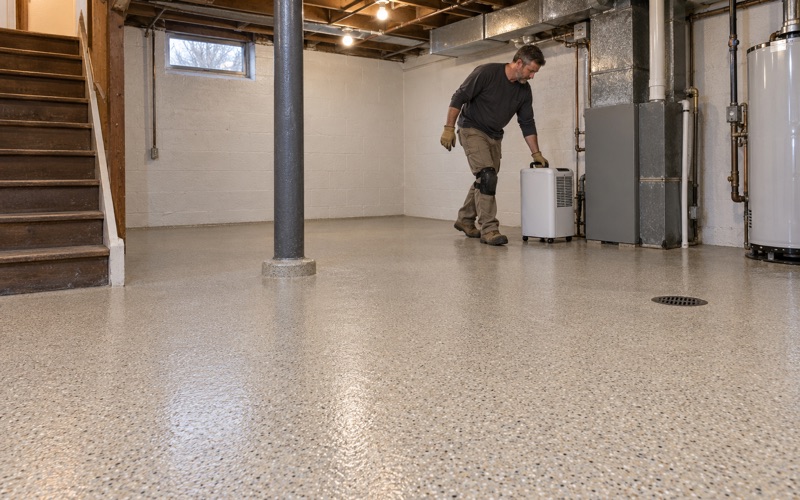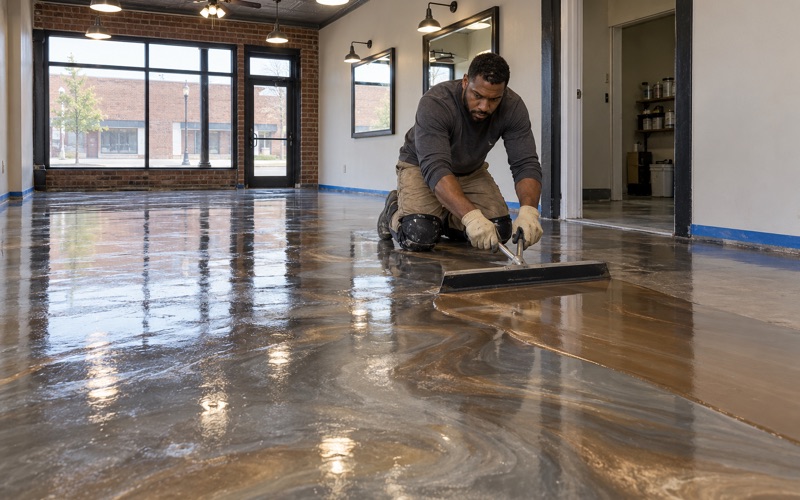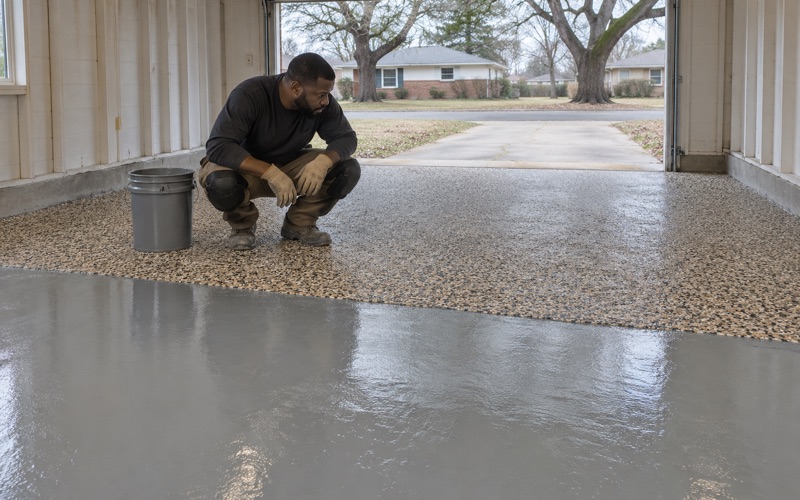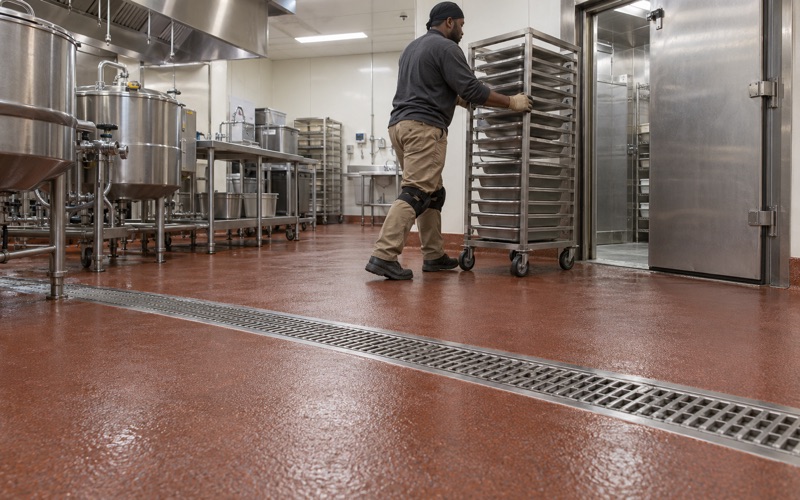
Gary Epoxy Flooring has spent more than 20 years installing epoxy flooring in East Chicago, IN and across Lake County, and the first question on most of our jobs here comes before color or finish: what is already on the slab, and how does it come off? Plenty of basement and garage floors we are asked to coat already carry a coat of paint, sometimes several. That old film has to go before any new system can bond.
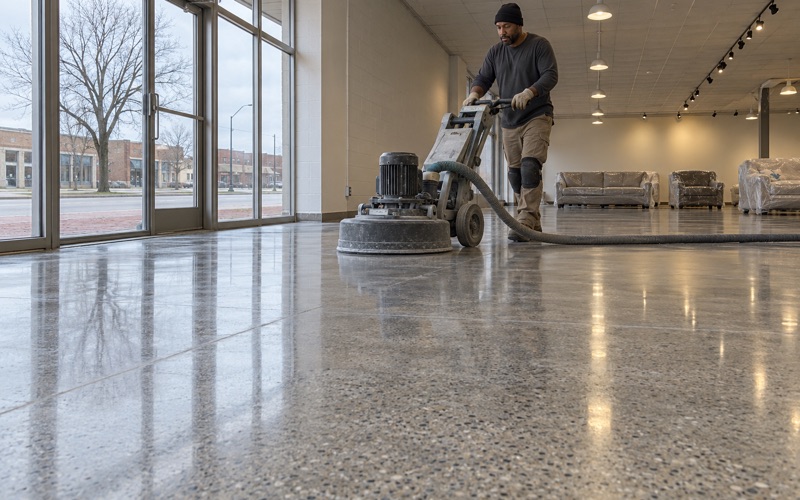
Every slab we coat is opened mechanically, with a diamond grinder or a shot blaster, and never with an acid etch. That gives a 100% solids epoxy or a polyaspartic topcoat a real surface profile to hold. It also means removal is the step where dust is made, and in an older home that dust is the part of the job a federal rule speaks to.
So our first visit is a look and a conversation rather than a price. We map the cracks, the spalls and the old paint, we tell you what the floor needs before it should be coated, and we explain which rules apply to taking the old coating off. The written quote follows that, not the other way around.
The USS Lead Cleanup in East Chicago, IN Neighborhoods
East Chicago, IN is home to the USS Lead Superfund Site, which the U.S. Environmental Protection Agency placed on the National Priorities List in 2009. The residential part of the site, Operable Unit 1, was divided into three zones. Zone 1 was the former West Calumet Housing Complex, and EPA has since proposed deleting that zone from the list.
The site is a federal matter run by EPA Region 5. It is not something a flooring contractor touches, and we have no relationship with EPA, its contractors or any party paying for the work. We describe it here because it is the backdrop to any conversation about dust in an East Chicago home.
Zones 2 and 3
Zones 2 and 3 cover the blocks between E. Chicago Avenue on the north and W. 151st Street and E. 149th Place on the south, running east to Parrish Avenue and lying west of the Indiana Harbor. EPA’s October 2019 newsletter counted 1,078 properties in those two zones. Of those, 791 required exterior soil cleanup at the time of that report.
Those are 2019 figures from one newsletter, not a current tally, and they say nothing about any particular house. What they do show is that lead in this part of the city has been measured yard by yard rather than assumed. That habit of measuring first is the right one to carry indoors.
Lead and arsenic in indoor dust
The same newsletter reported that dust inside the home was collected and tested for lead and arsenic. Samples were taken at 444 homes, and 259 of them needed cleaning, with houses above EPA’s safe levels cleaned with the resident’s permission.
A floor coating is none of that work. Epoxy does not treat soil, does not clean household dust and is not a substitute for anything EPA’s program does. Arsenic, in particular, sits outside the renovation rule we describe next. What a coating job can control is whether stripping an old floor adds fresh dust to the house, and that comes down to how the paint is removed.
Looking for epoxy-flooring closer to Hammond? See Hammond Epoxy-Flooring.
Old Painted Floors in Pre-1978 Homes Fall Under EPA’s Renovation Rule
EPA’s Renovation, Repair and Painting Rule, written at 40 CFR 745, governs work that disturbs painted surfaces in older housing. Indiana does not run its own version of the program, so the federal rule applies here directly under EPA Region 5. Firms that do covered work certify with EPA, and the individual renovators on those crews complete an EPA-accredited course.
The rule matters for floor work in this city because of the housing it covers. A detached house, a two-flat or a three-flat with a painted basement slab is the kind of property it covers when the building predates 1978.
Target housing is anything built before 1978
The rule defines target housing as housing constructed prior to 1978, with limited exceptions for housing for the elderly or disabled and for units with no bedroom, unless a child under six lives there. In East Chicago, 6,425 of the city’s 12,365 housing units, or 52.0 percent, were built in 1939 or earlier, according to the Census Bureau’s American Community Survey.
That figure does not tell us what is on your floor. It does mean a painted basement or garage slab here is very likely in pre-1978 housing, and the paint on it could be any age. Nobody can say a floor contains lead paint by looking at it, so we never do.
Floors are a listed building component
The rule lists the building components it covers, and floors are named among them, along with walls, doors, trim and ceilings. A concrete basement floor painted gray in some earlier decade is a painted building component in the rule’s terms, not an exception to it.
Renovation, in the rule’s language, means modifying an existing structure in a way that disturbs painted surfaces. Grinding a coat of floor paint off a slab fits that description plainly.
The 6 square feet per room threshold
Small jobs are carved out as minor repair and maintenance. Inside a home, that means disturbing 6 square feet or less of painted surface per room. Stripping a basement or garage floor runs far past that in almost every case, which puts paint removal from a whole floor into the category of covered renovation work in target housing.
Stripping Paint by Grinding: Shrouds, HEPA and Sheeting
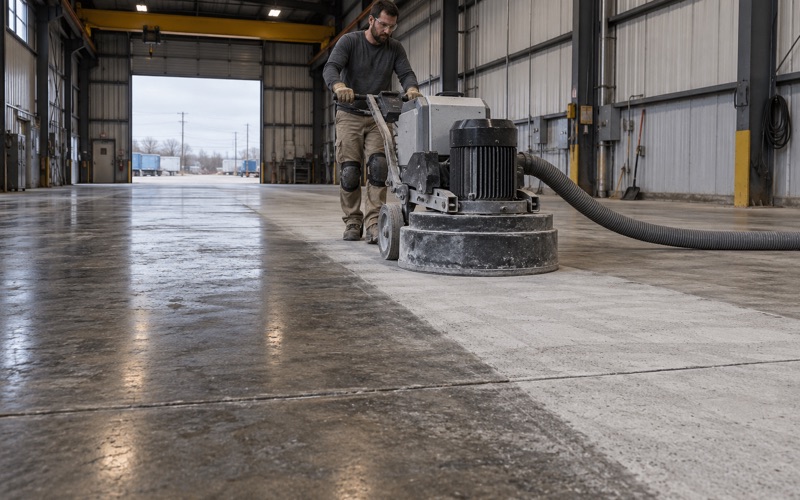
The two ordinary ways to take an old coating off concrete are diamond grinding and shot blasting. Both are high-speed removal, and both are methods the rule restricts on painted surfaces in target housing. Nothing about those machines is banned outright; the rule sets conditions on how they are run.
A shroud and a HEPA vacuum attachment at the machine
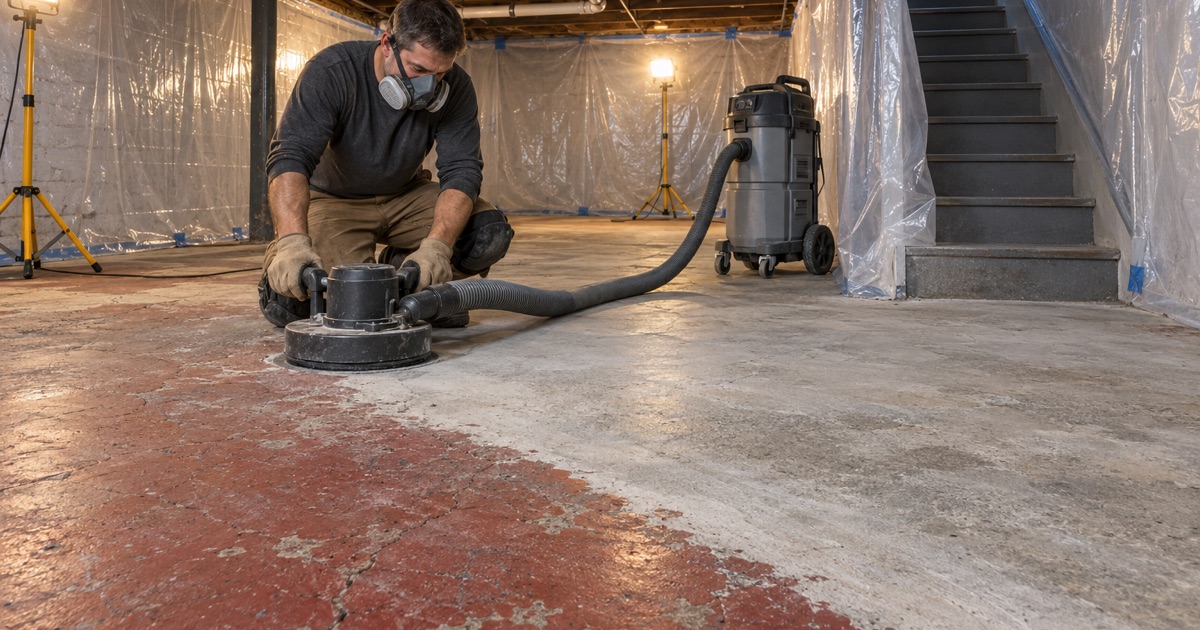
Under 40 CFR 745.85, machines that remove paint by high-speed operation, including sanding, grinding and abrasive blasting, are prohibited on painted surfaces unless they have shrouds or containment systems and are equipped with a HEPA vacuum attachment. That attachment has to collect the dust and debris at the point of generation, right where the cutting head meets the paint.
That lines up with how we already run every slab. Grinding dust is captured at the machine with a vacuum, never swept loose and never rinsed toward a floor drain. On a painted floor in an older East Chicago home, the rule makes shrouded, HEPA-equipped capture a requirement for whoever does the stripping.
Sheeting 6 feet beyond the work
The rule also requires the floor surface in the work area, including installed carpet, to be covered with taped-down plastic sheeting or another impermeable material extending 6 feet beyond the perimeter of the surfaces being renovated. On a full-floor strip, that protection can reach past the doorway into whatever space adjoins the room.
Those steps shape the schedule. Setup, containment and cleanup take real time, and a quote that skips them is a quote for a different job.
Bare concrete versus painted concrete: testing before the quote
A slab that has never been painted is ordinary surface preparation. A painted one in pre-1978 housing raises the question of what the paint is, and the honest answer comes from testing the existing coating before a removal method is chosen. We tell you up front which case your floor appears to be and what that means for how the old paint comes off.
When removal falls under the rule, it is work for an EPA-certified firm. We will say that plainly before anything is sold, rather than letting it surface halfway through a job.
Two-Flats, Three-Flats and Rented Houses: Who Arranges the Work
East Chicago is a majority-renter city. Renters occupy 57.1 percent of its occupied homes, detached houses make up 41.0 percent of its housing units, and buildings of two to four units account for 29.0 percent. A basement floor in one of those buildings often serves several households at once.
Owners, landlords and tenants
The decision to strip and coat a shared basement floor belongs to the property owner, not to a tenant who would like a cleaner laundry area. We write the scope with the owner. When people living in the building would be affected by the work, we raise that early so the owner can plan access, timing and notice.
For a home job, the owner signs a written contract covering what Indiana’s Home Improvement Contracts Act requires it to contain before any grinding begins. City permit and bond requirements are checked with the City of East Chicago Building Department before the job is booked.
The new coating, once the old one is off
After the floor is bare, the job becomes the one we do everywhere else. A moisture test is written into the scope before the price is final, and the proposal states which test, such as ASTM F2170 in-situ relative humidity probes or ASTM F1869 calcium chloride testing, along with the reading the slab must meet. Older basements can show efflorescence, and moisture is the first exclusion we explain when we go over what a coating warranty does not cover.
The proposal also lists the product line, coat count and finished thickness, giving you something concrete to hold the finished floor against. Like the rest of North Township, East Chicago falls within the Lake County portion of the Chicago 2015 ozone nonattainment area, and Indiana’s 326 IAC 8-14 holds floor coatings to 250 grams per liter. That limit binds us as the applicator, and we choose products inside it.
We time the cure by slab temperature and the gap between surface temperature and dew point rather than by the calendar. In an unheated garage in deep winter, our advice is to wait for warmer weather. Garage systems get a broadcast and topcoat chosen to stand up to the rock salt and brine that come in on tires, and a slip-resistant texture is specified by the materials used.
One more line we keep: a floor coating is a floor finish. It is not waterproofing, not radon reduction and not a remedy for lead in a home, and we will not describe it as any of them.
- 20+ Years Coating Concrete
- Written Moisture Testing
- Free Estimates