Gary Epoxy Flooring has spent more than 20 years on epoxy flooring in Evergreen Park and across the region, and the floors we think hardest about here are the ones that get dusted rather than splashed. A kitchen, bakery or prep room that works with flour and sugar carries a slip risk most people never picture, because nothing on the floor looks wet. The floor still has to give a shoe something to hold.
That changes how a coating is chosen. Gloss photographs well, but a smooth, glassy topcoat under a film of fine powder can behave like a polished floor under a scatter of tiny ball bearings. We size the texture to what actually lands on the slab, then write that texture into the proposal by the broadcast and topcoat used, so it is a specification you can check rather than a promise.
The same logic scales down. A home baker’s basement kitchen, a pantry corner where flour bins get refilled, or a garage that doubles as a holiday cookie room all collect the same kind of dust, just less of it. The sections below walk through why powder matters, how roughness gets matched to it, how a dusty floor should be cleaned, and what all of it means inside a house.
Paczki by the Tens of Thousands, and Flour on Every Surface
On 95th Street, Wolf’s Bakery shows what a working bakery’s season looks like. The shop at 3241 W. 95th St. has been baking since 1939 and has been owned by the same family since 1991. During the 2026 season, local reporting says the staff fried, filled and dusted more than 24,000 paczki, offered 18 varieties on Paczki Day, and saw a line down 95th Street before sunrise.
We have no relationship with Wolf’s, and we have not seen its floors or how it cleans them. We mention it because it makes the numbers concrete: tens of thousands of pastries rolled, fried and finished in powdered sugar means fine powder in the air and on the floor for weeks at a stretch. Any bakery, restaurant pastry station or commercial kitchen in the village faces the same physics at its own scale.
Why dry powder is a slip hazard of its own
Most people think of slips as a water problem. The UK Health and Safety Executive, Britain’s workplace safety regulator, says otherwise: its research on dry contaminants states that powders such as flour in the food industry can lead to a significant slip risk. A thin layer of fine particles sits between the shoe sole and the floor and lets the two slide past each other.
That guidance comes from Britain, not from any Illinois or US rule, and we treat it as trade knowledge rather than a legal standard. What it tells a floor owner is practical. A dry floor is not automatically a safe floor, and a coating that feels grippy when clean can lose much of that grip under a dusting of flour or sugar.
Wet and dry together
Bakeries rarely get only one contaminant. Fryer oil, glaze drips, filling, mop water from a wash sink and condensation off a cooler door all meet the powder, and a damp paste of flour and sugar is often slicker than either one alone. That combination is why we ask what happens at each station, not just what the room is called, before we recommend a finish.
Looking for epoxy-flooring closer to Crestwood? See Crestwood Epoxy-Flooring.
Surface Roughness Matched to What Lands on the Floor
The most useful single case we know on this subject is another HSE study, this one at a filled-pastry factory where slip injuries led an inspector to serve an Improvement Notice. The plant found that removing every trace of water and ingredients from the floor was not practical. Instead, it looked at the floor surface room by room.
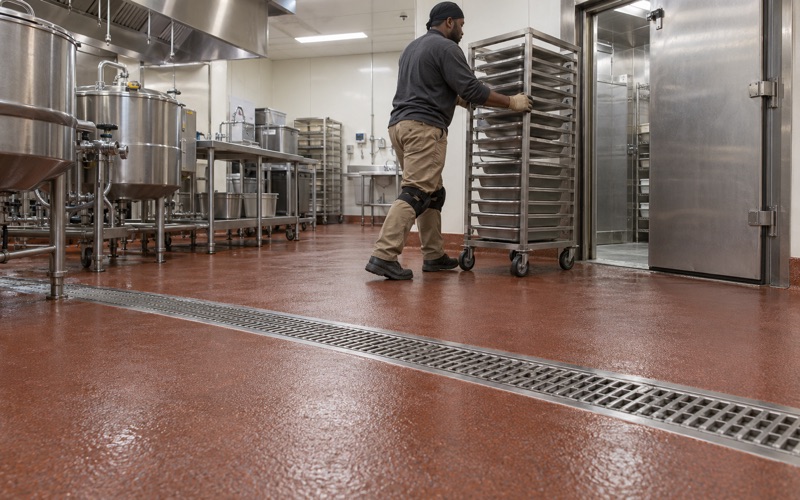
In the wet tray-wash area, the micro-roughness of the existing floor gave good slip resistance without compromising hygiene. In pastry preparation, the same report found that the floor surface roughness was not enough to cope with the type and extent of contamination there. Drip trays around machines and conveyors, non-clogging footwear and better spill cleaning cut slip accidents to less than a quarter of what they had been.
Picking texture by contamination, not by looks
The lesson we take from that case is that roughness is not one setting for the whole building. A wash-down corner with clean water needs a different surface from a bench line where flour and sugar fall all shift. We specify each zone by the aggregate size and how it is locked in, then say so in writing.
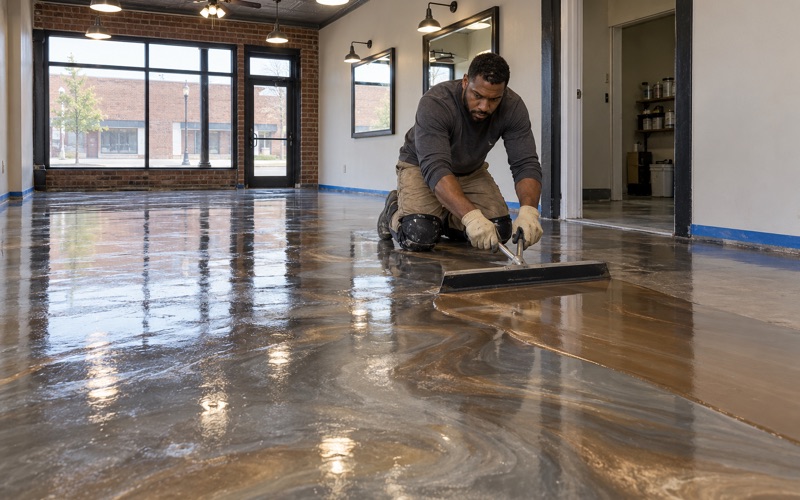
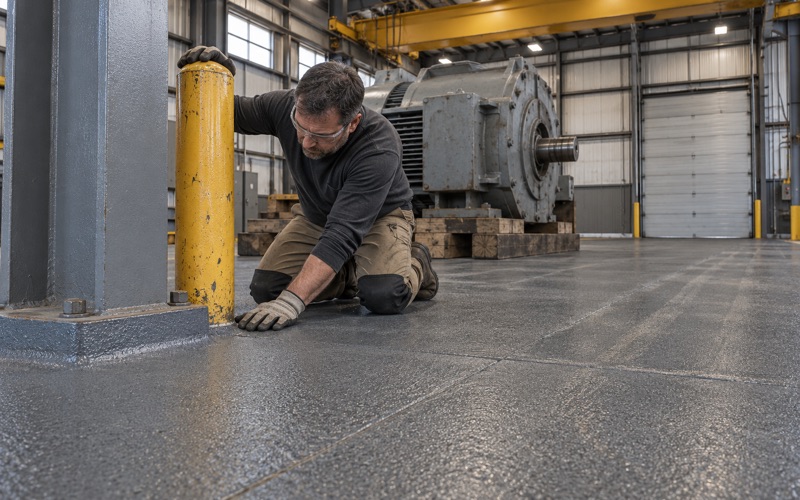
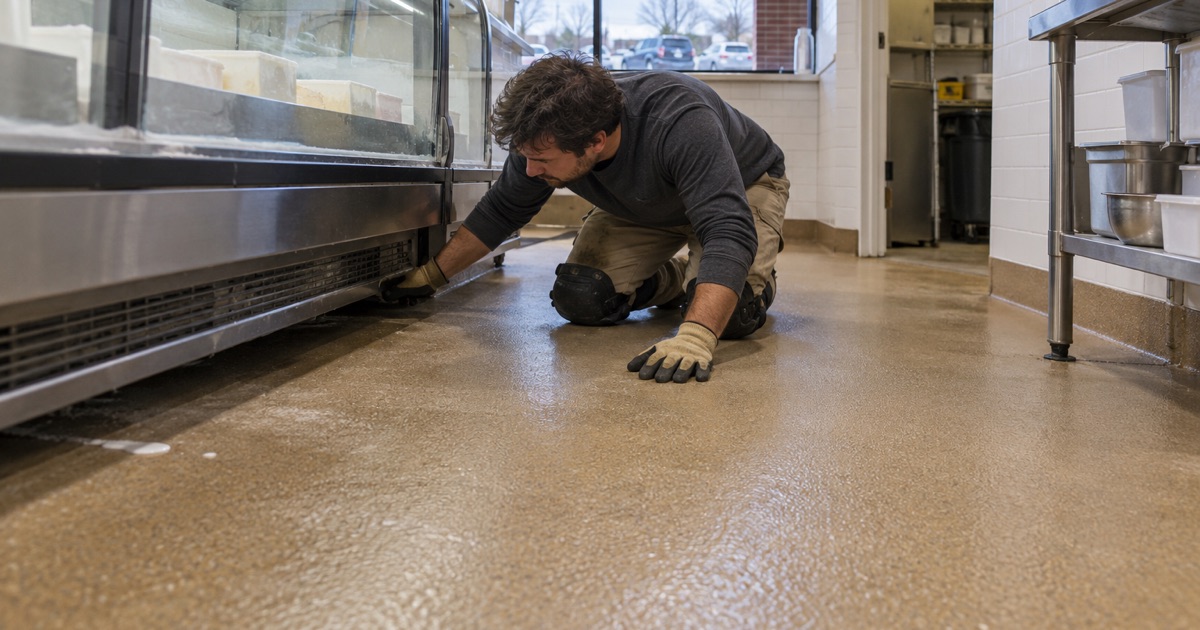
In practice that means a quartz aggregate broadcast into 100% solids epoxy, sealed with a topcoat that leaves the texture standing rather than burying it. A heavier broadcast and a thinner final coat give more bite under powder; a finer one is easier to clean in a room that sees mostly water. No floor removes all slip risk, and we do not quote a friction number we have not measured, but the texture can be matched to the mess.
What the slab underneath has to allow
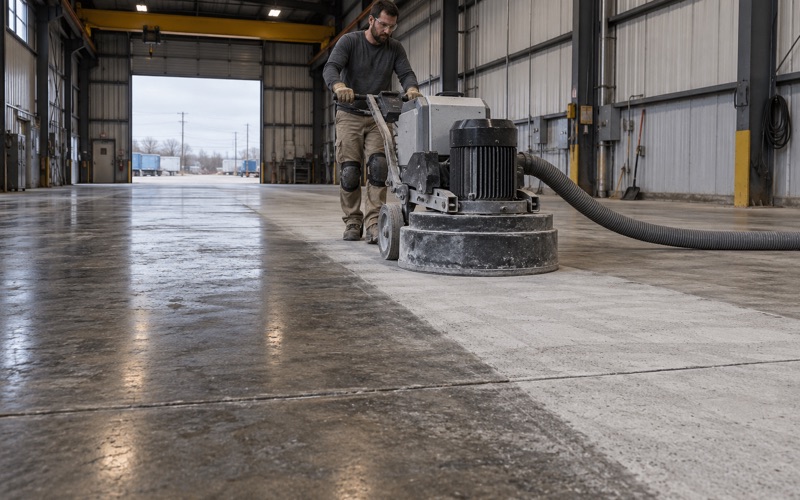
Texture only holds if the coating stays bonded. Every slab we coat is opened with a diamond grinder or a shot blaster, never acid etched, so the resin has a real profile to grip, and we map cracks, spalls and old paint before pricing. A moisture test is written into the scope before the price is final, with the test method and the number it has to pass named in the proposal.
For a commercial space in the village, the building side matters too. The Evergreen Park Building Department at 9418 S. Kedzie Avenue requires a numbered contractor license before any permit issues, a permit for any alteration or repair, and a sworn statement of total project cost, and we check those rules before a job is booked. Where new commercial slab work is part of the project, the village calls for VisQueen and wire mesh throughout.
Collect the Dust, Do Not Spread It
A textured floor that is cleaned badly can end up worse than a smooth one. Dry sweeping a bakery floor mostly moves flour around: some goes back into the air, some lands two feet away, and a fine layer settles into the texture where the next shoe meets it. The goal is to pick the powder up and take it out of the room.
Vacuum first, then wet clean
On the floors we coat, we recommend capturing loose powder with a vacuum before any water touches it, then wet cleaning with a deck brush or auto-scrubber that can reach into the texture. Wetting a heavy layer of flour first turns it into paste that smears across the floor and fills the very roughness that was specified for grip. The HSE pastry plant’s own result, where better spill cleaning was part of the fix, points the same way.
We also look at where the dust starts. Drip trays under fillers and glazers, a mat zone at the bench line and a clear path between stations reduce how much powder reaches the open floor. None of that is a floor product, but it decides how well any floor performs.
Matching the topcoat to the cleaning routine
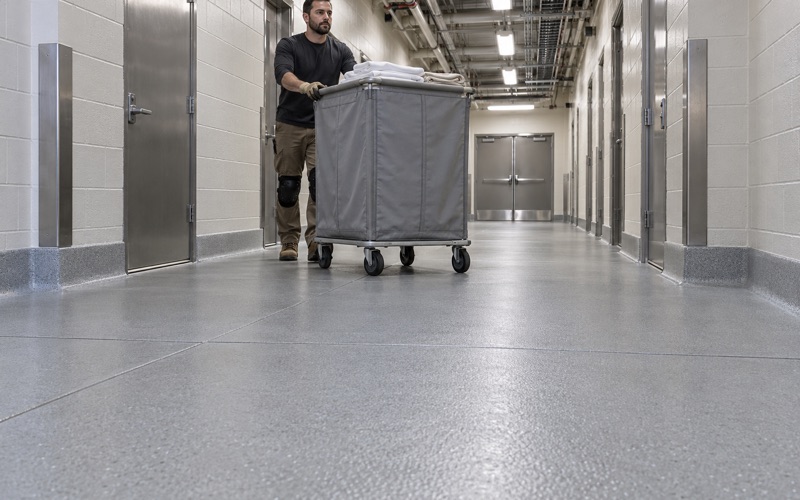
Daily wet cleaning with degreasers and hot water is hard on a finish. We choose a topcoat, often a polyaspartic or a urethane cement system in hot or heavily washed rooms, that holds up to the chemicals and temperatures the staff actually use. If the cleaning plan calls for a product the coating cannot take, we say so before the job is sold, along with what the warranty leaves out; moisture is the first exclusion we name.
Baking Corners, Pantries and Basement Kitchens at Home
Most of the floors we coat in Evergreen Park are not commercial at all. The village is largely detached houses from the 1940s and 1950s, so a basement or garage slab here has usually been in service since one of those decades, often under old paint, patches or sealer. Plenty of those basements hold a second refrigerator, a chest freezer and a work counter that comes alive every holiday baking season.
The same dust, at a smaller scale
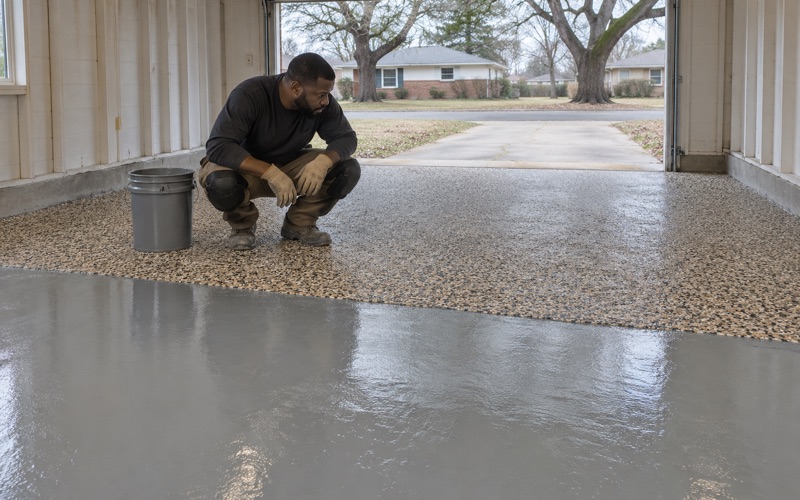
A family that turns out dozens of cookies or a few batches of paczki in a basement kitchen puts flour and powdered sugar on the floor the same way a bakery does. The difference is footwear: people at home walk in socks or slippers, which slide easily on a smooth finish once powder settles. For those rooms we usually suggest a vinyl flake broadcast with a textured topcoat, or a light quartz broadcast near the counter, rather than a high-gloss metallic look.
Cleaning follows the bakery rule at a smaller scale. Run a vacuum over the floor before mopping, and keep a washable mat at the counter where most of the flour falls.
Older slabs and basement water
A 1950s basement slab can carry moisture coming up from below, and that is the condition most likely to lift a new coating. That is why the moisture test comes before the quote, not after a coating fails. A floor coating is not waterproofing or flood protection, and we never sell it as either.
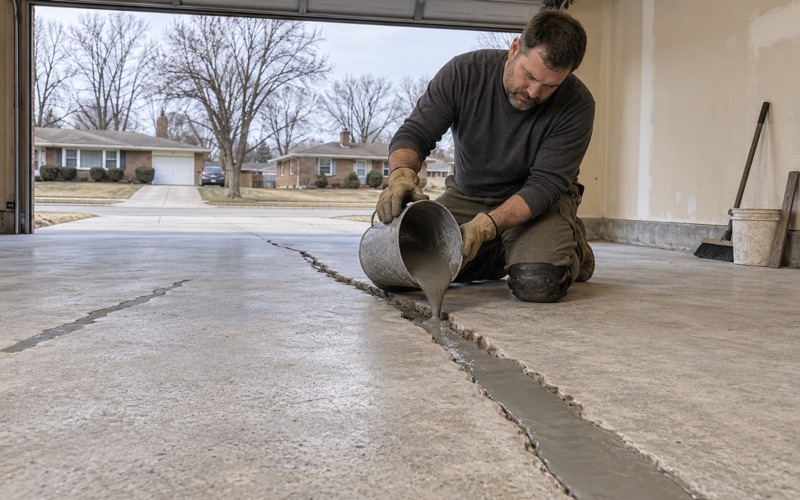
What we do is grind off what is loose, repair what is cracked and tell you plainly if the floor should be fixed or replaced before it is coated. Cure times follow slab temperature and dew point, so a cold garage in deep winter waits. The result is a floor sized to the dust and spills that really land on it, written down so you can hold the finished job against the quote.
- 20+ Years Coating Concrete
- Written Moisture Testing
- Free Estimates