
Gary Epoxy Flooring installs epoxy garage floor systems in Gary, IN, serving surrounding cities including Lake Station, Griffith, Highland, Hobart and East Chicago. With 20+ years spent grinding and coating concrete, we build garage floors the slow way that lasts: the slab is opened with a diamond grinder, tested for moisture, repaired, and then coated in multiple layers that bond into the concrete instead of sitting on top of it.
A garage floor in Northwest Indiana takes more abuse than most rooms in the house. It carries the weight of vehicles, takes hot tires straight off the road, and spends every winter under a film of melted snow, rock salt and calcium chloride brine. A coating that survives that has to be specified for it from the first grind to the last topcoat.
Every proposal we write names the moisture test and the reading it has to pass, the product line, the number of coats and the finished thickness. That lets you hold the finished floor against the quote, and it gives a clear record if anything ever needs to be checked later.
What Goes Into a Garage Floor Coating System
Diamond Grinding Instead of Acid Etching
Acid etching is the method on the back of most hardware store kits, and it leaves a shallow, uneven surface with residue in the pores. We open the slab with a walk-behind diamond grinder tied to a dust-collecting vacuum, cutting to a concrete surface profile the coating manufacturer rates for bonding.
Grinding also removes the weak top layer of a garage slab, called laitance, along with old sealers, paint drips and oil stains that would block adhesion. Anything left on the surface becomes the weakest point of the floor, so we grind until what remains is clean, sound concrete.
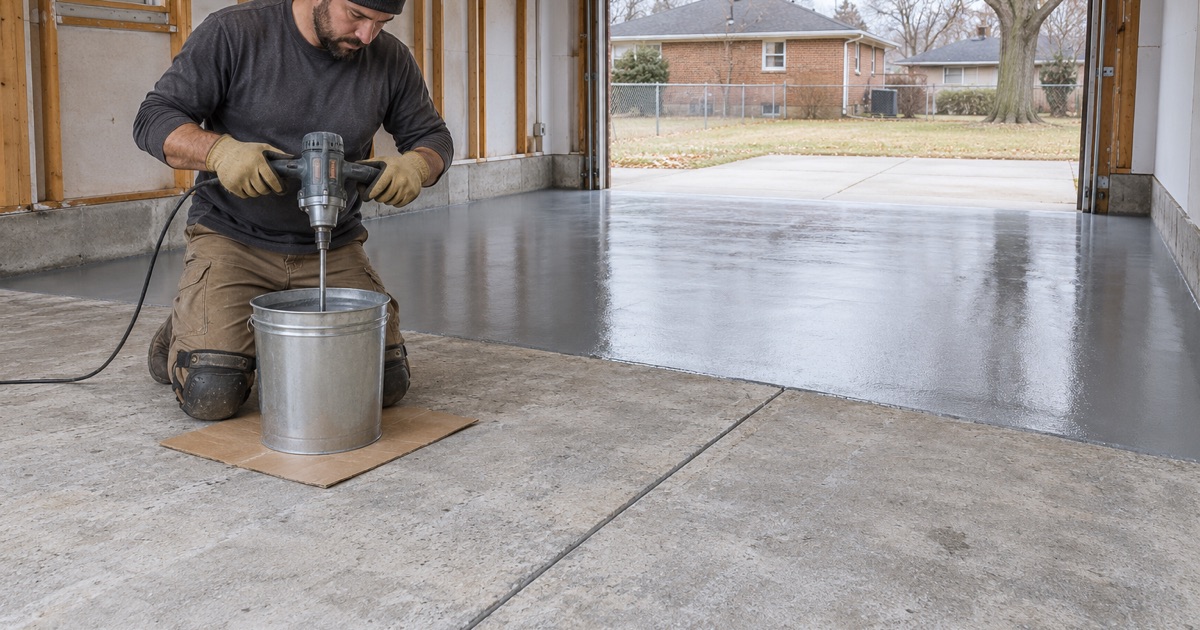
A 100% Solids Epoxy Base Coat
The base coat is the layer that bonds to the concrete, so we use a 100% solids epoxy that goes on thick and soaks into the ground profile. Unlike water-based kit epoxy, which loses much of its thickness as it dries, a solids-rich base keeps its film build and gives the broadcast something substantial to lock into.
On slabs with minor pitting or rough patches, the base coat also levels the surface. Where the moisture test calls for it, a moisture-mitigation primer goes down first, and the base coat bonds to that primer instead of directly to the slab.
Flake Broadcast and a Polyaspartic Topcoat
While the base coat is still wet, we broadcast vinyl flake across the whole floor until it is fully covered, then scrape and vacuum the excess once it has set. A full broadcast adds texture, hides small slab imperfections, and gives the topcoat a thicker body to protect.
The finish is a clear polyaspartic topcoat, which resists abrasion, chemicals and ultraviolet light far better than an epoxy clear coat. Garages with doors open to the afternoon sun stay their original color instead of ambering, and the hard surface holds up to tires, jack stands and dropped tools.
Why Northwest Indiana Garages Need More From a Coating
Winter Brine and Rock Salt
Every car that comes in from a salted road drips brine onto the floor, and on bare concrete that brine soaks in, refreezes and scales the surface away. A properly built coating keeps salt water on top of the floor, where it can be squeegeed toward the door instead of working into the slab.
Thin coatings fail under brine because the salt water finds every pinhole and edge, creeps underneath and lifts the film. Building the system in multiple coats with a full broadcast closes those paths, which is why we size the system to a lakeshore winter rather than to a showroom.
No Vapor Barrier Under Many Garage Slabs
The residential code allows a garage slab to be poured without the vapor retarder required under living space, and many older garages in Gary were built that way on sandy, damp ground. Moisture moving up through that slab pushes against any coating above it, causing blisters and peeling from underneath.
That is why moisture testing is part of the written scope. We use ASTM F1869 calcium chloride tests or ASTM F2170 relative humidity probes, and the proposal states the number the slab has to pass before coating goes ahead.
Cold Slabs and Cure Schedules
Epoxy and polyaspartic resins cure by chemical reaction, and a cold slab slows that reaction or stops it from finishing. A coating laid on a slab that is too cold, or too close to the dew point, can stay tacky, turn cloudy, or form an oily amine blush that blocks the next coat from bonding.
We check slab temperature and the dew point spread at the surface before every coat, not just the forecast. In an unheated detached garage during deep winter, the honest answer is often to wait until spring, and we say so before taking a deposit.
Our Step-by-Step Epoxy Garage Floor Process
Step 1: Slab Assessment and Moisture Test
We walk the garage, map cracks, spalls, old coatings and oil-soaked areas, and run the moisture test. You receive a written proposal with the prep method, any repair work, the system, coat count, thickness and price.
Step 2: Grinding and Dust Control
On install day, the floor is cleared, walls and storage are covered, and the slab is ground edge to edge. Dust is captured at the grinder with a vacuum, and nothing is rinsed out the door toward a storm drain.
Step 3: Crack and Spall Repair
Cracks are chased with a diamond blade and filled, spalls are rebuilt with a rigid repair material, and the repairs are ground flush. Control joints are either honored or filled, depending on the system and your preference.
Step 4: Base Coat, Broadcast and Topcoat
The base coat goes down, flake is broadcast to full coverage, and the excess is removed once set. The polyaspartic topcoat seals the floor, with grit added where you want extra traction.
Step 5: Cure and Return to Service
We leave written cure times for walking and for parking based on the slab conditions that day. The garage stays closed until the floor is ready, so the first hot tire does not mark a soft coating.
Garage Floor Problems We See Before We Coat
Hot Tire Pickup From Earlier Coatings
Many garages we see already have a coating peeling in two strips where the tires sit. That is hot tire pickup: a warm tire softens a thin coating, and when it cools on the floor, the tire pulls the film off as the car leaves. We grind that coating off completely and rebuild with a bond and topcoat hardness that resists it.
Cracked, Spalled or Settled Slabs
Hairline shrinkage cracks and small spalls are normal in an older garage and are repaired as part of the job. A slab that has heaved, sunk in sections or broken into pieces is another matter, and we will recommend replacing those sections before any coating rather than selling a floor that cannot hold together.
Oil Stains and Contaminated Concrete
Years of oil drips soak deep into concrete and keep weeping back up through a coating if they are not dealt with. We grind contaminated areas deeper, degrease them, and test the result before coating, because oil left in the slab will release the coating above it.
- 20+ Years Coating Concrete
- Written Moisture Testing
- Free Estimates