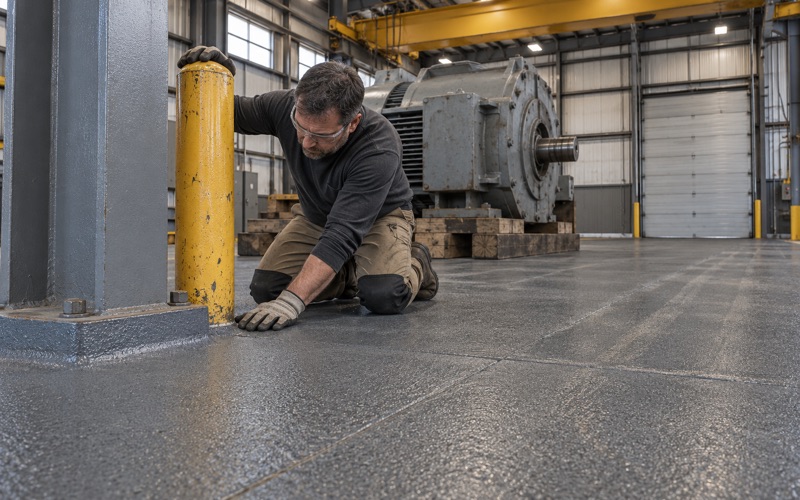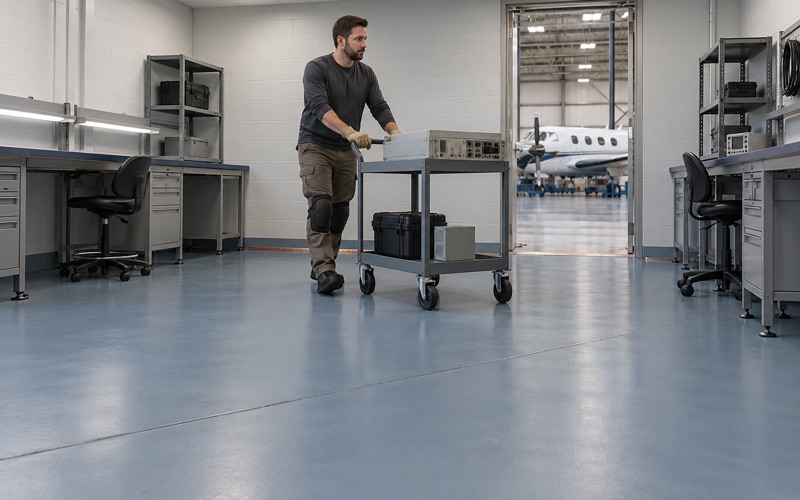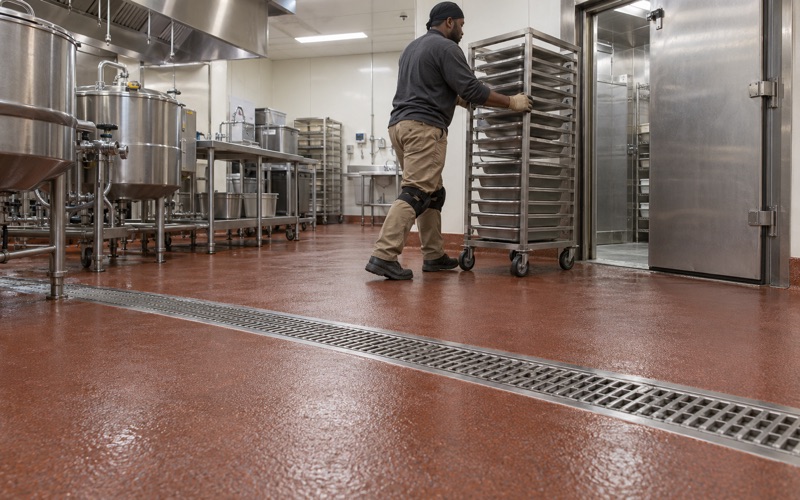
Gary Epoxy Flooring has spent more than 20 years putting down epoxy flooring in Griffith, IN and across Lake County, and the floors we think hardest about are the ones that stay wet for a living. A machine shop floor is one of them. Water-mixed coolant reaches the concrete every shift, and bare concrete drinks it.
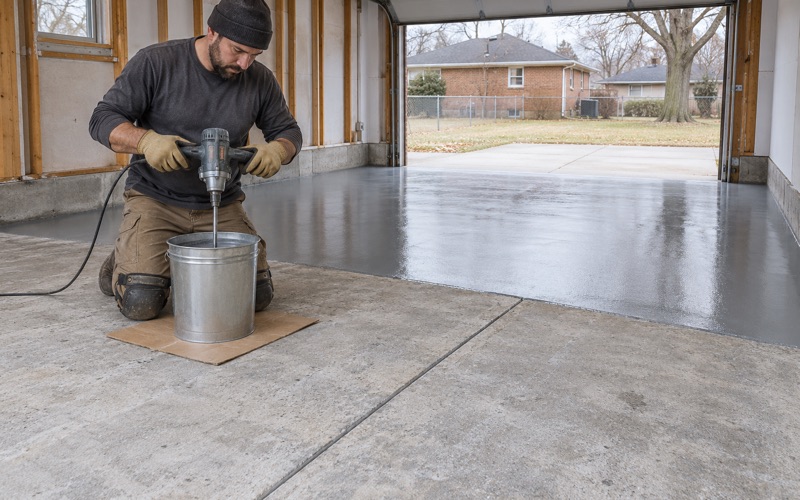
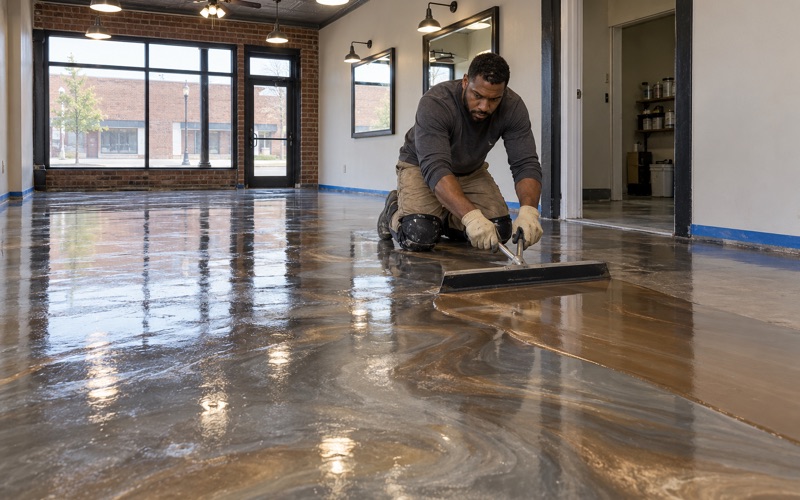
Our answer is a seamless, nonabsorbent coating built for that wetness. The slab is opened by diamond grinding or shot blasting rather than acid, a 100% solids epoxy body coat goes down, and a textured topcoat takes its grip from a named aggregate broadcast. The written proposal lists the product line, how many coats go down and the finished thickness, so the floor in front of you can be measured against the paper.
Before any of that is priced, we test the slab for moisture, map its cracks and spalls, and tell you plainly when a section should be repaired or poured again first. A coating laid over a failing slab fails with it, no matter how good the resin is.
A Steel-Mill Mandrel Shop and the Coolant Around Big Machines
What gets rebuilt at 739 S. Arbogast Street
Aeromet Industries works out of a 25,000-square-foot facility at 739 S. Arbogast Street in Griffith, IN, designing, building and repairing mandrels for steel-mill coil handling. Its own site lists recoiler, uncoiler, stub, tension, hot strip and cold-mill clamshell mandrels, with repair work that runs from equipment assessment and disassembly through inspection, testing and rebuilding. It also describes reverse engineering and CNC machining, and says it has been in business for more than 45 years.
The machine list reads like a steel producer’s maintenance department moved indoors. A CNC Union floor-type boring mill carries 394 inches of X travel, and a CNC lathe offers 395 inches of Z travel with a 69-inch swing. Mazak lathes, a Giddings & Lewis VBM, horizontal boring mills and a vertical mill fill out the list.
We have no connection to the company and have not seen its floors or how it handles fluids. We bring it up because it shows the kind of work done in Griffith, IN, and because machine tools of that size share one condition with every lathe in town, large or small.
Coolant: the fluid machine tools put on the floor every day
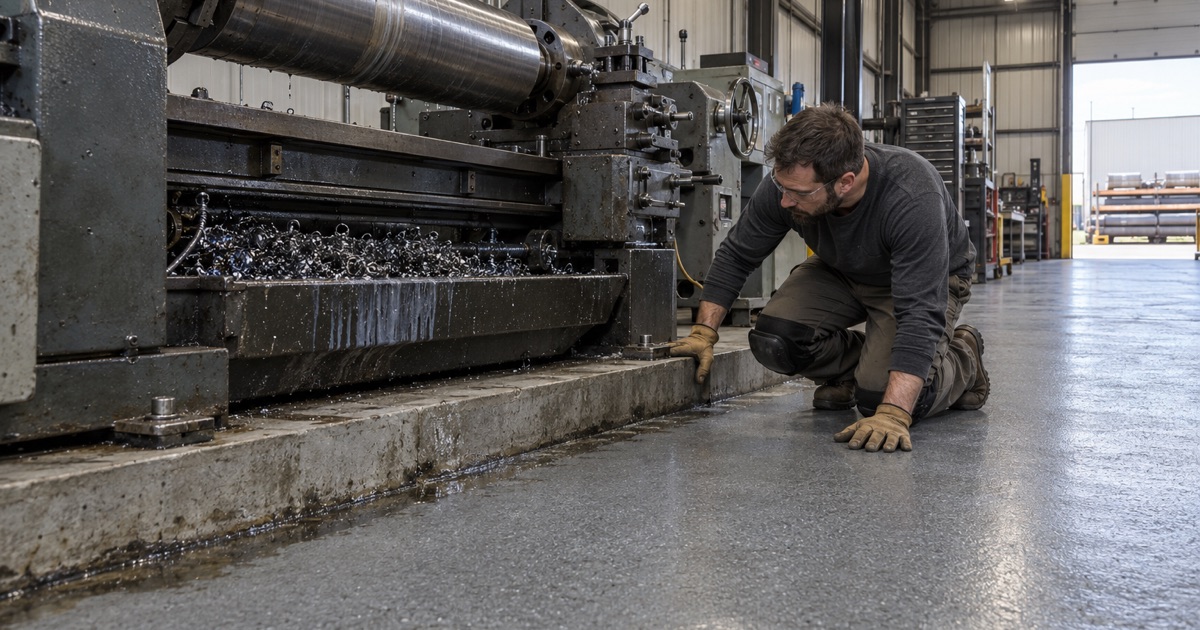
Around most metal-cutting machines, the floor’s daily load is not a spilled drum. It is water-miscible coolant, the mix of concentrate and water that cools the cut and flushes chips away. It reaches the floor as splash past a worn guard, as drips from a part lifted out of the machine, and as the film that rides out on a basket of chips.
Coolant rarely arrives clean. Tramp oil, meaning hydraulic fluid, gear and spindle oil, way lube and grease that leak into the sump, floats in it and comes out with it. On bare concrete the water carries that mixture into the pores, and what soaks in stays there.
Why soaked concrete starts to smell
OSHA’s metalworking-fluids manual notes that a fluid turning gray or black usually means bacteria, and that a bad smell signals uncontrolled microbial growth. Coolant held in a porous slab sits beyond the reach of any sump maintenance, so it is free to sour where nobody can treat it.
That is the core case for a seamless coating near machines. A film with no pores and no open joints keeps the fluid on top, where it can be squeegeed, collected and washed off, instead of in the concrete, where it lingers.
Looking for epoxy-flooring closer to Highland? See Highland Epoxy-Flooring.
Wet and Slippery: What OSHA’s Metalworking-Fluids Manual Asks
Splash guards come first
OSHA’s Metalworking Fluids: Safety and Health Best Practices Manual is advisory guidance, not a standard, and we treat it that way. Among the hazards it lists beyond the fluid itself are wet and slippery work surfaces. Its first answer is not a floor at all: well-designed enclosures and splashguards keep fluid from spilling onto the ground, and existing ones should be maintained.
A coating does not replace any of that. If a guard is cracked or missing, the floor will be wet no matter what it is made of. We say so during the walk-through, because a floor sold as a substitute for guarding would be sold on a false promise.
Spills cleaned up immediately
The manual’s housekeeping line is short: on a day-to-day basis, spills should be cleaned up immediately. How quickly that happens depends partly on the floor. Coolant on bare, dusty concrete smears into a slick paste and soaks in at the edges, while on a sealed, nonabsorbent surface it stays a puddle that a squeegee moves in one pass.
The edges matter as much as the open field. Coolant collects where the floor meets a machine base, a chip-conveyor pit or a wall, so we carry the coating up as a cove or finish it with a sealed edge at those lines. That leaves no raw joint for fluid to find and no seam for a mop to push it into.
Texture where floors stay oily
When floors of the work area are oily, the manual says safety shoes with slip-resistant soles should be provided. Footwear is the shop’s decision; the floor’s job is to give those soles something to work against.
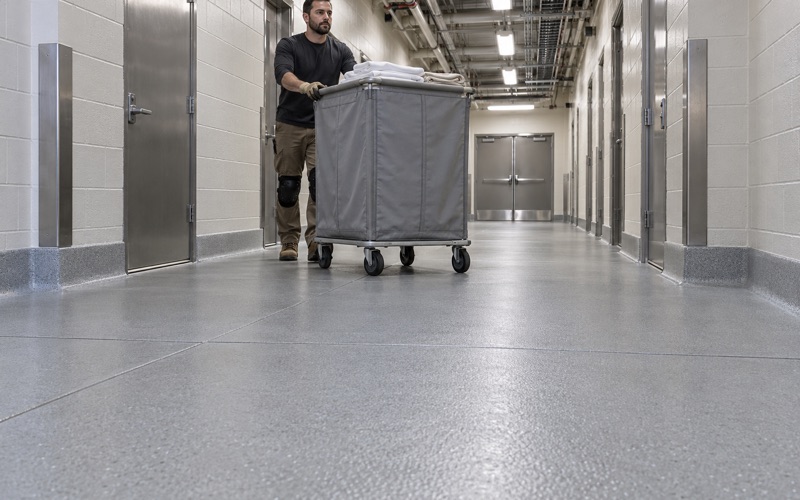
We build that texture into the system rather than promising it as a slogan. A quartz aggregate broadcast into the body coat and locked down by the topcoat sets the grip, and the proposal names both so the texture can be checked. No coated floor is slip-proof under a film of coolant and tramp oil, and we will not describe one that way.
The trade-off is cleaning effort. A coarser texture holds footing better and takes more scrubbing, so we often set it by zone, heavier beside the machines and finer in the aisles where carts and foot traffic move.
Keeping Coolant Out of the Slab and Wash Water Out of the Coolant
The other half of the housekeeping rule
OSHA’s manual adds a line that floor care affects directly: wastes, including floor wash water, should not be dumped or swept into metalworking-fluid sumps or coolant return trenches. Dirty wash water carries soap, grit and whatever was on the floor straight into the fluid the machines depend on.
So a floor near machine tools needs a cleaning routine that collects its own water. We talk through where the wash water goes before the layout is final: which way the squeegee pushes, a sealed curb or finished edge at the trench lip so mop water does not spill over, and a wet vacuum or auto-scrubber that picks up what it puts down.
Prep that opens the slab without flooding it
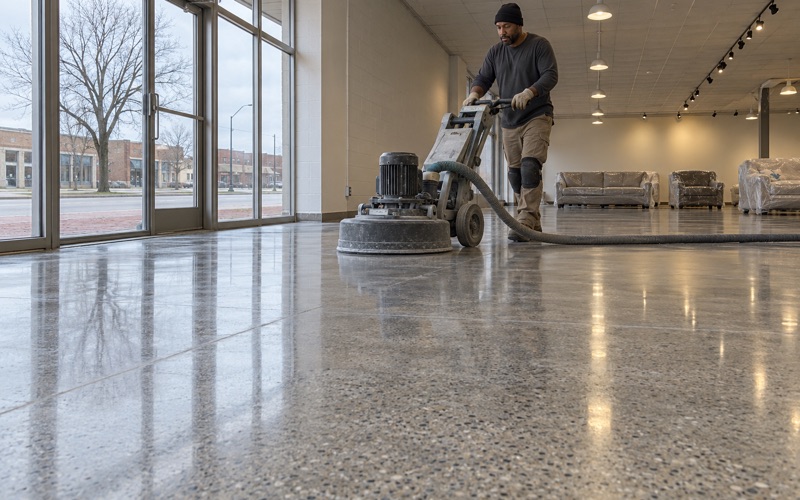
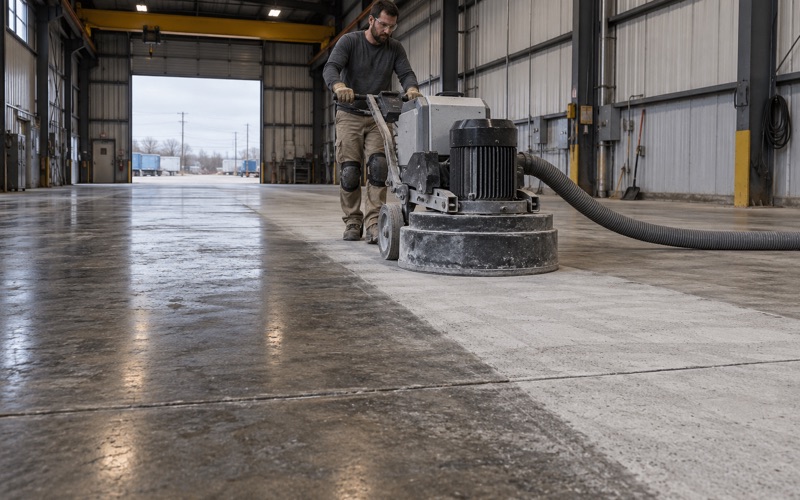
The same thinking runs through our own work. Every slab is opened mechanically, by diamond grinding or shot blasting to the ICRI concrete surface profile the coating calls for, never by acid etching, which puts liquid on the floor and leaves residue behind. Grinding dust is captured at the machine by vacuum, so nothing gets rinsed toward a floor drain or into a trench.
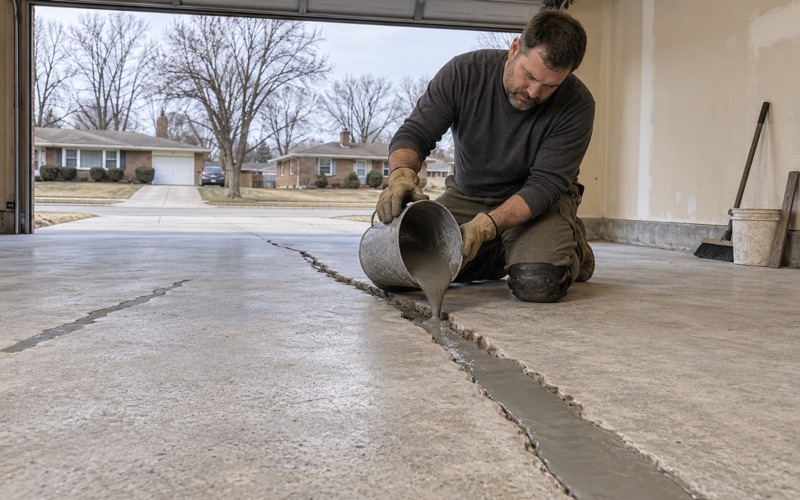
An older shop slab usually needs more than a profile. Concrete that has taken in coolant for years can hold oil deep enough that a coating will not bond over it, so we map contaminated areas, cracks, spalls and old paint before pricing. When a section has to be cut out and replaced rather than coated, the proposal says so.
Moisture testing and the system itself
A slab on grade can push moisture up from below as well as take it in from the top. Before the price is final, our written scope names the test, such as ASTM F2170 in-situ relative humidity probes or ASTM F1869 calcium chloride testing, and the number the slab has to pass. If it falls short, a moisture-mitigation primer goes into the scope or the job waits.
For the field itself we usually pair a 100% solids epoxy body coat with a polyaspartic or urethane topcoat chosen for the shop’s fluids, and we turn to urethane cement where a wet area needs a heavier, more tolerant build. Moisture is also the first exclusion we name when we explain what the coating warranty leaves out, before the job is sold.
Cutting Fluid and a Lathe in a Griffith, IN Garage Shop
The same problem at home scale
Not every machine in Griffith, IN sits in an industrial building. The town is mostly detached, owner-occupied houses from the middle of the last century, with 66.3 percent of its homes built before 1970, and plenty of those garages hold a benchtop lathe, a small mill or a drill press. Cutting fluid at that scale is a spray bottle or a drip rather than a flood, but it lands on the same porous concrete.
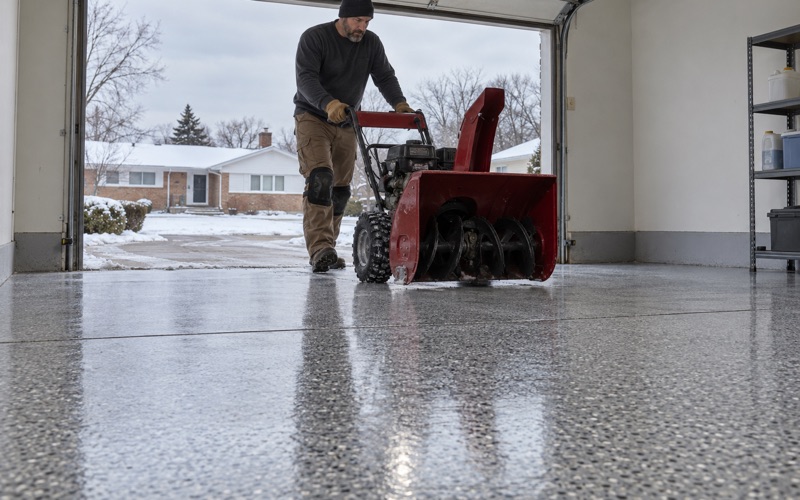
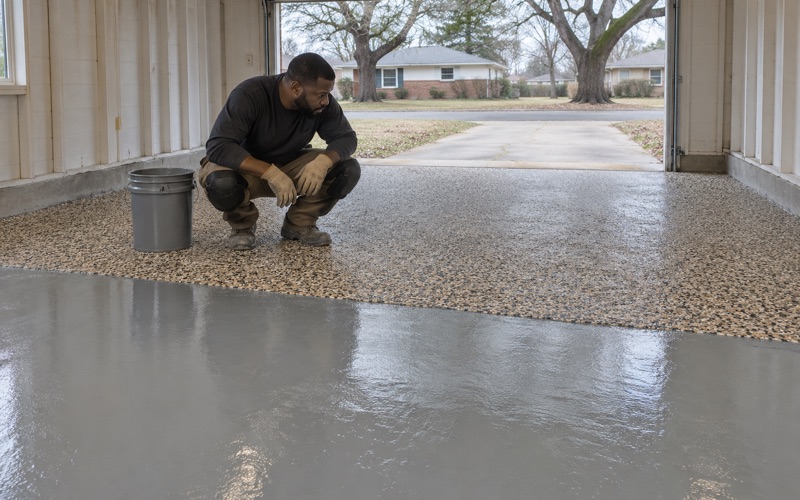
A garage shop floor gets the same treatment in miniature. A coated area around the machine keeps fluid and tramp oil from staining the slab, a light aggregate texture gives footing when the floor is wet, and a drip tray does the job a splash guard does in a plant. That same floor also has to stand up to the brine and rock salt that ride in on tires all winter, and we choose garage systems with that in mind.
Timing a garage job in a Lake County winter
Cure follows slab temperature and dew point, not the calendar. Before coating we check the spread between the slab surface temperature and the dew point, because a cold, damp slab invites amine blush and a weak bond.
An unheated garage in deep winter is told to wait for warmer weather. A few weeks of patience costs far less than grinding off a floor that never cured properly.
Paperwork in Griffith, IN
The Town of Griffith’s permit list does not require a permit for residential floor coverings or painting, though concrete work such as driveways, patios, aprons and pads does need one. Either way, every contractor working for hire in town must hold a Griffith contractor license through the Griffith Building Department at 111 N. Broad Street, backed by a recorded license and permit bond and a certificate of insurance naming the town. We check those requirements before a Griffith, IN job is booked.
Home jobs get a written contract carrying the items Indiana’s Home Improvement Contracts Act lists, signed before any grinding starts. Indiana’s statewide 326 IAC 8-14 rule caps VOC content at 250 g/L for floor coatings and 340 g/L for industrial maintenance coatings, and because it binds whoever applies the product, we pick materials inside those limits for shop and garage floors alike. We never offer a floor coating as radon reduction, waterproofing or flood protection.
- 20+ Years Coating Concrete
- Written Moisture Testing
- Free Estimates