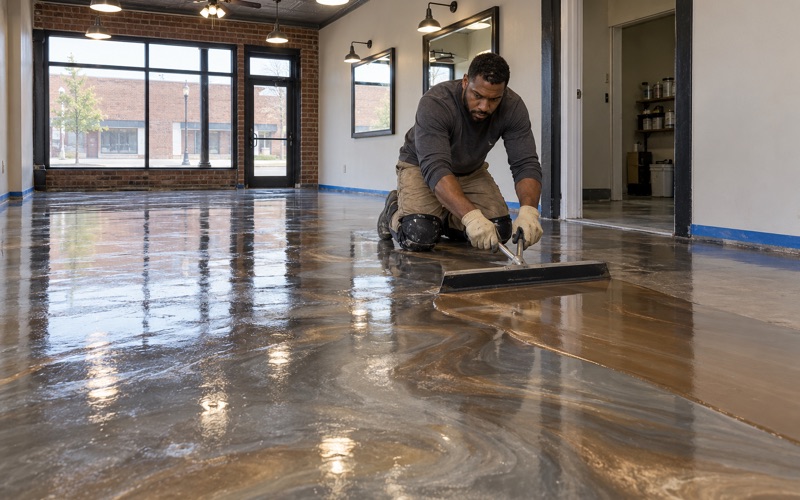
Gary Epoxy Flooring brings more than 20 years of epoxy flooring work to Hammond homes, shops and plants, and on this side of the state line we start every job by looking hard at the concrete before anyone talks colors or flake blends. A resin floor is only as steady as the slab under it, so our first visit is about cracks, old patches and how the floor has behaved over the years.
That inspection carries extra weight in Hammond, IN, because some ground in the city was built up from industrial fill. Not every lot sits on it, and we never assume a given floor does. What we do is ask, look and test, then tell you plainly whether the slab is ready for a coating, needs repair first, or needs an answer from someone other than a flooring crew.
When a floor checks out, the rest of the job is familiar ground for us: a diamond-ground or shot-blasted surface, a moisture test written into the scope, and a proposal that names the product, the coat count and the finished thickness.
Hammond, IN Ground That Started Out as Steel Slag
Steel mills near the lake produced slag for generations, and some of it ended up as fill. Two Hammond sites document that on the public record, and they are the reason we ask about fill before we price a floor here.
West Point Plaza Industrial Park
HUD’s 2002 Section 108 summary for Indiana describes the West Point Plaza Industrial Park in one line: “The site, previously used for as a steel slag dump, will become a light to heavy manufacturing park.” The city put $3,000,000 in Section 108 funds toward site preparation and construction, out of a project total of $7,228,842, and the site was designated a brownfields pilot.
The park later went through Indiana’s Voluntary Remediation Program, run by IDEM. Consultants for the Northwest Indiana Brownfield Redevelopment Project ran a Phase II investigation and helped obtain a Certificate of Completion and a Comfort/No Further Action letter. Those documents are an environmental record, not a statement about how any floor slab on the property behaves.
Lost Marsh and the Bairstow Slag Dump
In north Hammond, the Lost Marsh golf complex is described in its course listing as “the restoration of a 350 acre industrial slag dump site.” An Audubon International case study says the south portion of George Lake was filled between 1937 and 1958 with steel mill slag, fly ash and other industrial waste, a 100-acre area known as the Bairstow Slag Dump.
The City of Hammond acquired the property in 1998 and built the golf complex as a cap over the dump. A low-permeability cap over the 40-acre Youth Golf Academy portion used 60,000 cubic yards of bottom ash found on the site, and the complex opened on September 20, 2003.
Why Slag Fill Can Swell Under a Slab
Steel slag carries free lime and magnesia, and when those oxides take on water they hydrate and grow. The FHWA steel slag guideline puts it directly: “Volume changes of up to 10 percent or more can occur during the hydration of calcium and magnesium oxides.” The same guideline says steel slag base should not be used in confined applications, such as backfill behind structures.
GeoEngineers, a geotechnical firm writing about slag fill in general, lists “lifting of floor slabs” among the common problems and notes that expansion can occur even in fill above the water table and beneath buildings. Because that process can continue for years, an old slab is not automatically past it.
Looking for epoxy-flooring closer to Dyer? See Epoxy-Flooring in Dyer.
Reading the Cracks Before Any Coating Goes Down
We map cracks, spalls and old paint on every job. On a floor that may sit over fill, that crack map becomes the main event, because a crack records the slab’s history for anyone who reads it carefully.
Fresh, Widening or Displaced
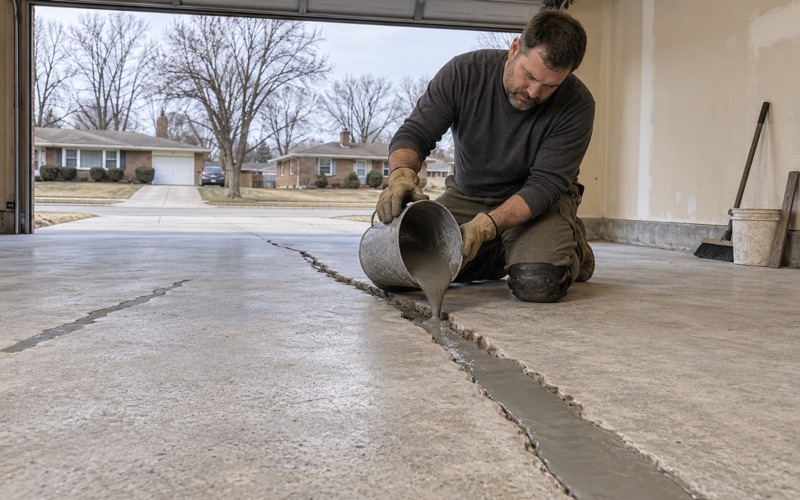
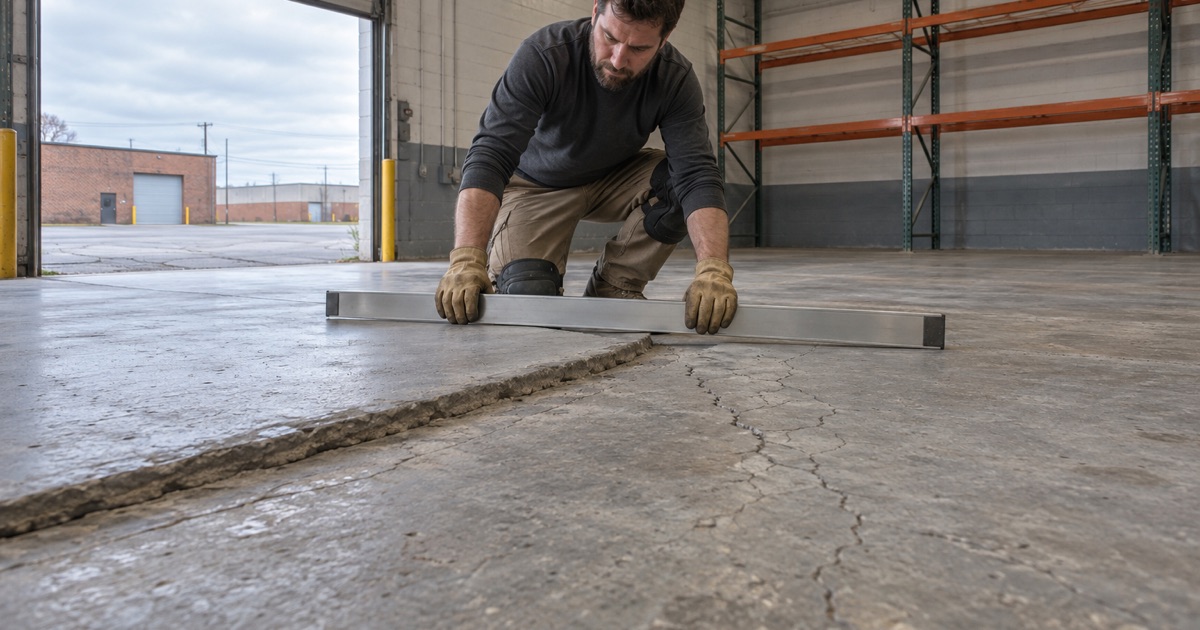
A hairline shrinkage crack with dirty, rounded edges that has looked the same for years usually means the slab has settled into place. A crack with clean, sharp edges, one the owner says has grown, or one where one side now sits higher than the other tells a different story.
Displacement is the sign we watch most closely. When a slab edge rides up across a crack, something underneath is pushing or dropping, and no filler at the surface changes that. We note each crack, its width and whether the two sides still line up, and we photograph them so the record does not depend on memory.
Questions About Past Slab Repairs
We also ask what has been done to the floor before. Has it been patched, ground flat, mudjacked or partly replaced? Do doors that once swung freely now drag? Did an earlier coating split along the same lines it sits over now?
Those answers often say more than one visit can. A floor that was ground flat a few years ago and has humped up again is showing ongoing movement. A slab with one old patch and no change since is far less worrying.
When We Tell You to Hold Off
If the cracks look active, we say so and stop short of selling a floor. A slab that is still being pushed up by its fill is a subgrade problem, and settling it belongs to a structural or soils professional, not a coating crew. We are not engineers and do not pretend to be.
Once that question has an answer, we come back, map the cracks again and quote the floor. Sometimes the right call is repair before coating, and sometimes it is slab replacement. Either way, you hear it before any grinding starts.
What a Resin Floor Can and Cannot Do on a Slab That Moves
Coatings are good at a lot of things: abrasion, stains, chemicals, cleanup and looks. Structural movement is not on that list, and it is worth being clear about where the line sits.
A Coating Follows Its Slab
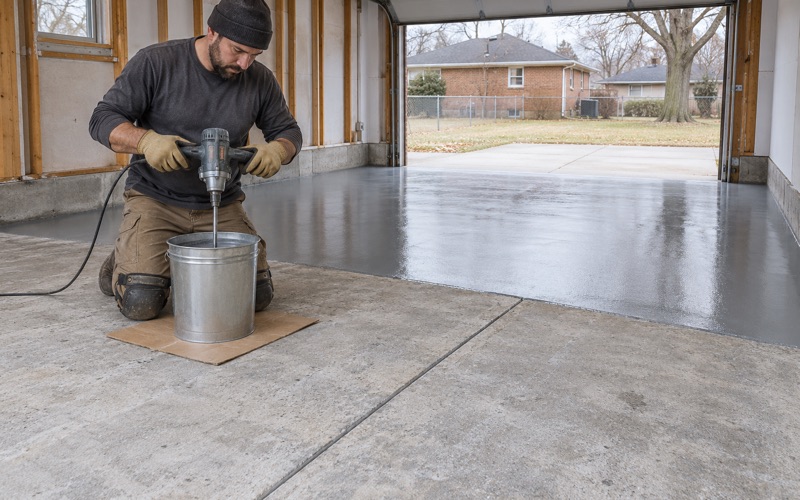
A 100% solids epoxy, a polyaspartic topcoat or a urethane cement system bonds tightly to the concrete under it. That bond is the whole point of the system, and it also means the coating goes wherever the slab goes. When a crack opens under a thin-film or broadcast floor, it generally shows through the finish.
A floor coating does not stop heave, close structural cracks or remediate a brownfield. It is not a cure for a slab with a vapor problem, and we never sell it as radon reduction or flood protection. Saying that up front keeps a buyer from paying for a floor that was never going to solve the real problem.
Preparing a Slab That Passed the Crack Review
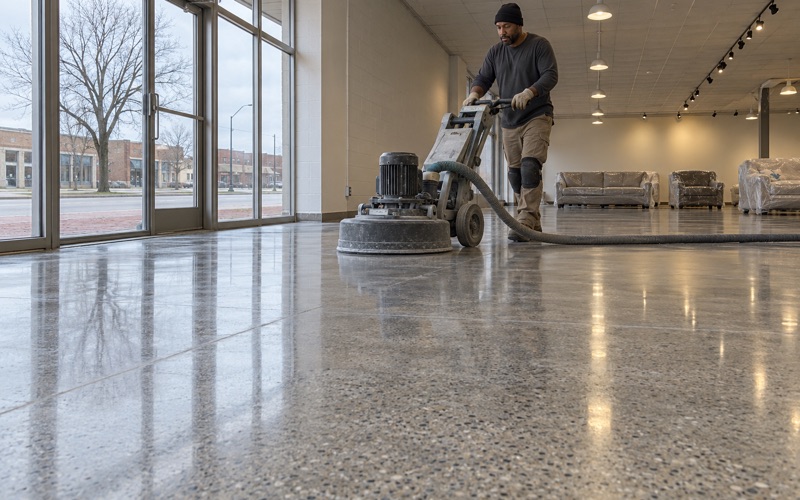
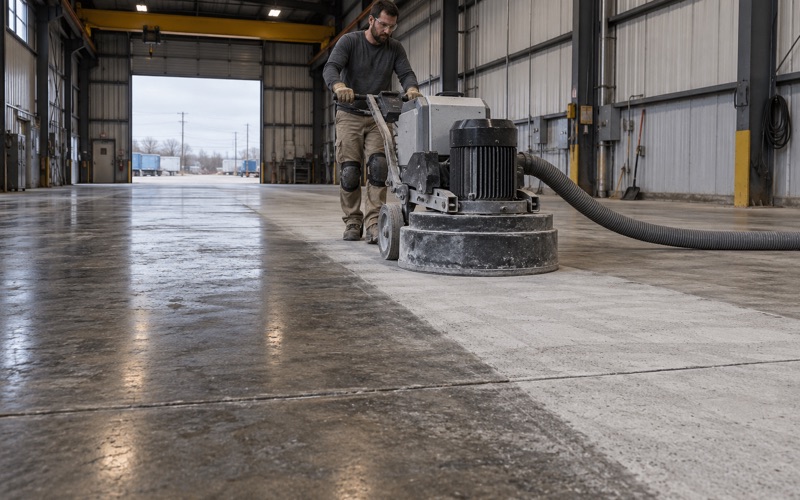
When the slab reads as stable, prep starts with diamond grinding or shot blasting to an ICRI concrete surface profile the primer can grip. We never acid etch. Grinding dust is pulled into a vacuum at the machine rather than washed across the floor.
Moisture testing is written into the scope before the price is final. Depending on the slab, that may be ASTM F2170 in-situ relative humidity probes or ASTM F1869 calcium chloride testing, and the proposal names the method and the number the slab has to pass. If it falls short, a moisture-mitigation primer goes into the quote, or we tell you to wait.
What the Proposal and Warranty Spell Out
The written proposal names the product line, the number of coats and the finished thickness, so you can check the floor against the quote. It also explains what the coating warranty leaves out. Moisture is the first exclusion we name, and on a floor near known fill, movement from below comes up in the same conversation.
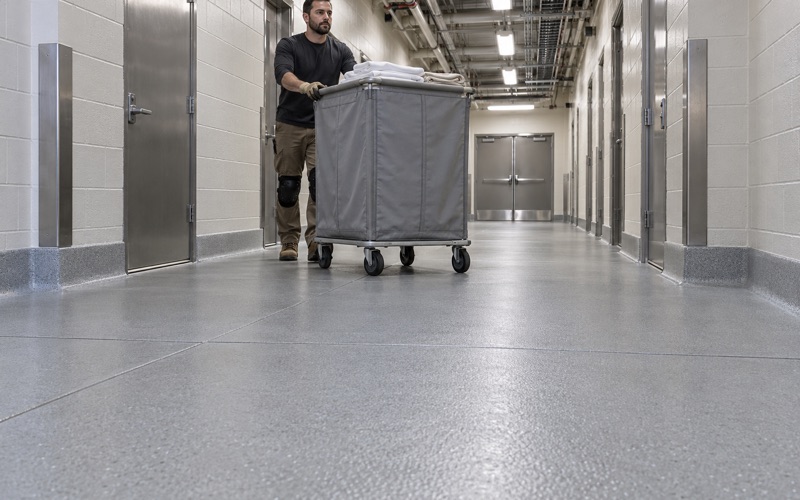
Plant and warehouse floors get the same review, with work phased around shifts and overnight or weekend windows when a space cannot close. Slip resistance is specified by the broadcast and topcoat chosen, whether quartz aggregate or vinyl flake, rather than promised in general terms.
Hammond Garages and Basements on Ordinary Ground
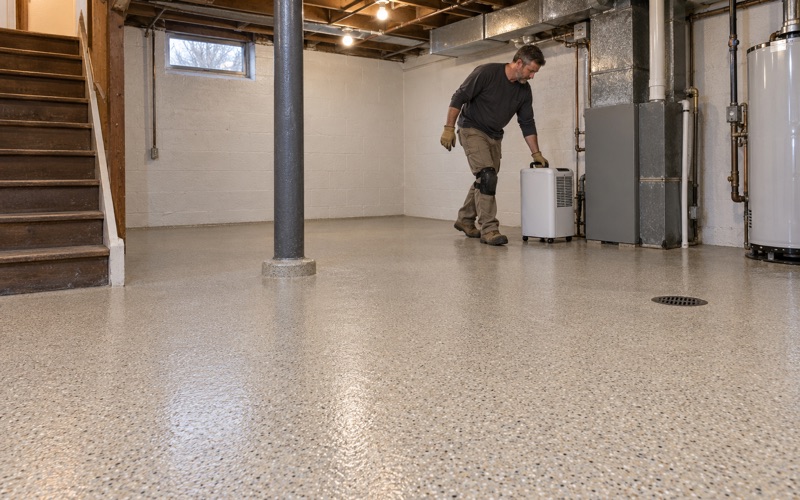
Most Hammond jobs are not on a former dump. Owners occupy 18,601 of the city’s 29,797 occupied housing units, and 17,679 of those owner-occupied homes are detached houses, which adds up to a lot of residential garage and basement slabs that have simply aged.
Garage Floors Through a Lake County Winter
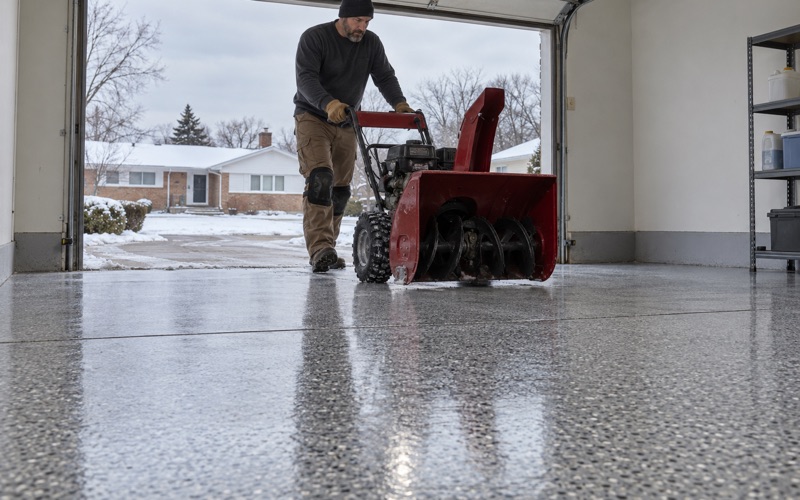
Tires carry brine and rock salt into garages all winter, so we pick garage systems built to stand up to calcium chloride and the grit that rides in with it. A polyaspartic or polyurea topcoat over a flake broadcast also resists hot tire pickup far better than a thin roll-on paint.
Cure schedules follow slab temperature and the dew point spread at the surface, not the calendar. An unheated garage in deep winter is told to wait for warmer weather, because a coating cured too cold can develop amine blush or fall short of full strength.
Registration, VOC Limits and the Paperwork
Hammond requires every contractor, subcontractor and specialty contractor working within city limits to register with the city through the Building Division at City Hall, 5925 Calumet Avenue. The $5,000 license bond is recorded with the Lake County Recorder in Crown Point, and we check those rules before a job is booked.
Hammond sits in North Township, inside the Lake County part of the Chicago 2015 ozone nonattainment area. Indiana’s 326 IAC 8-14 caps floor coatings at 250 g/L and binds whoever applies them, so our products are chosen inside that limit. Home jobs also get a written contract carrying the items Indiana’s Home Improvement Contracts Act lists, signed before any grinding starts.
- 20+ Years Coating Concrete
- Written Moisture Testing
- Free Estimates