Gary Epoxy Flooring installs epoxy flooring in Harvey for owners who want a hard, cleanable floor, and after more than 20 years on concrete the detail we watch closest here is not the flake blend or the gloss. It is the edge of the coating, and exactly where that edge meets a pipe, a duct or a conduit passing down through the slab.
Each of those openings was sealed by somebody for a reason, usually to slow smoke and fire or to keep pests from traveling between spaces. Our part is to grind and coat the concrete around those seals without harming them, and to stop the resin neatly where another trade’s work begins.
That boundary shows up in the paperwork as well. The written proposal names the product line, the number of coats and the finished thickness, a moisture test with its method and passing number sits in the scope before the price is final, and any penetration we did not install is listed as someone else’s to maintain.
Ingalls Memorial and the Licensing Line About Floors
Harvey is a city and south suburb of Chicago in Cook County, with 20,324 residents at the 2020 census. Its best-known institution is UChicago Medicine Ingalls Memorial at One Ingalls Drive, and the rules that govern a building like that explain a floor detail most owners never think about.
A Hospital on Ingalls Drive Since 1923
According to UChicago Medicine’s own history page, the hospital was founded in 1923 after industrialist Frederick Ingalls recognized the need for one. The original fifty-bed facility was expanded to double its size just seven years later, and today the health system spans over 22 acres.
UChicago Medicine has been the corporate parent since a 2016 merger. In fairness to the hospital and to readers, we have no tie to Ingalls or UChicago Medicine, and we have not seen its floors, its penetrations or the products used to seal them. It appears here only because of the code that licenses hospitals in Illinois.
The Sentence About Pipes, Ducts and Conduits
The finishes section of the Illinois hospital licensing code, 77 Ill. Adm. Code 250.2460, carries a line that has nothing to do with appearance. Subsection (g) reads: “Floor and wall penetrations by pipes, ducts, and conduits shall be tightly sealed to minimize entry of vermin, smoke, and fire. Joints of structural elements shall be similarly sealed.”
Elsewhere the same section asks for floor materials that are easily cleanable, with wear resistance appropriate for the location, and says floors that are frequently wet-cleaned shall not be physically affected by germicidal and cleaning solutions. It names no floor material. A resin system can answer the cleaning and wear lines, but subsection (g) is a different kind of requirement, and no coating meets it.
Why the Line Matters Outside a Hospital
Slab penetrations exist in nearly every commercial building and many homes: drain lines, water risers, electrical conduit, gas piping, sleeves left for future work. Wherever a hole crosses concrete between spaces, somebody sealed it against smoke, rodents, insects or fire.
That seal is a building system with its own trade and its own inspection. When we arrive with a grinder it is already in place, and we owe the owner a floor that leaves it working exactly as well as before.
Looking for epoxy-flooring closer to Cedar Lake? See Epoxy-Flooring Services in Cedar Lake.
Where the Coating Stops: A Floor Finish Is Not a Firestop
What a Firestop Collar or Sealant Does
A firestop system is a tested assembly: a sleeve, collar, wrap or sealant matched to a particular pipe, a particular opening and a particular floor or wall rating. Plastic pipe often gets a collar that swells shut in a fire, while metal pipe in a sleeve may get sealant packed to a set depth. The product, the depth and the listing all matter.
A floor coating has none of that. However thick a 100% solids epoxy or a urethane cement system goes down, it is not a firestop, a smoke seal or a fire-rated assembly, and we do not install firestopping. Flooding resin into a penetration does not make it tightly sealed in any sense the code means.
Terminating Cleanly at Each Sleeve
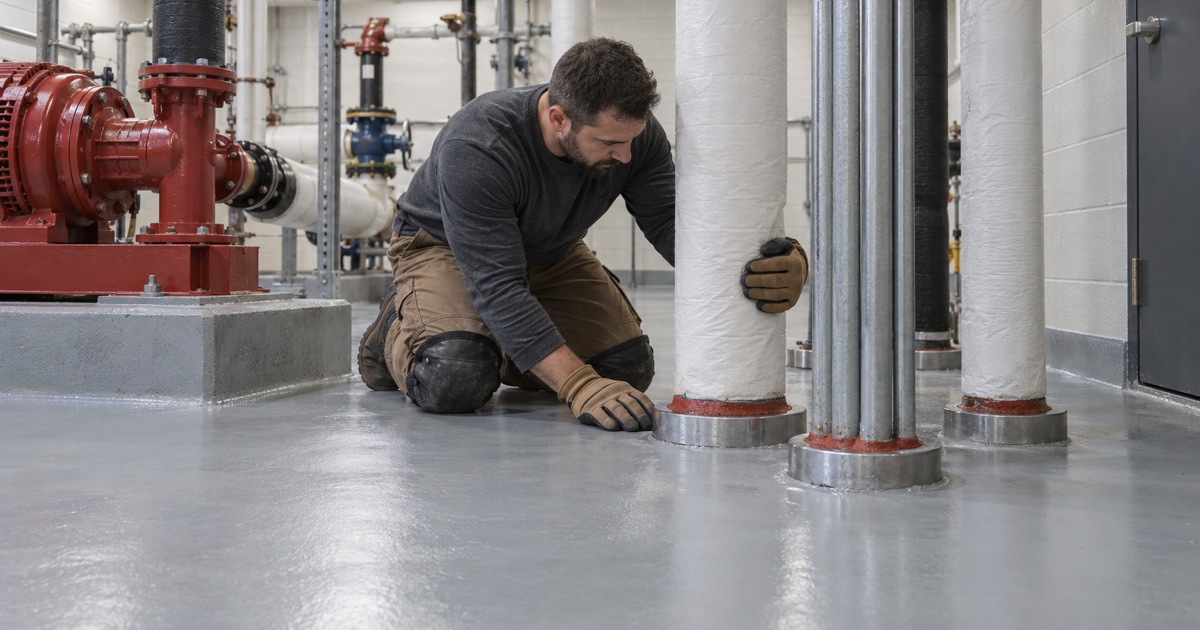
On a floor with penetrations, we bring the coating up to each sealed sleeve or collar and end it in a crisp line at the edge rather than flowing it over the seal. That stop line leaves the firestop product itself in plain view, not buried under a layer of epoxy.
Keeping the seal visible pays off later. When a plumber, an electrician or an inspector checks that opening years from now, they need to read the material or its label, and nobody should have to cut through a finished floor to do it.
The code’s second sentence, about joints of structural elements, points the same way. Where an isolation joint separates a slab from a column or a wall, we carry that joint up through the coating instead of bridging it with rigid resin, so the joint and whatever seals it can still move and be inspected.
Coved Bases in Wet-Cleaned Rooms
Rooms mopped with strong cleaners are where a resin floor earns its keep, and 250.2460 asks that wall bases in kitchens, soiled workrooms and similar wet-cleaned areas be integral and coved with the floor, tightly sealed to the wall. A coved resin base can do that work along the wall line.
The cove still ends where a pipe or conduit leaves the floor. From that point the seal around the penetration belongs to the trade that installed it, and our edge simply meets it. Slip resistance in those rooms is set by the quartz aggregate broadcast and topcoat written into the spec, not promised as a slogan.
Grinding Around Sealed Sleeves and Coring New Holes
Protecting Sealant During Surface Prep
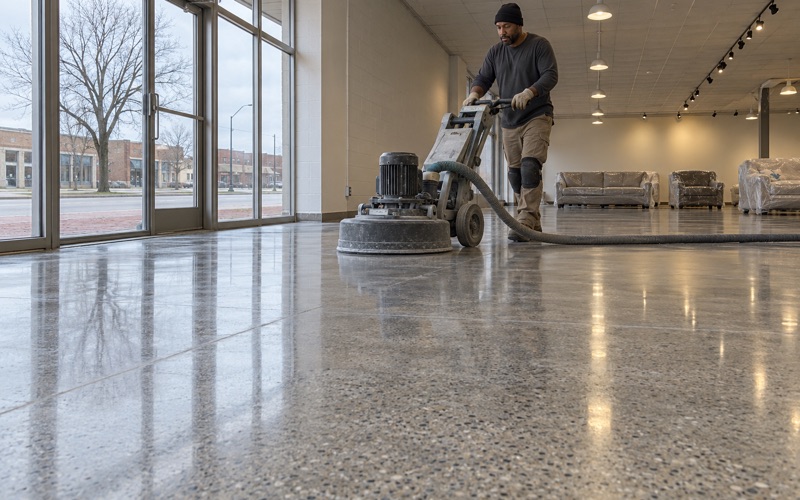
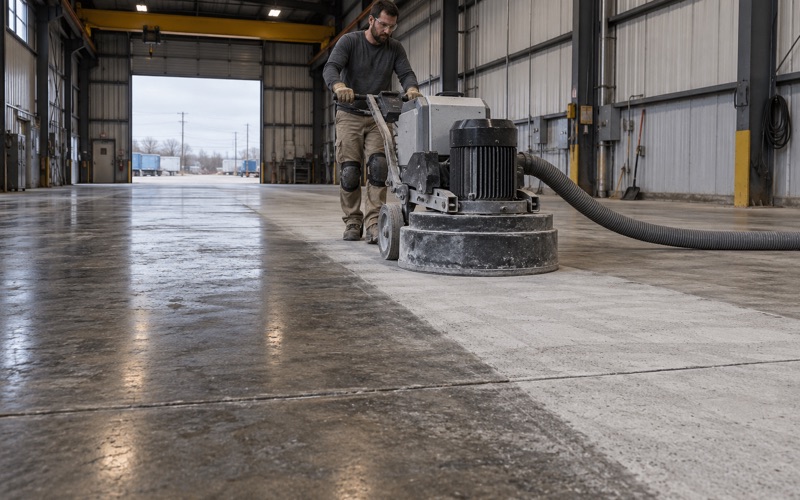
Every slab we coat is opened with a diamond grinder or a shot blaster, never an acid etch, so the primer has a real ICRI concrete surface profile to grip. Those machines are aggressive by design, and a grinder head that drifts into a sealant joint can tear it out in seconds.
Before prep starts, we walk the floor and mark every penetration. The large machines stay back, and the last few inches around each sleeve are worked by hand at low speed, clear of the sealant. Dust is pulled into a vacuum at the machine instead of being rinsed toward a floor drain, which also keeps grit out of open sleeves.
In a clinic, shop or office that cannot close, we phase the floor around shifts, with overnight and weekend windows. Penetrations in each zone are marked and protected before that zone is opened up, so no seal is left exposed to a machine between visits.
When a Seal Is Damaged or Missing
Now and then we find a penetration with dried, cracked or missing sealant before we have touched it. We photograph it, leave that spot alone and tell the owner, because restoring it is firestop work and not ours.
If our own prep nicks a seal, the same rule holds: we report it instead of hiding it under coating material. The owner’s firestop contractor repairs it, and we finish up to the restored edge afterward.
New Holes Cored for a Drain or Line
Renovations add penetrations all the time, such as a drain cored for a new sink or a conduit run for equipment. Any new hole cut through the slab is sealed by the trade that made it, with a listed system, before our coating goes back down around it.
Getting that order right keeps the floor from being opened twice. We schedule the coating after coring and sealing are finished, and if a coring date slips, our install date moves with it rather than going down beside an open hole.
Pipes Through a Harvey Basement Floor: Leave the Seal to Its Own Trade
Older Houses and Their Slabs
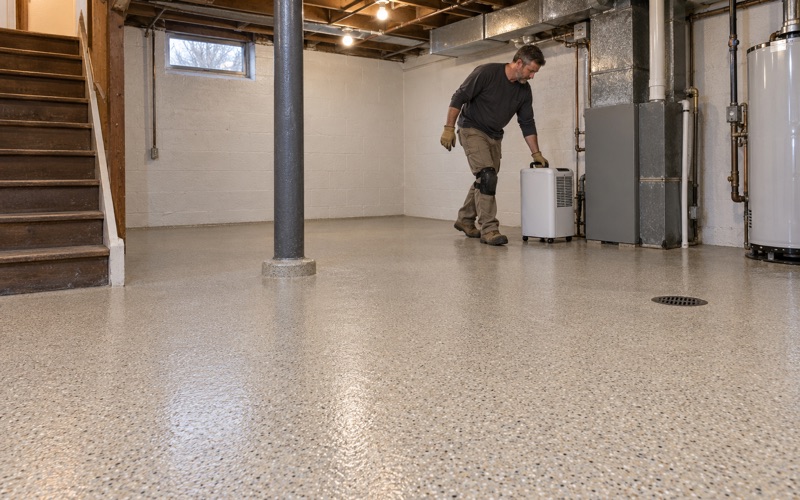
Harvey’s homes skew old. Of 9,857 housing units in the Census Bureau’s estimate, 2,355 were built in 1939 or earlier and only 33 date from 2010 on, so many basements have floor drains, waste lines and supply pipes passing through aging concrete. We map those penetrations along with cracks, spalls and old paint, and we say so when a slab needs repair or replacement before it should be coated.
Moisture comes next. Depending on the slab, the scope calls for ASTM F2170 in-situ relative humidity probes or ASTM F1869 calcium chloride testing, and the result decides whether a moisture-mitigation primer joins the system. Moisture is also the first exclusion we explain in the coating warranty, before the job is sold.
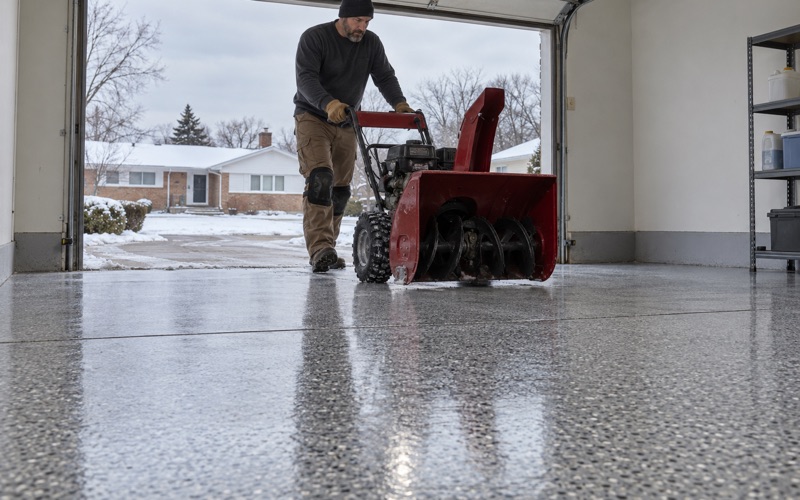
Garages get the same care where a gas line or conduit drops through the slab, and a polyaspartic or polyurea topcoat over a vinyl flake broadcast holds up to the brine and rock salt that tires carry in all winter. Cure timing follows slab temperature and the dew point spread at the surface rather than the calendar, so an unheated garage in deep winter is told to wait.
Not every Harvey home has a slab to coat. The Census Bureau counts 660 mobile homes in the city, and a manufactured-home floor is not a concrete slab, so it is not an epoxy job.
Radon Pipes Belong to Radon Work
Illinois homes built since June 1, 2013 are required to have passive radon pipes, and sealing slab openings around a radon system is radon work, which Illinois licenses. We treat that pipe the way we treat a firestop: coating up to its edge, never over its seal.
A floor coating is never radon mitigation, and we will not describe one that way. Nor is it waterproofing or flood protection; if water is coming up through a drain or a crack, that source gets fixed before any resin goes down.
Registration and Permits in Harvey
The City of Harvey requires a contractor to be registered and licensed with the city before work starts, and it lists all work requiring the pouring of concrete among jobs that need a permit. Applications are made in person at the Planning Department, 15320 Broadway Avenue, with 7 to 10 days to process.
A coating over existing concrete is not on that list as quoted, so we confirm with Planning, Building and Inspectional Services and settle registration before a date is booked. On a Harvey floor crossed by pipes, the finished job should leave every sealed opening readable, untouched and still doing the work it was put there for.
- 20+ Years Coating Concrete
- Written Moisture Testing
- Free Estimates