Gary Epoxy Flooring brings more than 20 years of epoxy flooring work to Hazel Crest, and one question shapes how we quote a floor in any building where people clean their hands all day: what happens to the finish when alcohol lands on it? Hand sanitizer is mostly alcohol, and alcohol is a solvent for the acrylic finish many commercial floors wear.
That makes the floor under a sanitizer dispenser one of the hardest-working few square feet in a care home, a clinic lobby or an office entry. Our answer is usually a cured resin floor with a topcoat chosen for alcohol resistance, or, where the existing floor stays, a drip tray and a spot test with the exact product on the wall.
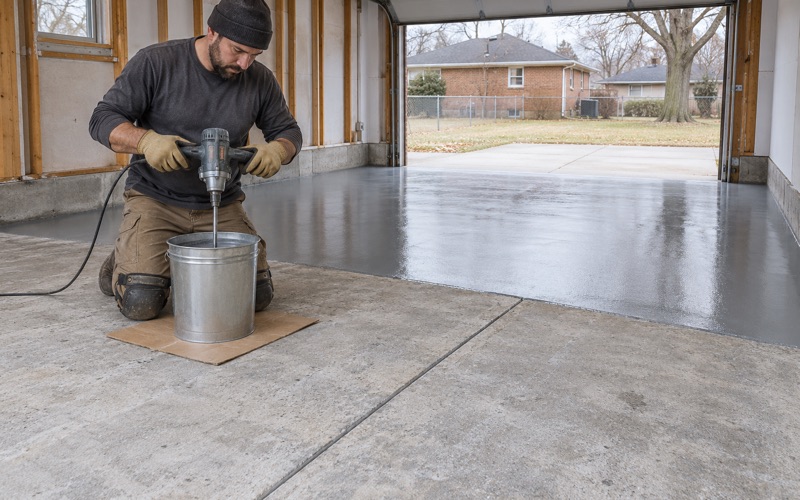
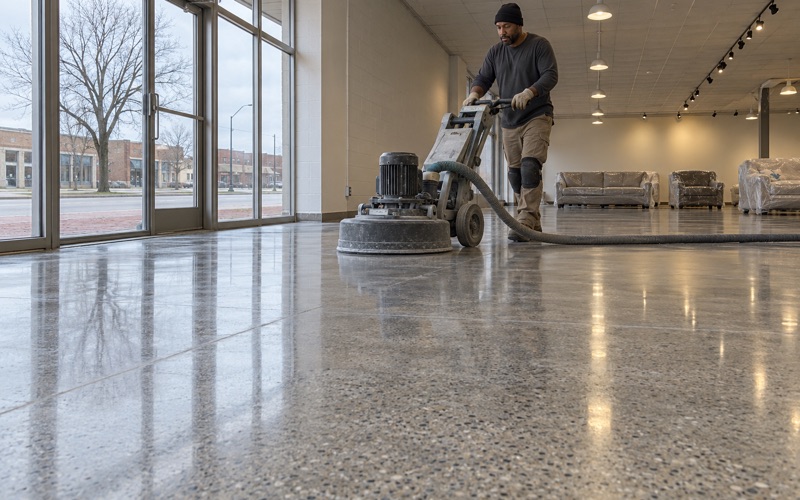
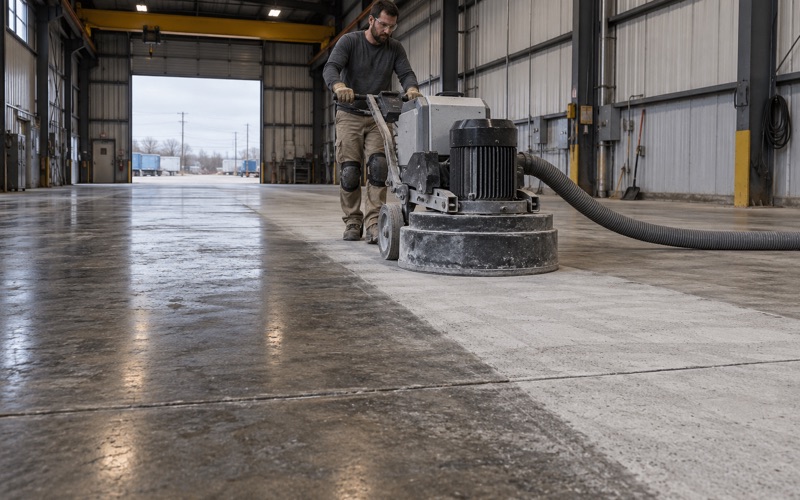
Houses get the same scrutiny. Every slab we coat is opened with a diamond grinder or shot blaster rather than an acid etch, and the written proposal lists the product line, the coat count and the finished thickness so the result can be measured against the quote.
Pine Crest on 175th Street and the Federal Dispenser Rule
A 199-bed nursing home in Bremen Township
Pine Crest Health Care is a Medicare and Medicaid nursing home at 3300 W. 175th Street, listed with 199 certified beds. The address sits inside the Village of Hazel Crest, on the Bremen Township side of a Cook County village whose southern edge reaches into Rich Township.
We use the building as a reference point because a care home of that size is exactly where the dispenser question gets asked. We have never worked there, and we have not seen its dispensers, its floors or the hand rub it stocks, so nothing on this page describes them.
What 42 CFR 483.90 allows
Federal requirements for long-term care facilities cover the physical environment in 42 CFR 483.90. Paragraph (a)(4) says a facility “may install alcohol-based hand rub dispensers in its facility” as long as they are “installed in a manner that adequately protects against inappropriate access.”
The same section ties the building to the Life Safety Code, NFPA 101 in its 2012 edition, and calls for automatic sprinklers throughout. In practice that lets dispensers appear in corridors, at room doors and by nurse stations, and every one of them is a spot where alcohol will eventually reach the floor.
That is federal text, not Illinois code, and we do not read it as a requirement that any building install dispensers. The point for a floor is simpler: once a building hangs them, the floor beneath each one becomes part of the plan.
Looking for epoxy-flooring closer to Markham? See Epoxy-Flooring Services in Markham.
Drips Beneath the Dispenser and What Alcohol Does to Wax
How the drip happens
Nobody pours hand rub on a floor. It arrives a drop at a time: a pump that dispenses more than a palm holds, a few drops shaken off while hands are rubbed together, a residue that gathers at the nozzle and falls on its own.
Health Facilities Management described this at a California hospital in 2022, where users dripped sanitizer while rubbing their hands. The magazine reported that those drips “often create white spots, dark spots and sticky residue on a floor’s finish,” and that alcohol-based sanitizers eat away at floor finishes.
Because the drops land in the same few square feet day after day, the damage concentrates. A corridor can look freshly finished end to end except for a dull, blotched halo under every dispenser.
Why acrylic finish gives way
Many care homes and clinics run vinyl composition tile or other resilient flooring under a sacrificial acrylic finish, the coating crews strip, recoat and buff on a schedule. A 3M technical bulletin is summarized as saying alcohol penetrates and swells that acrylic film and weakens its adhesion in about three to five minutes.
With longer contact the finish can let go of the tile entirely. Wiping the drop up quickly helps, but a dispenser nobody watches overnight does not get wiped quickly, so the white and dark spots keep coming back between strip cycles.
The usual response is more labor: spot-stripping, recoating and burnishing the same patch again. That treats the symptom and leaves the cause, an alcohol-sensitive finish under an alcohol source, exactly where it was.
The same chemistry at a front desk
The pattern is not limited to nursing homes. Doctor’s offices, school entries, church lobbies and office reception counters have added sanitizer stands in recent years, and many of them stand on waxed tile that reacts the same way.
Alcohol-Resistant Topcoats, Drip Trays and a Test With the Real Product
Replacing strip-and-wax with a cured system
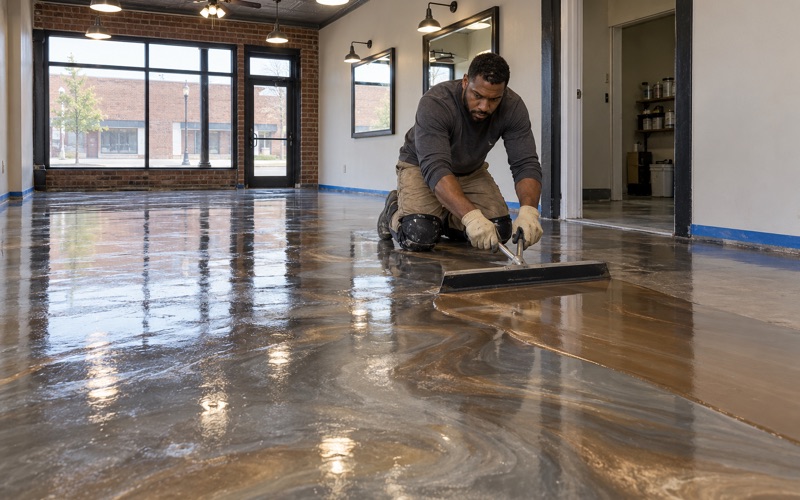
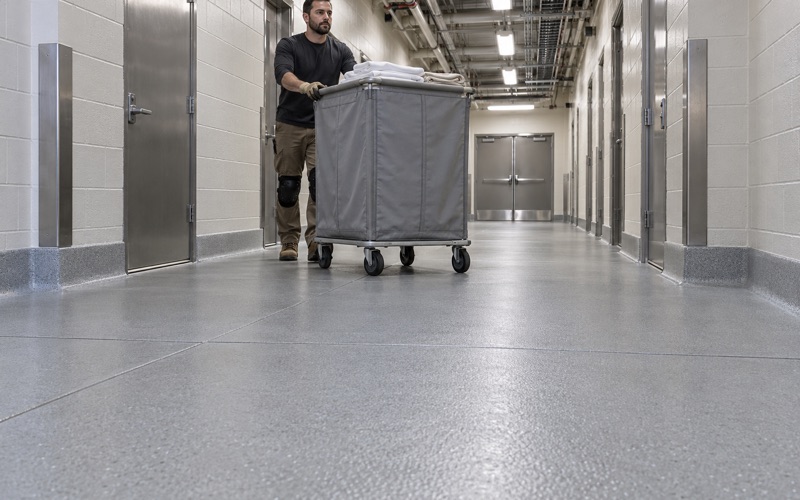
A cured resin floor does not depend on a soft sacrificial film. In a corridor or common room we typically look at a 100% solids epoxy body coat over a properly profiled slab, finished with a polyaspartic or polyurethane topcoat whose data sheet lists resistance to alcohols.
On a concrete slab that means grinding to bare concrete; where old tile is down, it usually means taking up the tile and adhesive first. The HFM account offers one data point: after deep cleaning, the California hospital applied a high-performance polyurethane coating that proved, by the vendor’s report, 98 percent resistant to alcohol-based solvent damage, and stripping, buffing and waxing ended there.
That figure is one vendor’s reported result at one hospital. It is not a test we ran and not a property every coating shares, which is why we test the products in question ourselves before trusting any of them.
A care home cannot close a wing for a week, so we phase work room by room and corridor by corridor in overnight and weekend windows and capture grinding dust at the machine with a vacuum. The schedule says when each stretch can take foot traffic and when furniture can return.
Drip trays where the floor stays
Not every building is ready to replace a wing of flooring because of a few dispensers. Cleaning-trade advice for that case is drip trays and mats under sanitizer stands, so the drops land on something replaceable.
A tray is a stopgap rather than a floor system, and it only works if someone empties it. Finish makers also sell alcohol-resistant floor finishes, which can be the right middle step for a building that keeps its tile.
A spot test with the hand rub on the wall
Hand rubs differ in alcohol type, strength and added gels or moisturizers, so a chart rating for one solvent says little about the bottle a building actually buys. Before we commit to a topcoat, we coat sample panels and leave the facility’s own product on them for a timed period, then check for softening, clouding, tackiness and loss of gloss.
Where an existing floor stays, the same test runs on an inconspicuous patch of the current finish. The result is written into the proposal, so whoever manages the building can see which product was tested, on what, and for how long.
None of this makes a floor part of infection control. A coating does not kill germs; its job is to keep its finish while staff and visitors clean their hands above it.
Sanitizer Stations, Alcohol Spills and Hazel Crest Houses
Most of Hazel Crest is owner-occupied houses: 75 percent of households own, and 77 percent of housing units are single-family detached. Much of the village south of I-80 went up as subdivisions in the 1960s, 1970s and 1980s, and those houses bring the alcohol question home in a smaller way.
A pump bottle by the garage door
Plenty of families keep a pump of hand sanitizer by the door from the garage or on a workbench, and the drops land on the garage floor just as they do in a corridor. A plain concrete floor stains less visibly, but a one-part garage paint or an acrylic sealer can soften and lift in the same spot.
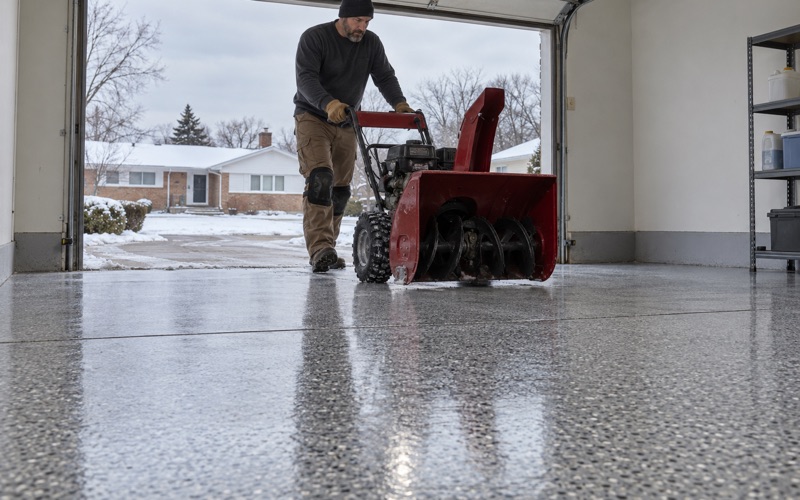
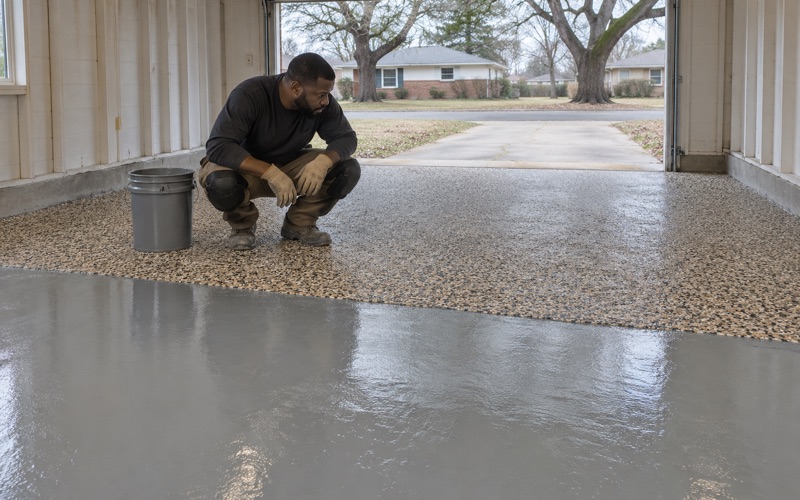
For a garage we generally build an epoxy base coat, a vinyl flake broadcast and a polyaspartic topcoat, chosen for hot tire pickup and for the brine and rock salt that come in on tires every winter. The same topcoat question applies here as in a care home, so if a sanitizer station or a shop full of solvents shares the space, we check the data sheet against it.
In an unheated garage in deep winter we tell homeowners to wait, because cure schedules follow slab temperature and the dew point spread at the surface, not the calendar. A coat laid on a cold, damp slab can develop amine blush and lose adhesion.
Rubbing alcohol, spilled drinks and the basement bar
Inside the house, alcohol reaches floors in other ways: a tipped bottle of rubbing alcohol in a basement workroom, a hand-rub pump beside a home office desk, a spilled drink at a basement bar. A cured epoxy with a resistant topcoat gives those spills time to be wiped up before they mark the floor.
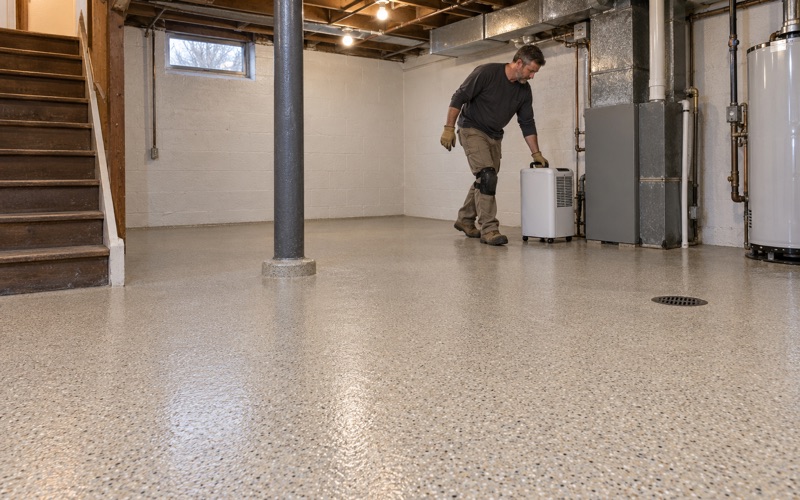
Before a basement slab is coated, it is tested for moisture, and the proposal names the method and the number it must pass, whether that is ASTM F1869 calcium chloride, ASTM F2170 relative humidity probes or an ASTM D4263 plastic sheet check as a first look. A high reading adds a moisture-mitigation primer to the scope, and moisture is the first warranty exclusion we explain before the job is sold.
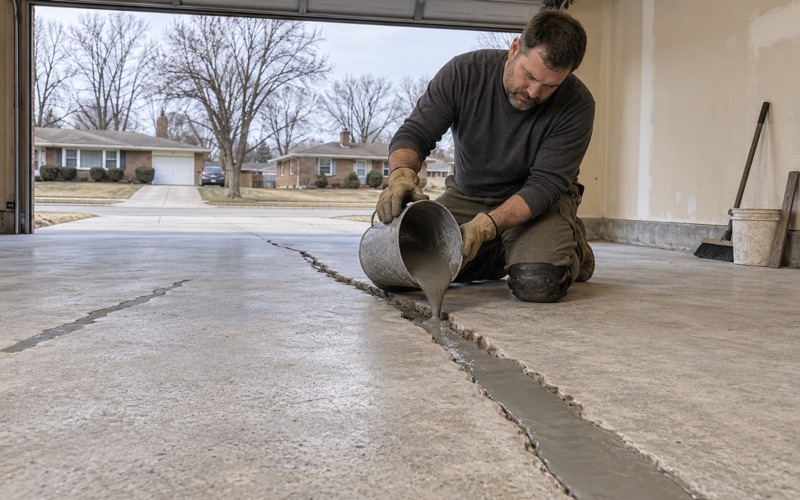
We also map cracks, spalls and old paint first and say plainly when a slab needs repair before it should be coated. A coating is not waterproofing, and we never sell one as a fix for water coming through a basement floor.
Before work starts in the village
Illinois licenses no general, flooring or coatings contractor, so the local rules are the ones that count. Before booking, we ask the Hazel Crest Building Department what registration, bond and insurance it expects and whether the job needs a permit; the village adopted its building code by ordinance in 2012, and how it treats floor work is the department’s call.
A care-home corridor lined with dispensers and a sanitizer pump by a garage door in a 1970s subdivision pose the same question at different scales. We answer it the same way each time: find out what the finish is, test it against the alcohol that will actually land on it, and choose the floor from the result.
- 20+ Years Coating Concrete
- Written Moisture Testing
- Free Estimates