Gary Epoxy Flooring has spent more than 20 years on concrete, and with epoxy flooring in Hickory Hills we often start with a question owners rarely ask: what is the floor supposed to tell the people standing on it? In a shop that services vehicles over a pit, the answer is unusually specific. A coated band on the slab can stand in for a guardrail, but only when it is placed, kept visible and backed up the way a federal rule spells out.
That makes a few inches of colored coating one of the hardest-working parts of a garage floor. It has to stay bright under boots, tires, wash water and grit, and it has to sit in the right place relative to an edge that drops several feet. Tape and spray paint rarely last long enough to do that job.
This page walks through that one detail from start to finish: the rule behind the line, how we lay it out around a working pit, why we build it into the coating, and what a homeowner should do with an old grease pit hiding under a sheet of plywood.
District 117’s Bus Shop and the Pit Rule
North Palos School District 117 keeps its own fleet running. The district’s Transportation Department staff page lists a Transportation Director, an Assistant Director, a head mechanic and an assistant mechanic who also covers routes as a substitute bus driver. That is a working repair shop, not just a parking lot for buses.
The State Fire Marshal’s underground storage tank file adds an address. Facility 2000608, recorded as the Transportation Garage at 9530 S. 79th Avenue and owned by District 117, geocodes inside Hickory Hills city limits in Palos Township. The file shows one 8,000-gallon gasoline tank removed in May 2020, and the record’s Closed status refers to the tank facility, not the garage.
We have not been inside that building, and nothing we read says whether it has a service pit or what is painted on its floor. We have no relationship with the district. We name the shop because it shows that heavy-vehicle maintenance happens right here, and any shop that works over a pit runs into the same paragraph of federal law.
What 1910.28(b)(8) Actually Says
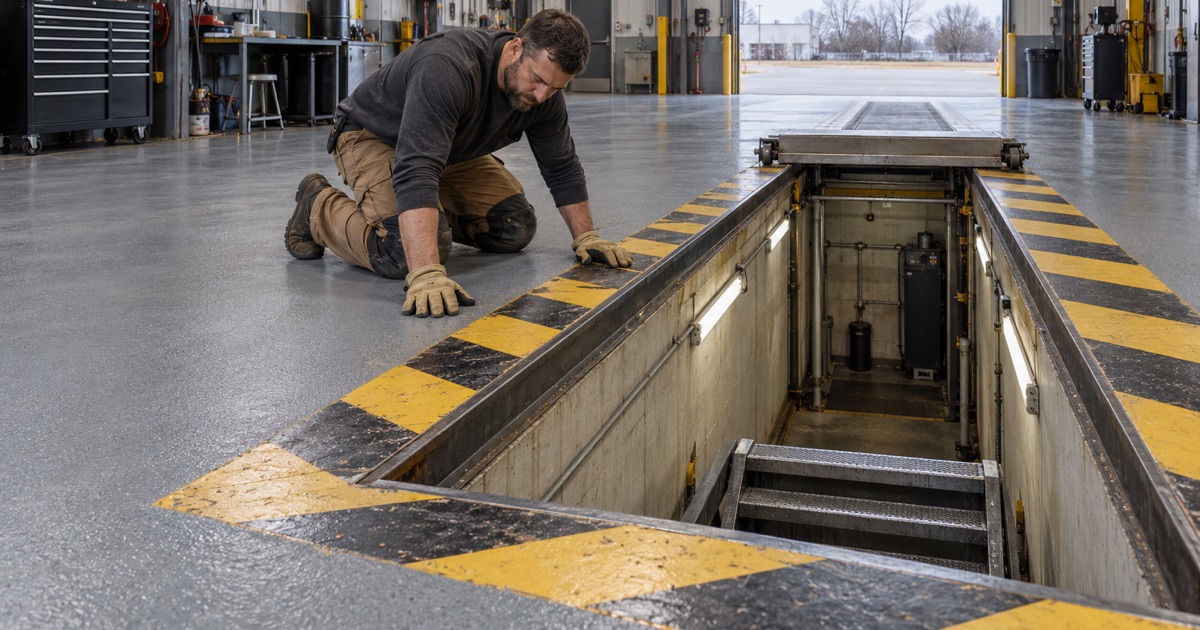
OSHA’s walking-working surfaces rule, at 29 CFR 1910.28(b)(8), covers repair pits, service pits and assembly pits. It says a fall protection system is not required for a pit less than 10 feet deep, provided the employer does three things. Guardrails and harnesses can be skipped only when all three are in place.
First, access within 6 feet of the pit edge is limited to trained, authorized employees. Second, floor markings are applied at least 6 feet from the edge, or warning lines and stanchions are placed there, or both. Third, readily visible caution signs meeting OSHA’s sign standard, 1910.145, are posted.
Where the Floor Fits, and Where It Does Not
Only the second condition is something a floor contractor can build. The access limit is a shop policy and the signs are hardware on the wall, so a coated stripe on its own does not satisfy the rule. We say that plainly because a stripe that looks official can give a shop false confidence.
What a coating can do is make the marking last. A line that wears gray in three months leaves the shop with no marking at all, and the exemption then rests on nothing. Keeping it visible is the part of the job we own.
Looking for epoxy-flooring closer to Justice? See Epoxy-Flooring Services in Justice.
Six Feet Back: Laying Out the Line Around a Working Pit
The 6-foot figure is a minimum distance from the pit edge, so the line has to be measured from the actual edge, not from a curb, a grate or a lip that sits back from it. We mark the edge first, then measure out on every side the rule covers before any coating color goes down.
Planning Around How the Pit Is Used
A bus or truck straddles a pit, so the zone inside the line is also where wheels roll, mechanics walk and parts carts park. The layout has to keep the marked boundary clear of drains, column bases and door tracks where it would be hard to see or hard to recoat. Where the line must cross a trench drain or an expansion joint, we plan how the stripe stops and restarts so the boundary still reads as one continuous shape.
Width and color are decisions for the shop, made with whoever writes its safety program. High contrast against the base floor matters most: a yellow band on a gray floor reads at a glance, while a yellow line on a tan floor can disappear in poor light. We show samples on the actual slab before committing.
Stanchions, Signs and the Space Between
Some shops use warning lines and stanchions instead of, or alongside, a floor marking. The rule asks those stanchions to resist tipping under a 16-pound horizontal force applied 30 inches up, which often means a weighted base. If stanchions will sit on the coated floor, we plan the line so their bases land on sound coating rather than on a joint or a patch.
Caution signs are outside our scope, but placement interacts with the floor. A sign on a post set into the slab needs a core or anchor, and those penetrations are better drilled and sealed before coating than punched through a finished floor afterward.
Coated Stripes Versus Tape in a Wet, Gritty Shop
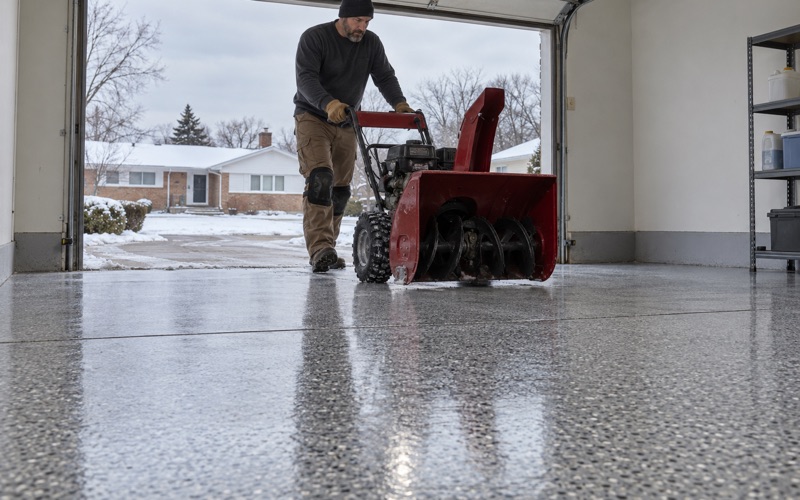
A vehicle shop floor sees wash-down water, road grit tracked in on tires, winter brine and the fluids that drip during repairs. Floor tape lifts at its edges once water gets under it, and grit then grinds the loose edge until the stripe tears. Aerosol line paint sits on top of the concrete with almost no bond and wears through where tires turn.
Building the Line Into the System
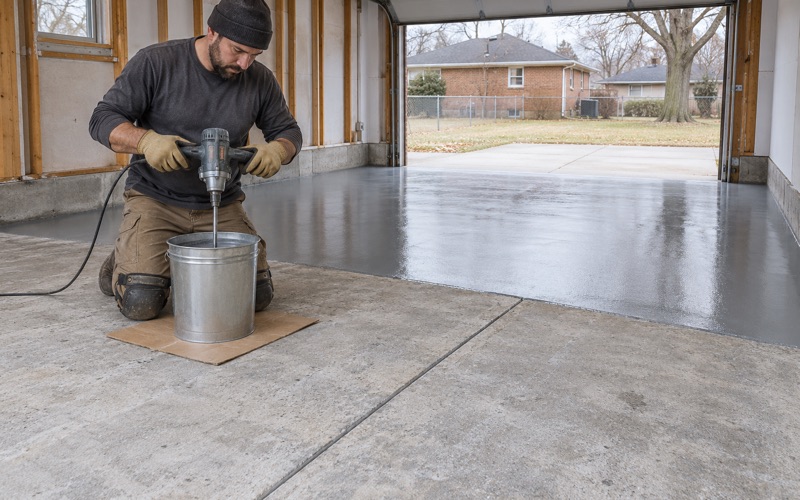
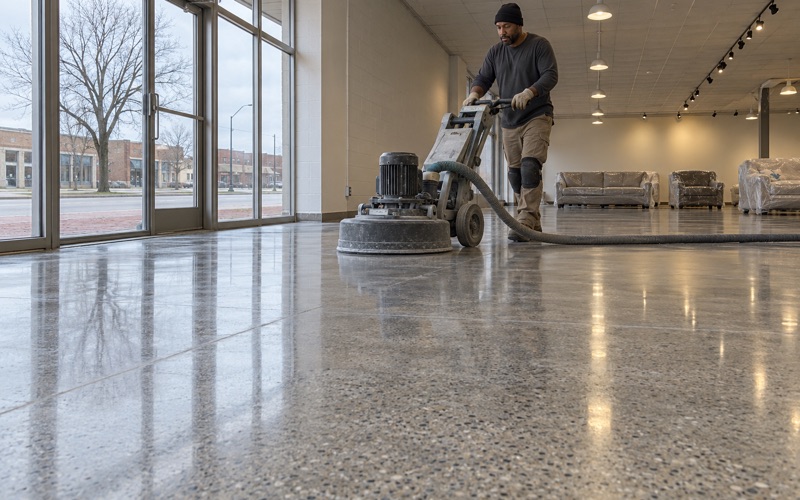
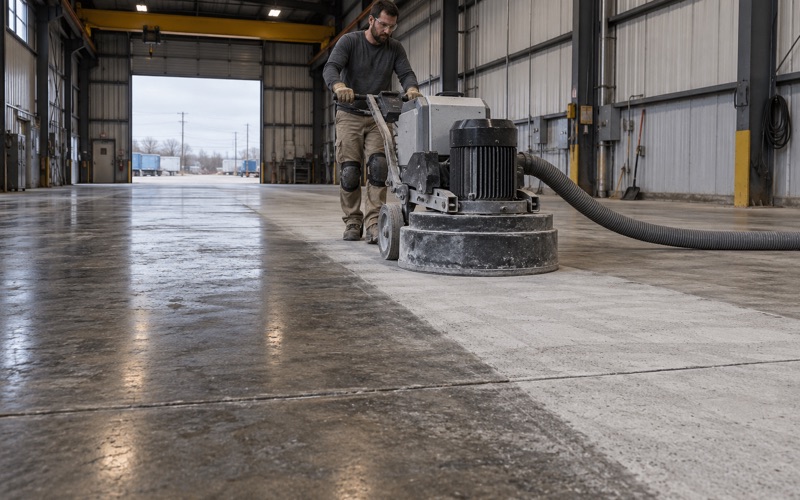
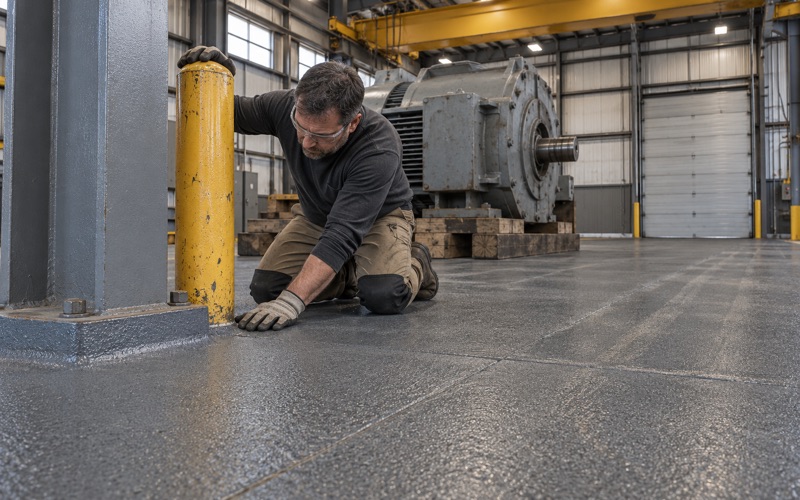
We treat the warning band as part of the floor, not something added afterward. The slab is opened with a diamond grinder or a shot blaster to a measured ICRI concrete surface profile, so the primer and body coats have something real to grip, and an acid etch is never the method. The band is laid in a pigmented coat within the same system, then locked under the same clear topcoat as the rest of the floor.
A 100% solids epoxy base with a polyaspartic or polyurea topcoat is a common build for this kind of floor. The topcoat carries the abrasion and chemical resistance, and its texture is set by the broadcast we specify. A quartz aggregate broadcast gives boots grip in the zone around a pit edge, where nobody wants a glossy, slippery approach.
Prep, Moisture and Cure in a Working Garage
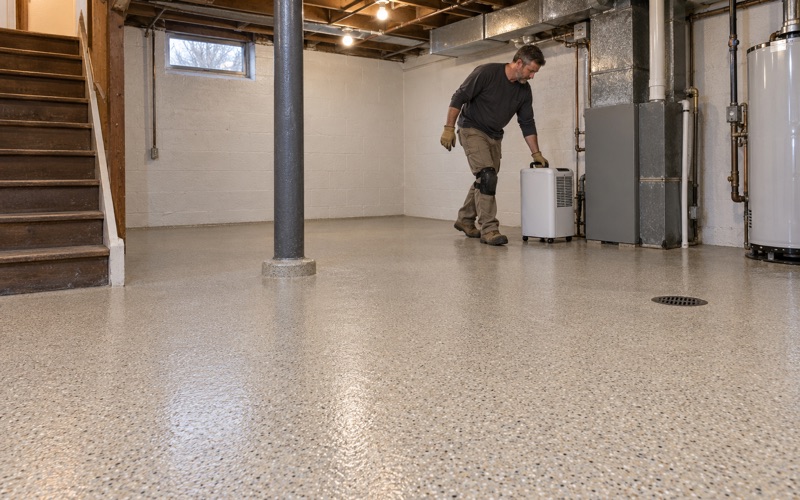
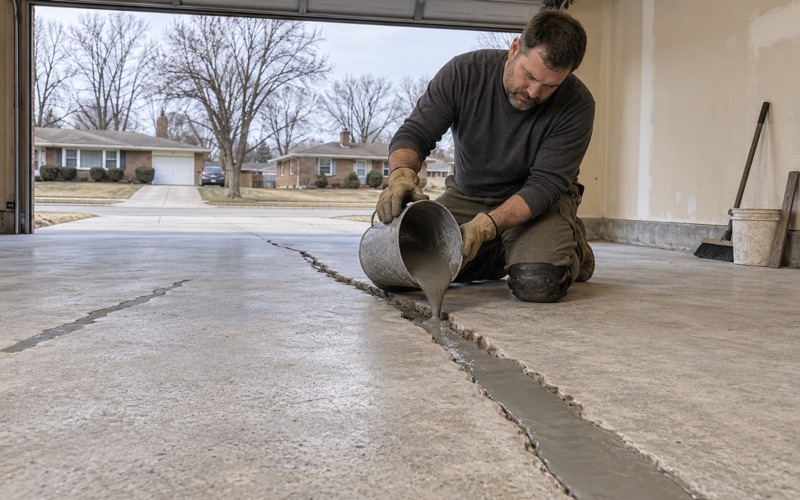
Old shop slabs often carry cracks, spalls and earlier paint, and those get mapped before anything is priced. If the concrete at the pit edge is broken, the edge needs repair before a line is painted next to it. A moisture test is written into the scope, and the proposal names the test method and the number it has to pass.
Cure times follow slab temperature and dew point, not the calendar, so an unheated garage in deep winter waits for better conditions. Every proposal names the product line, the coat count and the finished thickness, which gives the shop a way to check the band against the paper. When the topcoat finally wears thin over the line, it can be recoated before the color underneath is gone.
Old Grease Pits in Hickory Hills Garages
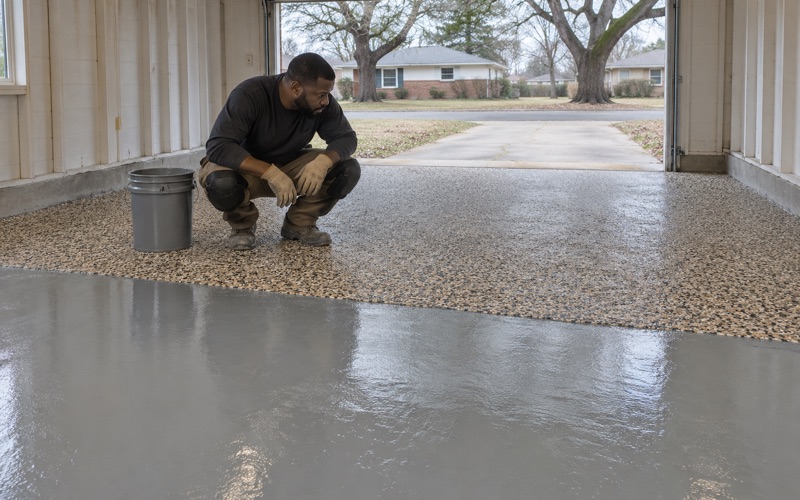
More than half of the houses in Hickory Hills were built between 1960 and 1979, and that is the age of garage where we sometimes look for a pit cut into the floor for oil changes. Where one exists, it is usually long out of use. Covering it with planks or a sheet of plywood turns the hazard from an open edge into a hidden one.
The homeowner’s version of the shop decision has the same logic: either the pit is taken out of service properly, or it is kept and clearly marked. What does not work is a coated floor that runs right up to a loose cover.
Filling a Pit Properly
If the pit is not coming back, the best answer is usually to fill it and pour a new concrete section flush with the slab. We check with the City of Hickory Hills Building Department about what the work requires before it is scheduled. A new pour needs its own cure and moisture test before it can be coated with the rest of the garage.
The joint between new and old concrete is the place that will show if it moves. We grind across it, treat it as a crack to be detailed, and then carry the coating over it in one continuous system so the old pit outline does not telegraph through.
Keeping It, Marked and Covered
Some owners still use a pit, or want to keep the option. In that case the cover should be rated for the load it may see, fitted flush and secured, and the edge marked with the same kind of coated, high-contrast band a shop would use. The rule written for employers does not bind a homeowner, but the reasoning behind a visible line holds just as well.
Hickory Hills requires every contractor to hold a city license that runs January 1 through December 31, with no half-year option, and it asks for a certificate of insurance naming the city plus a copy for the owner before work begins. We confirm those requirements before booking a job here. A floor coating, in a shop or a home garage, is a durable marking surface, never a substitute for the cover, the training or the signs that keep people out of the pit.
- 20+ Years Coating Concrete
- Written Moisture Testing
- Free Estimates