Gary Epoxy Flooring brings more than 20 years of epoxy flooring experience to Highland and the rest of our Lake County service area, and the floors we coat here usually fall into two groups. One is the attached garage that shelters a work truck every night. The other is a single room inside the house where a homeowner sees clients, teaches or works.
Those two floors ask for different systems. A garage that takes a warm truck at the end of every shift needs a coating chosen for tire contact and grit, while a room with a salon chair or a dance floor needs a surface that cleans easily, looks finished and gives the right footing. We plan each one on its own terms, and the proposal you get spells out the product line, the coat count and the finished thickness so you can check the floor against the paper.
Before any of that, every slab gets a moisture test written into the scope, and the price is not final until the test method and its passing number are on the proposal. That habit matters on both floors, because moisture is the first thing a coating warranty leaves out.
What Highland’s home-occupation code says about garages and rooms
Highland, Indiana sets out where a home business may operate in plain terms. Highland Municipal Code 18.05.060 has a home-occupation section, (H), that draws the floor plan for anyone who runs a business from the house, and it is worth reading before you decide which floor to invest in. We are flooring contractors, not zoning advisors, so we point you to the text and the town rather than interpret it for you.
One room, and a cap on the ground floor
Under subsection (H)(6), a home occupation may use a maximum of one room in the dwelling, and in no case more than 25 percent of the ground floor area of the residence. Subsection (H)(7) adds that no building or space outside the main building may be used for home occupational purposes, with an exception for agricultural uses.
Read together, those lines put the business inside the house in a single room. For a flooring decision, that tells us which surface carries the clients, the equipment and the daily foot traffic, and it is rarely the garage.
The work vehicle and the enclosed garage
Subsection (H)(5) allows one vehicle of not more than one ton to be used with the home occupation, provided it is owned by the operator and stored in an entirely enclosed garage when not in use. Commercial vehicles or trailers with hoisting devices, snow plows or cargo containers are not allowed.
That sentence is the reason so many Highland garages we see park a pickup or a light van that leaves in the morning and returns at night. The garage’s job is shelter for a working vehicle, and the coating has to be chosen around that routine. How the town applies these sections to a particular attached garage is a question for the town, and we do not speak for it.
Looking for epoxy-flooring closer to Hobart? See Epoxy-Flooring in Hobart.
A daily work-truck floor: hot tires, grit and a topcoat that takes it
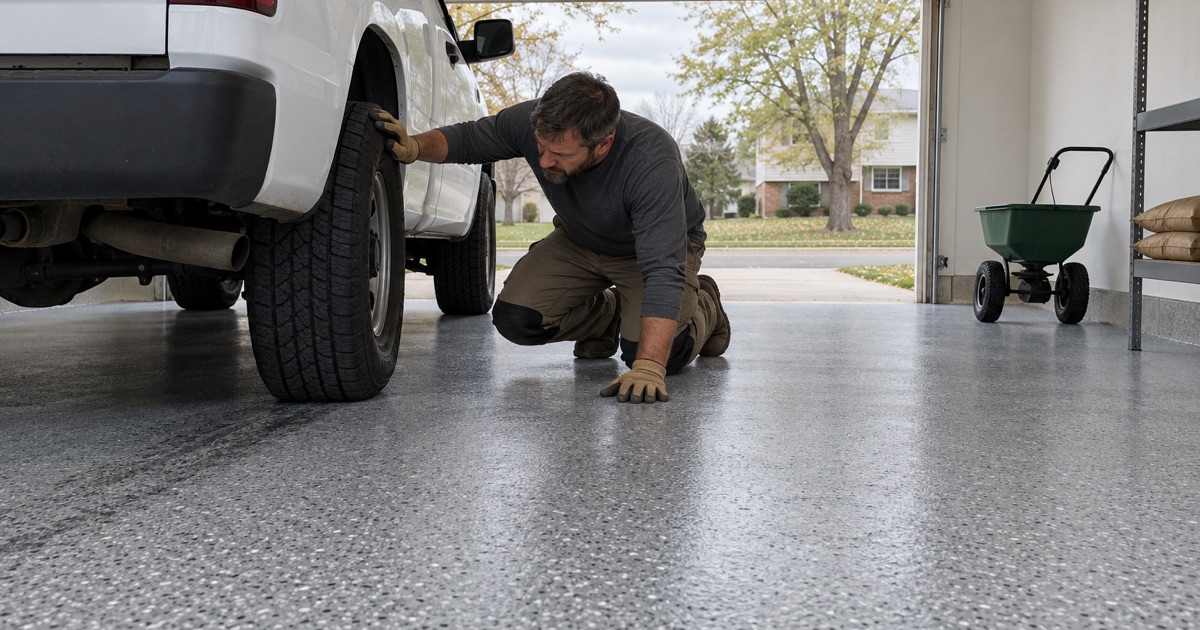
A truck that pulls in after a day of driving puts warm rubber straight onto the coating, and it does that every evening rather than on the occasional weekend. Some coatings soften or stain under warm tires as plasticizers migrate out of the rubber, a failure the trade calls hot tire pickup. It shows up first as tire-shaped marks in the parking lanes and can end with the coating lifting where the tires rest.
Opening the slab so the coating grips
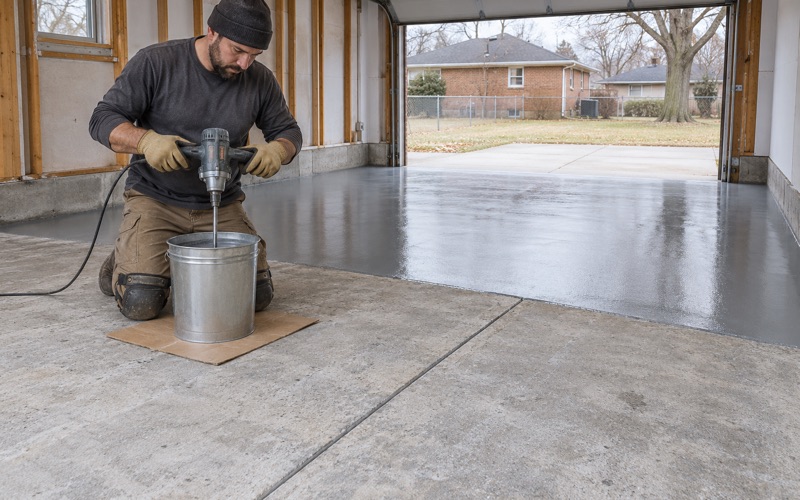
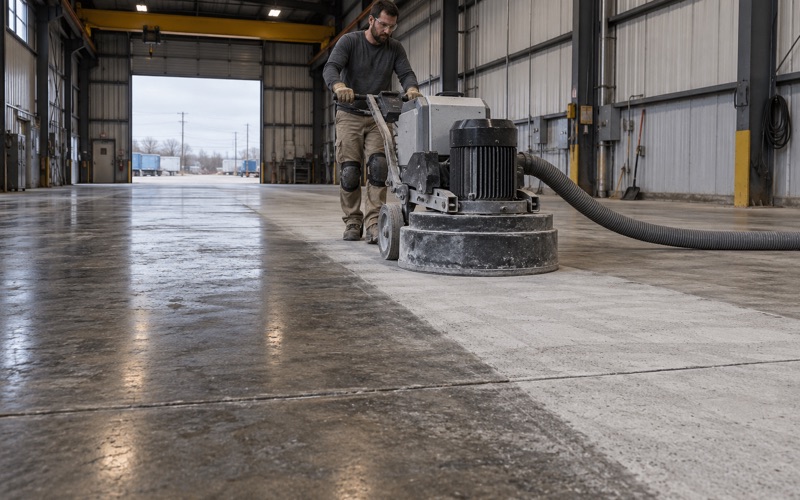
The best defense against hot tire pickup starts below the coating. We open every garage slab with a diamond grinder or a shot blaster, never an acid etch, and aim for a concrete surface profile in the ICRI CSP range the chosen system calls for. A real profile gives the primer something to bite into, which is what keeps a parking lane bonded when warm tires pull at it.
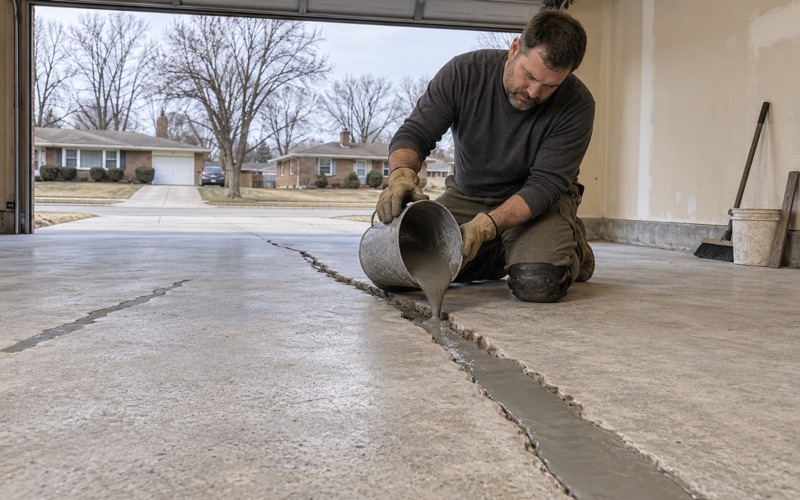
Grinding dust is pulled into a vacuum at the machine instead of being rinsed out the garage door toward a storm inlet. Before coating, we map cracks, spalls and old paint across the slab. If a section is too far gone to hold a coating, we say so and recommend repair or replacement first rather than coating over a problem.
Choosing a system for the parking lanes
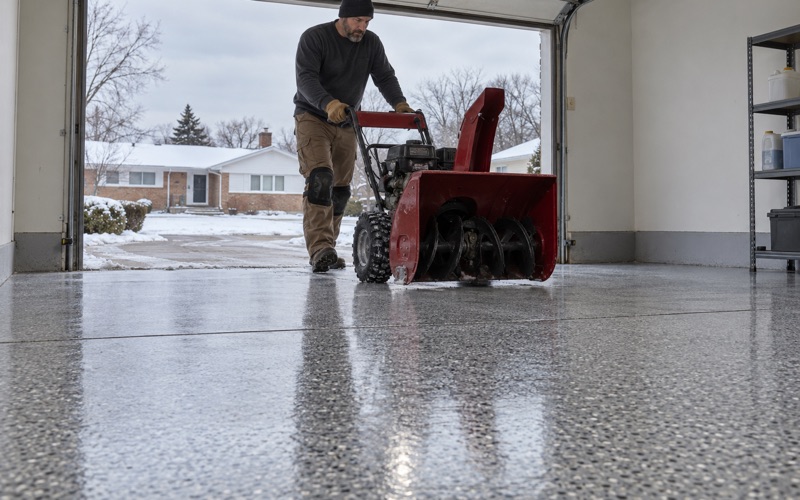
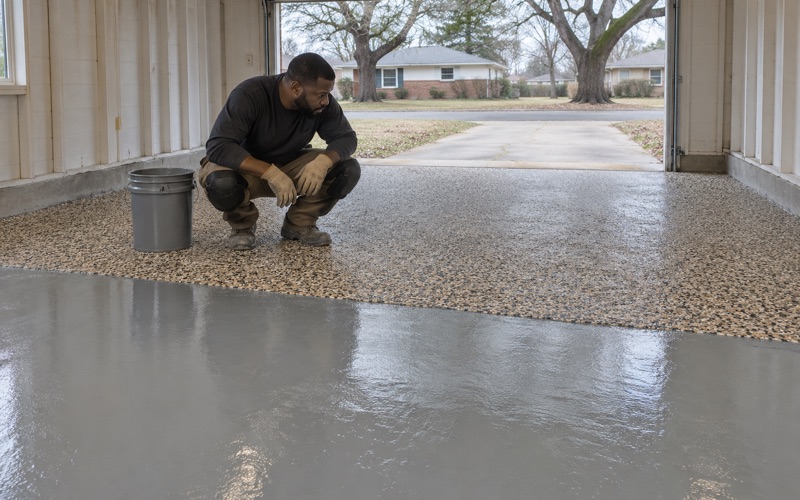
For a daily vehicle we usually build on a 100% solids epoxy base, broadcast with vinyl flake or quartz aggregate, then sealed with a polyaspartic or polyurea topcoat. That top layer is the one the tires touch, and it is selected for hot tire resistance and abrasion rather than gloss alone.
The broadcast also sets the texture. Grit tracked in from job sites wears a smooth floor dull in the lanes and makes it slick when wet, so we specify the slip resistance by the aggregate and topcoat used, and name both on the proposal rather than promising a feel. A heavier quartz broadcast holds up better where a work truck turns in every day.
Cure timing and cold weather
A garage with a truck in it is a garage someone wants back quickly. We set return-to-service times by slab temperature and the dew point spread at the slab surface, not by the calendar. An unheated garage in deep winter is told to wait, because a coating that cures cold can blush or stay soft, and amine blush under a topcoat is a common source of early failure.
We also plan around the truck itself. Where the vehicle cannot sit outside for long, we sequence the work so the driving lanes get their full cure before the first evening parking, and we say on the proposal how many days that takes at the conditions we measured.
The business room: one-chair salons, studios and offices
While the garage holds the truck, the business itself lives in that one room. Subsection (H)(8) of the code lists permitted home occupations, among them a barber or beauty shop limited to one customer at a time, music or dance instruction limited to one pupil at a time, an art studio, photography, dressmaking and professional offices. Each puts a different load on a floor.
A one-chair barber or beauty shop
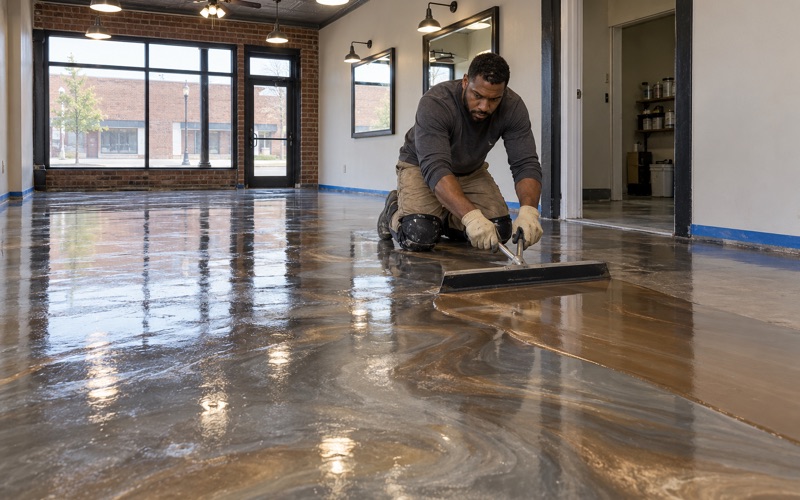
A salon room sees hair, chemical drips and a rolling chair base, all in a small footprint. A seamless coating with a smooth to lightly textured finish lets clippings sweep up in one pass and keeps stains from setting into concrete or worn vinyl.
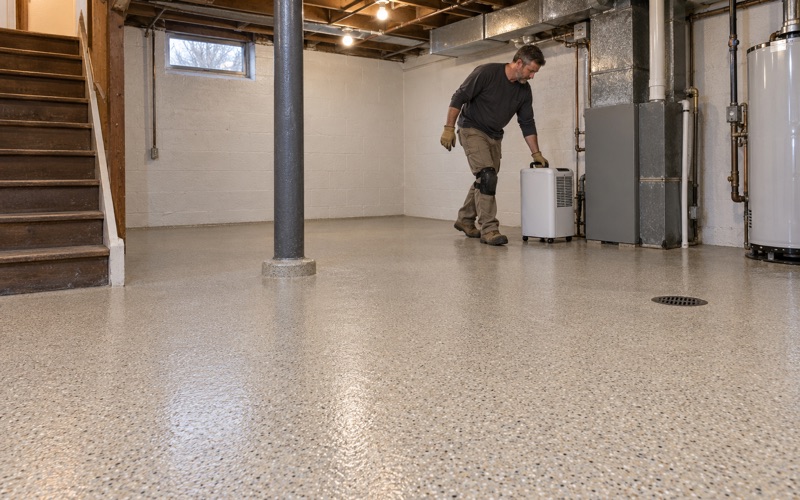
Where the room sits on a slab, such as a finished basement or a converted lower level, the moisture test does real work. A slab that passes a plastic sheet check under ASTM D4263 can still read high on ASTM F2170 in-situ relative humidity probes, and we write the method and the target number into the proposal before pricing. If the reading is high, a moisture-mitigation primer goes into the scope rather than being discovered after the fact.
Studios and offices
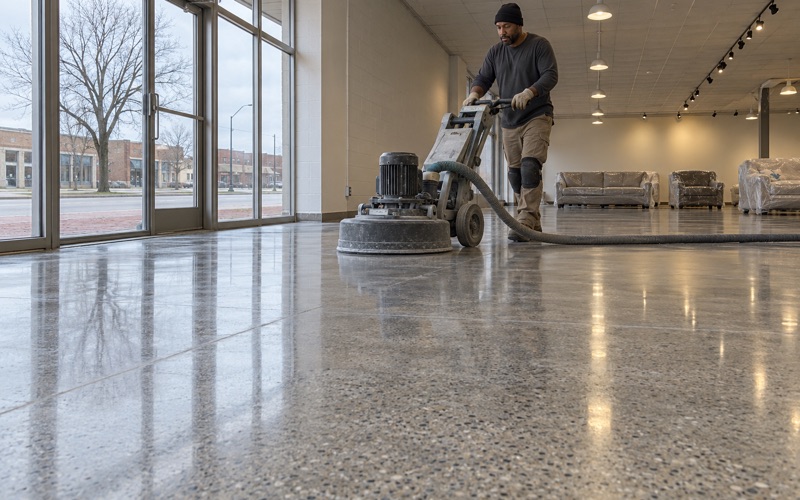
A one-pupil music or dance studio wants even footing and a finish that does not glare under lights. A satin topcoat over a smooth base suits most of these rooms, and we keep the texture modest so shoes neither stick nor slide. An art studio or a photography room usually wants a neutral color that cleans up after paint and plaster.
A professional office often needs the least, and a densified or lightly coated concrete floor can be enough. We would rather tell you that than sell a heavier system the room will never use.
What goes into the written contract
Home jobs get a written contract before any grinding starts, carrying the items Indiana’s Home Improvement Contracts Act (IC 24-5-11) lists. Alongside that, we explain what the coating warranty excludes before you sign, and moisture is the first exclusion we name. A floor coating is never sold as radon reduction or waterproofing, in a business room or anywhere else.
Not a garage shop: what the code rules out and who to ask
Some homeowners ask us to coat a garage so it can double as a workspace. Under subsection (H)(9), a machine shop or automobile repair shop is not a home occupation at all, and neither is a construction shop or related use such as landscaping. A coating does not change that, and we do not market any floor as making a garage business legal.
What a coating can and cannot do
A good garage coating keeps a parking floor clean, resists tire marks and makes grit easy to sweep out. It does not turn a garage into an approved workspace, and it does not settle how the town reads its own code. Those are separate questions, and they deserve a direct answer from the people who enforce the code.
Who to call in Highland
The Town of Highland Building & Inspection Department works out of the Highland Municipal Building at 3333 Ridge Road, and it can be reached at (219) 972-7595 between 8:30 a.m. and 4:30 p.m. on weekdays. The department posts the home-occupation excerpt, permit forms and its contractor licensing documents, and it keeps lists of contractors licensed to work in town.
Before we book a Highland job, we check the town’s current contractor licensing, bond and insurance rules so the paperwork is settled ahead of the first day. If you are unsure whether your plans for a room or a garage fit the code, ask the department first, then call us to talk through the floor itself.
Coatings and air rules
Highland lies in North Township, inside the Chicago ozone nonattainment area, and Indiana’s coating rule, 326 IAC 8-14, binds whoever applies the product. Floor coatings are capped at 250 g/L of VOC and industrial maintenance coatings at 340 g/L, and we pick products inside those limits for both the garage and the business room.
- 20+ Years Coating Concrete
- Written Moisture Testing
- Free Estimates