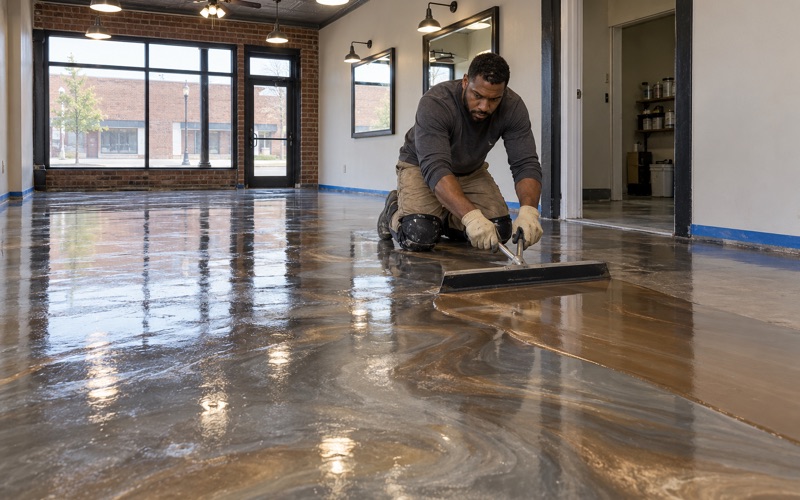
Gary Epoxy Flooring has spent more than 20 years on epoxy flooring in Hobart and the rest of northwest Indiana, grinding, priming and coating concrete for homeowners and businesses. On a job here, the first conversation is rarely about color. It is about what the floor has to live with: what gets tracked in, spilled or sanded onto it, and how someone will clean it at the end of a shift or a Saturday project.
That question carries extra weight in this city, because some of Hobart’s floors sit under saws and sanders, and fine dust on bare concrete is a housekeeping problem before it is a cosmetic one. A sealed, smooth coating makes that dust easy to pick up. It does not stop the dust from being made, and we say so before anyone signs.
Every slab we coat is opened with a diamond grinder or a shot blaster, never an acid etch. The written proposal then names the product line, the coat count and the finished thickness, so the floor you end up with can be measured against the paper.
A Balsa and Basswood Mill on S. Indiana Street in Hobart, IN
Midwest Products has made craft wood at 400 S. Indiana Street in Hobart, IN since 1952. The company describes its signature micro-cut woods, sold as balsa and basswood sheets and strips, and says its basswood is grown in Michigan and Wisconsin and manufactured in Hobart. That is a working wood mill inside a city Wikipedia describes as historically residential.
We use the mill as an example because it makes a mechanism easy to see, not because we have worked there. It is not a customer of ours, we have not been inside, and we do not know how its floors are finished or how it collects dust.
What fine wood cutting leaves behind
Cutting wood into thin sheets and narrow strips throws off sawdust, and sanding throws off finer dust still. The finest particles hang in the air for a while, then settle on ledges, beams, machine housings and, above all, the floor. A light layer builds up slowly enough that the people working over it stop noticing it.
That same pattern shows up anywhere wood gets cut in Hobart: a millwork or pallet shop, a school wood lab, a maintenance bay that rips plywood for repairs, or a detached garage with a table saw and a random orbit sander. The scale changes from building to building. The physics of fine dust settling onto a floor does not.
Another organic dust off Business Route 6
Wood is not the only organic material handled in town. Indiana Botanic Gardens, which Wikipedia calls the nation’s largest and oldest retailer of herbs, sits off Business Route 6, and dried plant material can make fine dust of its own.
We raise it only to make the point that combustible dust is not limited to sawmills. We have no relationship with that business either, and we know nothing about its floors. Any building where a dry organic material gets ground, cut or poured raises the same housekeeping question.
Looking for epoxy-flooring closer to East Chicago? See Epoxy-Flooring Services in East Chicago.
Wood Dust on the Floor: The 1/32-Inch Line Indiana OSHA Enforces
Fine wood dust that settles and builds up is a combustible dust concern, and Indiana treats it as one. The useful thing for an owner to know is that the regulators measure the problem on surfaces, and the floor is the largest surface in any shop.
IOSHA adopted the federal emphasis program identically
Indiana runs its own workplace safety program, Indiana OSHA (IOSHA), as a state plan. On July 30, 2023, IOSHA adopted federal OSHA’s Revised Combustible Dust National Emphasis Program, directive CPL 03-00-008, identically rather than writing its own version.
For a Hobart shop owner, that means the federal approach to finding and judging combustible dust is the approach the state program uses. We are a flooring contractor, not a safety consultant, so we point clients to IOSHA and their own safety advisers for what an inspection looks at. What we can speak to is the part of the picture that sits under everyone’s boots.
How thin a layer counts
OSHA’s April 21, 2015 interpretation on accumulation depth treats a 1/32-inch layer as hazardous when it extends over five percent of the floor area of a room or a building, or 1,000 square feet, whichever is less. The figure rests on assumptions that include a bulk density of 75 pounds per cubic foot, and the emphasis program references it.
The arithmetic is simple and a little sobering. In a 10,000-square-foot shop, five percent is 500 square feet, so a 1/32-inch layer over an area the size of a two-car garage reaches the line. In a building over 20,000 square feet, the 1,000-square-foot cap is the smaller number and governs instead.
What a coating can and cannot do here
A floor coating is not dust control, it does not reduce the explosion hazard of dust in the air, and it earns no sign-off from OSHA on its own. Nothing we install changes how much dust a saw makes.
What a coating can change is how quickly settled dust gets found and removed. On a light, sealed floor, a fine layer shows up against the color and lifts off in a pass. On gray, open concrete, the same layer blends in and works into the surface, which is how a building drifts toward that 1/32-inch line without anyone deciding to let it.
A Floor a Vacuum Can Clear, and Collection at the Saw
If the floor is part of housekeeping, the goal is a surface that gives up dust easily. That is a different target from the thick, heavily textured finish some shops ask for by default.
Sealed and smooth versus porous concrete
Bare concrete is porous, and a slab that has never been sealed often dusts at the surface on its own. Fine wood dust lodges in those pores and in the rough paste, so a broom moves the top layer around and leaves the rest. Each sweep stirs some of it back into the air.
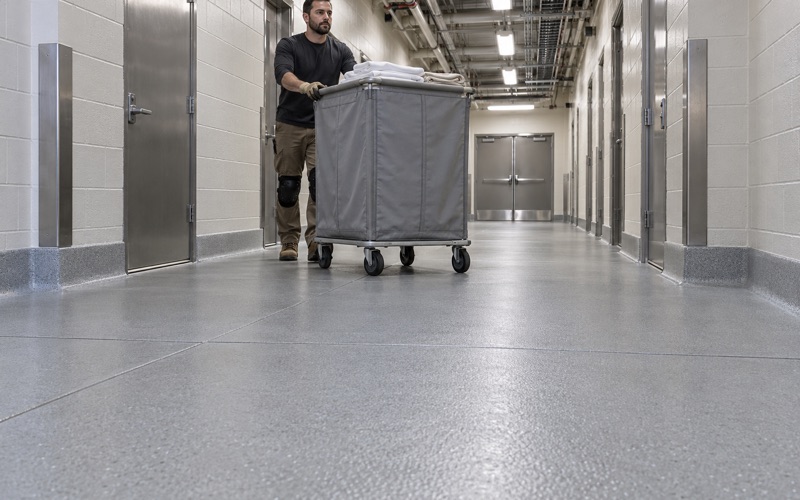
A ground and coated slab closes those pores. For a dust-heavy room we lean toward a 100% solids epoxy body coat with a smooth or lightly textured topcoat, because a deep flake or quartz broadcast gives fines more places to sit. A lithium silicate densifier is another option for a floor that has to stay uncoated, though it hardens the surface rather than sealing it.
Why compressed air is the wrong tool
When a floor will not come clean with a broom, people reach for the air hose. Blowing dust down lofts it into the air and redeposits it on beams, light fixtures and machine tops, which is the opposite of what housekeeping is supposed to do.
A floor that a vacuum can clear in one pass removes the excuse for blowdown. That is the practical case for coating a woodshop floor: it makes the right cleaning method the easy one.
Collection at the machine does the real work
Dust collection at the saws, sanders and planers is what controls the dust, and no floor finish replaces it. A good collector catches the bulk of the chips and fines at the source, and the coated floor handles what escapes.
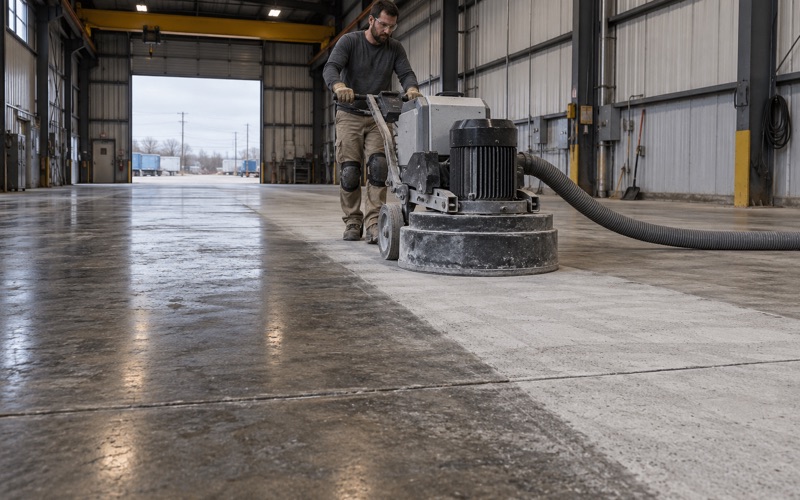
We hold our own work to the same rule. When we grind a slab, the dust is captured at the machine with a vacuum rather than swept loose or rinsed toward a floor drain or a storm inlet. Bringing a cloud of concrete dust into a shop that is trying to stay clean would undercut the reason for the job.
Sanding Dust in a Hobart, IN Home Garage
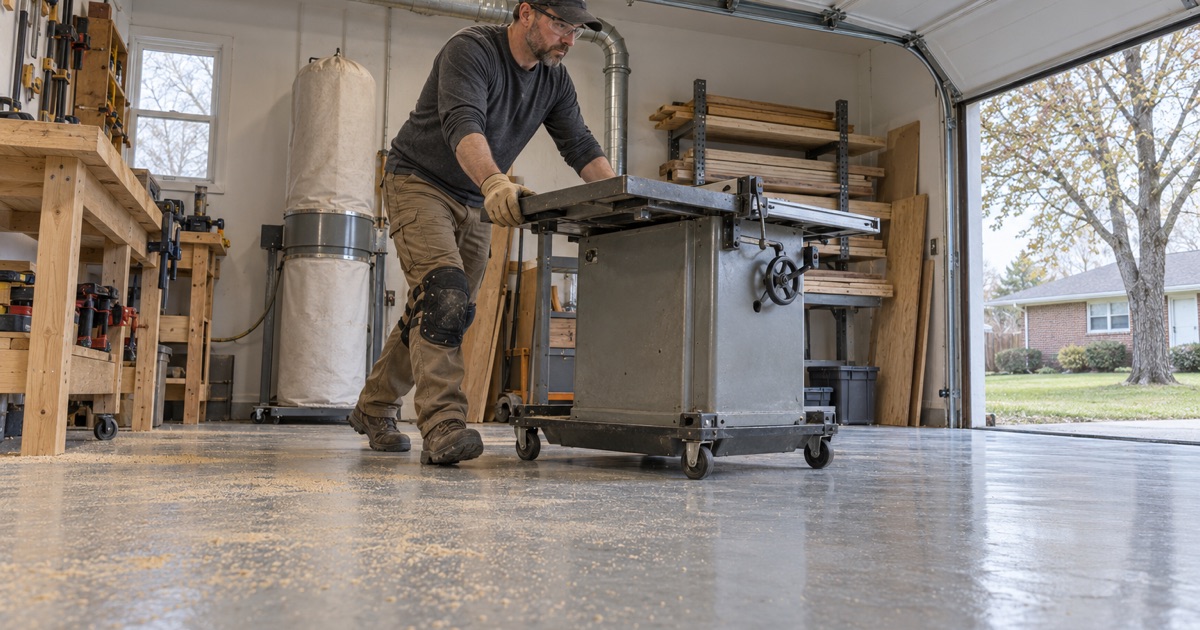
Plenty of woodworking happens at home, too. A garage that doubles as a shop gets the same fine dust as a commercial floor, just in smaller amounts, and it gets winter road salt on top of it.
Hobart’s houses and the garages behind them
According to Census estimates, 65.4 percent of Hobart’s housing units were built before 1980, while the 1990s and 2000s together add another 25.4 percent. Owner occupancy is 69.5 percent, and 94.3 percent of owner-occupied homes are detached houses.
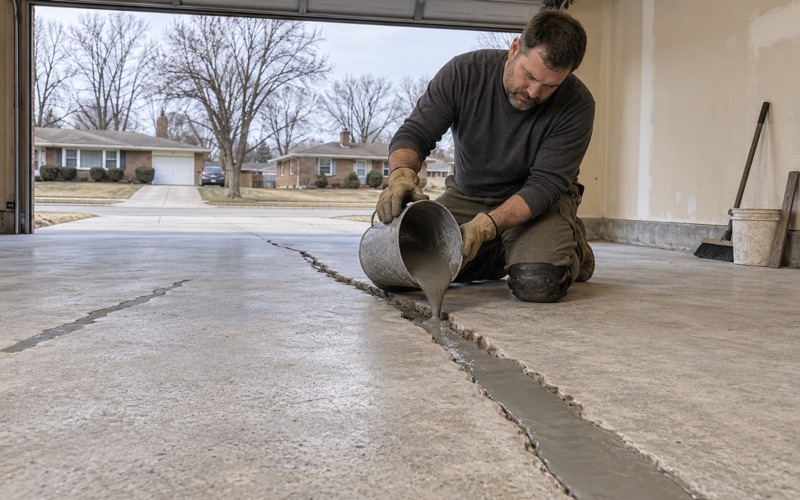
An older garage slab often carries old paint, oil stains, patched cracks and spalls. We map those first and tell you when a slab needs repair or replacement before it should be coated. Coating over a failing slab just puts a nice color on a problem.
Choosing a system for a garage woodshop
For a garage that sees sawdust in summer and slush in January, the system has to do two jobs. It has to hold up to the brine and rock salt that ride in on tires all winter, and it has to stay smooth enough that sanding dust vacuums off. We often pair an epoxy base with a polyaspartic topcoat and keep any broadcast light.
Cure schedules follow slab temperature and dew point, not the calendar. An unheated Hobart garage in deep winter is told to wait for warmer weather, because a coating that cures too cold can blush, stay soft or lose its grip.
Moisture, paperwork and local rules
A moisture test is part of the written scope before the price is final, and the proposal names the method, such as ASTM F2170 in-situ relative humidity probes or ASTM F1869 calcium chloride testing, and the number the slab has to pass. Moisture is also the first exclusion we name when we explain what a coating warranty leaves out.
Home jobs get a written contract carrying the items Indiana’s Home Improvement Contracts Act lists before any grinding starts. The City of Hobart Building Department requires any contractor, subcontractor or specialty contractor working within city limits to be licensed, so we check the city’s licensing, bond and insurance rules before a job is booked. Hobart also sits inside the Lake County part of the Chicago ozone nonattainment area, and Indiana’s 326 IAC 8-14 caps floor coatings at 250 grams per liter of VOC, a limit that binds whoever applies them.
- 20+ Years Coating Concrete
- Written Moisture Testing
- Free Estimates