
Gary Epoxy Flooring installs industrial epoxy flooring in Gary, IN, serving surrounding cities including Lake Station, Griffith, Highland, Hobart and East Chicago. Northwest Indiana is built around heavy industry, and in 20+ years of coating concrete we have seen what plant and warehouse floors go through: steel wheels, dropped parts, forklift traffic, oil, coolants, slag and winter brine dragged in from the yard.
Industrial floors fail for predictable reasons. The slab was not opened deeply enough, oil was left in the concrete, the system was too thin for the loads, or the coating was rushed back into service before it cured. We plan against each of those on paper before any equipment arrives, and the written proposal names the preparation method, the moisture test and its passing reading, the product line, the coat count and the finished thickness by area.
Most plants cannot stop for long, so phasing is part of the design. We schedule around shifts, shutdowns and holiday outages, close one area at a time, and choose cure times that fit the window the plant actually has.
Systems for Heavy-Duty Floors
High-Build and Broadcast Epoxy
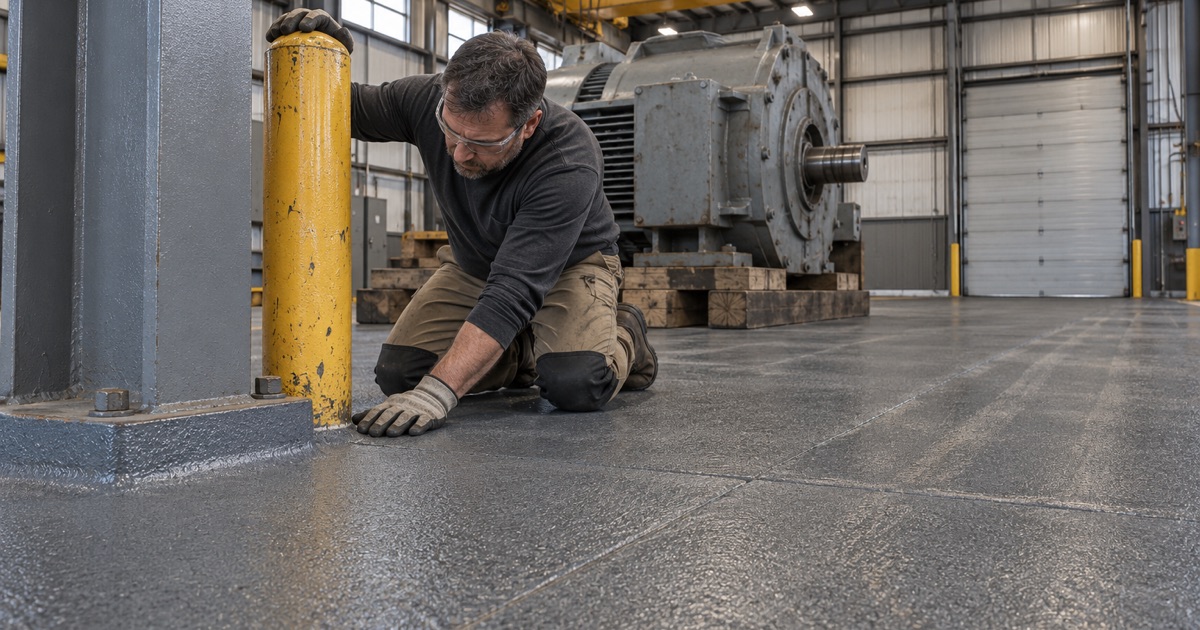
For most plant and warehouse floors, the backbone is a high-build 100% solids epoxy, often with a quartz or aggregate broadcast to add thickness, impact resistance and texture. Built in multiple layers, these systems hold up to forklift traffic and rolling loads far better than a single thin coat.
We size the build to the area. Aisles carrying loaded forklifts get more thickness than a parts storage room, and areas with dropped steel get a tougher, thicker system than an office corridor in the same building.
Trowel-Applied Epoxy Mortar
Where floors take heavy impact, such as under machining centers, at loading docks or in fabrication bays, a trowel-applied epoxy mortar is often the right choice. It is much thicker than a rolled coating and can also rebuild damaged or uneven concrete in the same step.
Mortar systems are sealed with a topcoat that closes the surface for cleaning and chemical resistance. They take more time and cost more, so we use them where the floor genuinely needs them rather than across an entire building.
Urethane Cement for Heat and Chemicals
Urethane cement handles thermal shock, hot washdown and aggressive chemicals better than standard epoxy, and it tolerates more moisture in the slab. It suits food processing, chemical handling and areas cleaned with hot water or steam.
In mixed facilities, we often combine systems: urethane cement in washdown or process zones and epoxy in dry production and storage areas, with planned transitions so the two meet cleanly.
Plant, Mill and Warehouse Conditions
Maintenance Shops Around Heavy Industry
Maintenance shops serving steel mills and heavy plants see steel-wheeled carts, dropped parts, lubricants and welding. Floors there need impact resistance and easy cleanup, and they need to be shot blasted to a rough profile so thick systems lock in.
Welding sparks are usually tolerated by resin floors, but hot slag that sits on the surface can mark it. We discuss sacrificial mats or bare zones in heavy cutting areas so the rest of the shop keeps a sealed, clean floor.
Warehouse and Distribution Floors
Forklift and pallet jack wheel loads concentrate stress at joints and in turning lanes. We rebuild chipped joint edges, fill joints with semi-rigid filler, and specify thicker systems in high-traffic lanes so the coating does not wear through where the trucks turn.
Large warehouse slabs are usually prepared by shot blasting, which leaves a uniform profile quickly over big areas. Any loose shot is collected completely before people or equipment cross the floor.
Oil, Coolant and Contaminated Slabs
Industrial slabs often carry decades of oil, hydraulic fluid and coolant. We prepare contaminated areas more aggressively, degrease them, and test whether the concrete still repels water before coating. Where contamination persists, an oil-tolerant primer is specified.
Moisture is tested alongside contamination, using ASTM F1869 calcium chloride kits or ASTM F2170 relative humidity probes across the floor. Older industrial slabs in the region were often poured without a vapor retarder, and a high reading changes the primer, the system and the warranty discussion before the price is final.
Safety and Workflow
Slip Resistance and Texture
Slip resistance is specified by the broadcast aggregate and topcoat used, not promised. Oily production areas and wet zones get more texture, while areas that need easy cart rolling get a finer finish, and we balance grip against cleanability for each zone.
Loading docks and doorways to the yard need extra attention in winter, when trucks and forklifts track in snow, slush and salt. A heavier broadcast at those transitions keeps footing secure where the floor is wet most often, and it wears more slowly under the constant turning of loaded equipment.
Safety Striping and Marked Zones
Aisle lines, forklift lanes, pedestrian walkways, hazard zones and equipment keep-out areas are coated into the system in contrasting colors. Coated lines last longer than paint or tape and keep the facility’s traffic plan visible for years.
We lay out striping with your safety team before the final coat, so lines match the actual traffic flow and racking layout rather than a drawing that changed months ago.
Dust Control in Working Facilities
Grinding and shot blasting create fine dust that can coat equipment and inventory. Our machines run tied to industrial vacuums that capture dust at the source, and we never rinse debris into floor drains or trench drains that connect to plant or municipal systems.
Compliance in Northwest Indiana
Indiana VOC Limits on Industrial Coatings
Indiana’s 326 IAC 8-14 caps industrial maintenance coatings at 340 g/L and floor coatings at 250 g/L, and the rule applies to whoever applies or solicits the application of a coating, not only to the manufacturer. Gary’s Calumet Township is also part of the Chicago 2015 ozone nonattainment area.
We select products that meet these limits and never thin them on site, which the rule specifically prohibits. Product data sheets are included with the proposal for your environmental and safety staff.
Licensing, Insurance and Bonding
The City of Gary requires flooring subcontractors to be licensed, insured and bonded through the Lake County Recorder, and other municipalities in the region have their own rules. We confirm those requirements and provide certificates before work begins on site.
- 20+ Years Coating Concrete
- Written Moisture Testing
- Free Estimates