Gary Epoxy Flooring brings more than 20 years of epoxy flooring in Justice and across the region to shop floors where diesel trucks are fueled, fixed and parked. In a village like this one, the fluid that decides how a coated floor should be detailed is often not oil or brake cleaner. It is diesel exhaust fluid, the clear liquid every modern diesel truck carries in its own tank.
DEF is unusual among shop fluids because the resin itself handles it well. The damage it does comes later, as a spill dries into white crystals and reaches bare metal set into the floor. So a good shop floor here is planned around rinsing, containment and the right metal at the fill point, not around a thicker topcoat.
This page covers what DEF is, where it causes trouble on a coated slab, and how we set up a floor so the fluid stays a nuisance rather than a repair bill. It also covers the diesel pickup in a home garage, which brings the same jug and the same drips into a much smaller space.
Diesel Trucks on Archer Road and the Fluid They All Carry
A trucking village, by its own count
The village’s own business list, updated in July 2025, carries a truck and trailer repair section and roughly 60 trucking companies, most of them run as home occupations. One of the names on that repair list is District Recovery, Inc., at 7450 S. Archer Road. Directories describe it as a towing, heavy-duty towing and roadside service that also repairs trucks, trailers and refrigeration units.
Its federal carrier record is the part we can state flatly. The FMCSA snapshot for USDOT 1067716 lists District Recovery Inc at that Archer Road address as an active for-hire carrier with 11 power units and 11 drivers. We have no working relationship with the company and have never seen its floor or how it stores fluid; we use it only because it shows how ordinary heavy diesel equipment is in Justice.
What diesel exhaust fluid actually is
Diesel exhaust fluid is 32.5 percent urea in demineralized water, made for injection into a diesel engine’s selective catalytic reduction, or SCR, exhaust system. Trade press reports that when the federal heavy-duty NOx standard tightened for the 2010 model year, about 85 percent of truck and engine makers chose SCR. That is why a tote or a rack of jugs now sits near the door in most diesel shops.
One supplier’s safety data sheet describes it as a slightly alkaline liquid at pH 9.5 with a faint ammonia odor, not classified as hazardous. It lists stainless steel, polyethylene and polypropylene as suitable containers. The same sheet notes that heated DEF releases ammonia, which is one more reason it belongs in a cool spot away from heaters and exhaust.
Looking for epoxy-flooring closer to Mokena? See Mokena Epoxy-Flooring.
The Resin Is Fine; the Steel Beside It Is Not
Why DEF does not worry us on the coating
Most fluids in a truck shop are judged by whether they soften or stain the topcoat. DEF is mostly water with a dissolved salt-like compound, and a well-cured 100% solids epoxy or polyaspartic topcoat is not the material at risk. One manufacturer’s immersion chart rates 30 percent urea as having no deleterious action on its solvent-free epoxy, which matches what the fluid’s chemistry suggests.
That chart is one maker’s data for one product line, so we treat it as a sign, not a promise for every system. When we write a proposal for a diesel shop, it names the product line, the number of coats and the finished thickness, so the owner can check the resistance data for the exact materials going down.
Crystals and corrosion as a spill dries
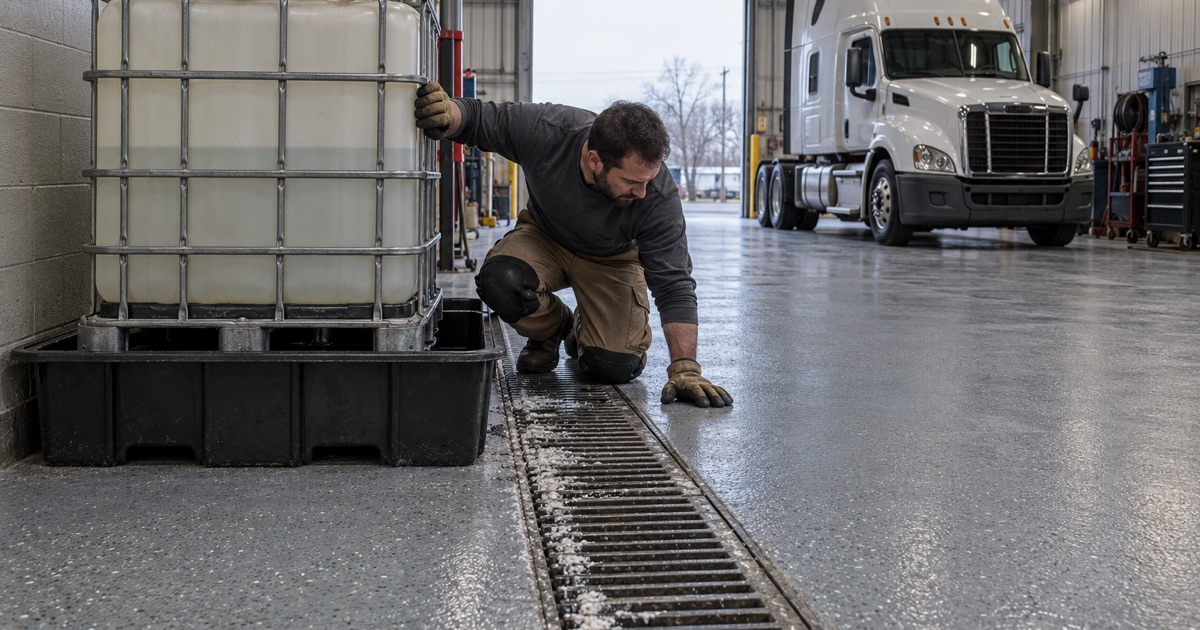
The trouble starts when a DEF spill is left alone. As the water evaporates, urea comes out as white crystals that track across the floor on boots and tires and leave a chalky film that looks like a failing coating even when it is not. A Shell data sheet warns that crystallization upon drying can cause corrosion.
The metals the Go Blue sheet says to keep DEF away from are a list of shop floor hardware: carbon steel, zinc-coated or galvanized steel, mild iron, copper and copper alloys, zinc, lead, aluminum and its alloys. Grates, drain frames, steel stair and dock nosings, diamond plate and metal drip pans are all made of some of these. A floor coating does nothing to protect embedded galvanized steel from DEF, and we never describe it that way.
Choosing the metal before the coating goes down
Because the coating cannot shield that hardware, the decision belongs in planning. Near a fill point, any grate, plate or nosing that sits in or on the floor is best made of stainless steel or kept covered and out of the drip path. We map the slab first, including cracks, spalls and every piece of metal set into it, and we flag hardware near the DEF area so the owner can replace or relocate it before we coat around it.
We stop our coating cleanly at those edges rather than lapping resin over a grate frame. A thin film over steel only hides corrosion until it lifts. The drainage and plumbing themselves stay with the plumber and the village; our job is the floor around them.
Rinse It Wet: Trays, Totes and the Fill Point
Water first, while the spill is still liquid
On a coated shop floor, the simplest DEF habit is the one the data sheets point to. Rinse a spill with water while it is still wet, then squeegee or mop it up, before it has the chance to dry into crystals. The supplier’s sheet also allows sand, earth or vermiculite to soak up a larger spill, which suits a big tote leak better than a hose.
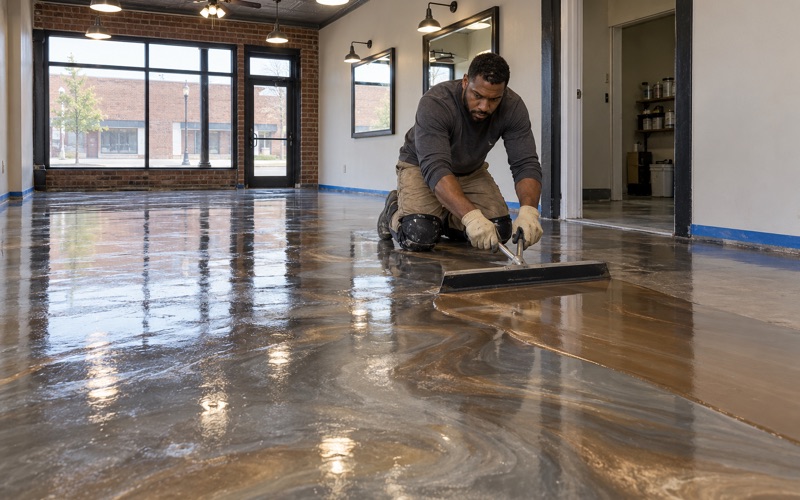
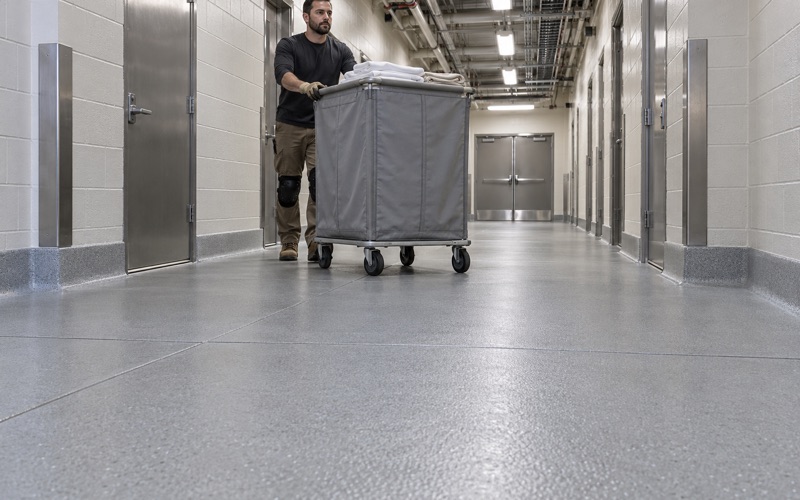
A coated floor makes that rinse easy because the liquid sits on a sealed surface instead of soaking into bare concrete. We specify the finish texture by the broadcast and topcoat used, so a wet rinse area near the pump still has grip without being too rough to squeegee. Quartz aggregate held in the topcoat is the usual choice for that zone.
Totes and pumps in a plastic tray
A DEF tote, its pump and the hose reel do best in a polyethylene or polypropylene containment tray, which matches the materials the safety sheet lists as compatible. Drips from a nozzle or a loose fitting stay in the tray, where they can be rinsed out, instead of creeping under the tote and drying against a steel pallet or a floor plate.
A metal drip pan is the wrong choice here for the same reason a galvanized grate is. We point this out during the walkthrough because it costs little to change and keeps crystals off the floor around the fill point.
Prep and timing in a working diesel shop
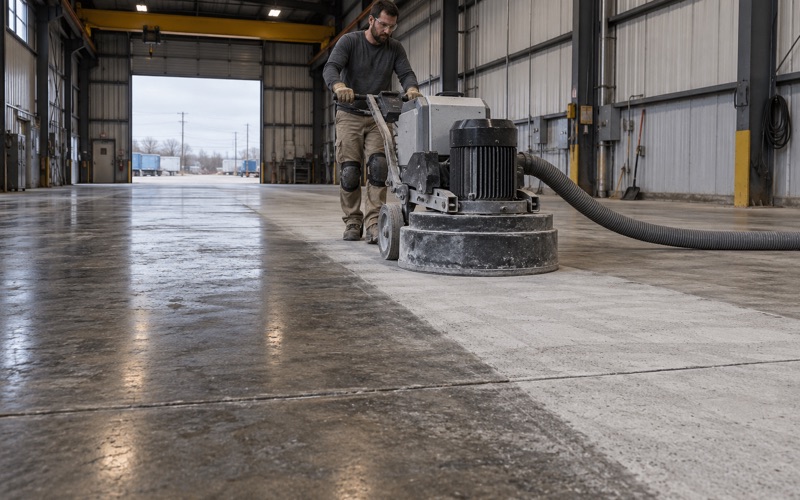
None of this works if the coating does not bond, so every slab is opened with a diamond grinder or a shot blaster rather than an acid etch. Grinding dust is captured at the machine with a vacuum instead of being washed toward a floor drain. A moisture test is written into the scope before the price is final, and the proposal names the method, such as ASTM F2170 in-situ relative humidity probes, and the number it has to pass.
Justice regulates who can work there. The village’s Contractor’s Work Permit Program requires contractors to be insured, licensed and registered, a $10,000 permit bond is standard for contractors other than sewer contractors, and concrete work needs its own permit and a plat of survey. We check those requirements with the Village of Justice Building Department on West 82nd Place before a job is booked.
DEF Jugs and Diesel Pickups in a Justice Home Garage
The same fluid on a smaller scale
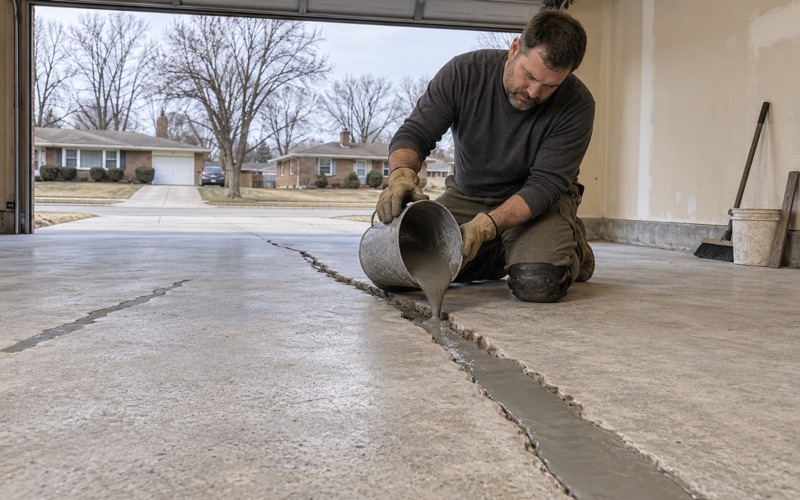
A diesel pickup with an SCR system carries its own DEF tank, and its owner usually keeps a jug or two on a garage shelf. The topping-up happens at home, on a cold morning, and a few ounces down the side of the truck or onto the floor is normal. On a flake or solid-color garage floor, those drips dry into the same white crust a shop sees, only closer to the kitchen door.
The fix is the same habit in miniature. Keep the jugs in a plastic bin rather than on a metal shelf over the floor, wipe or rinse any drip while it is wet, and keep a steel floor plate or aluminum ramp away from the fill spot. A garage coating handles the DEF itself well, and that is exactly why the drips are easy to ignore until the crystals build up.
Winter, salt and when to coat
That same pickup also brings in brine and rock salt all winter, so we choose garage systems to stand up to deicers, not just to DEF. Cure schedules follow slab temperature and dew point at the surface rather than the calendar, and an unheated garage in deep winter is told to wait for warmer weather.
Before any grinding starts on a home job, the owner gets a written contract, and we explain what the coating warranty leaves out, with moisture first on that list. A coating is never sold as waterproofing or flood protection, which matters in a village that names its own flood-prone streets.
- 20+ Years Coating Concrete
- Written Moisture Testing
- Free Estimates