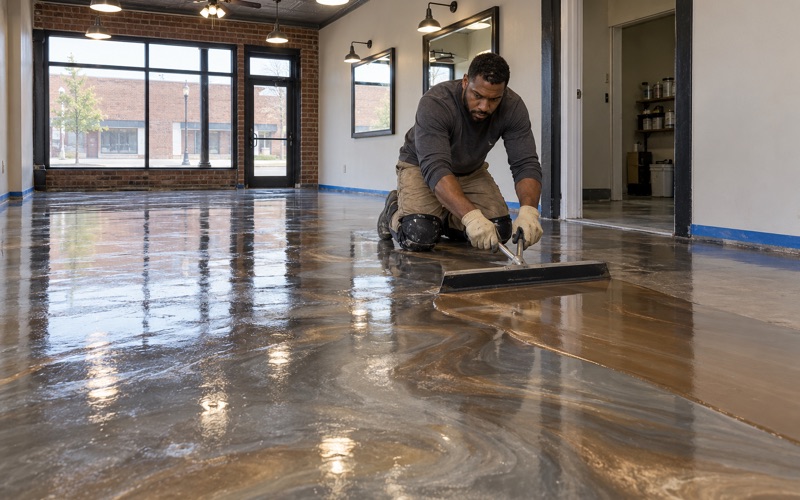
Gary Epoxy Flooring has spent more than 20 years putting epoxy flooring in Lake Station garages, shops and industrial bays, and a growing share of that work starts with one question: what does this floor have to hold if a tank or drum lets go? For a slab inside an oil storage area, the answer shapes everything from the resin we choose to how we close out the job.
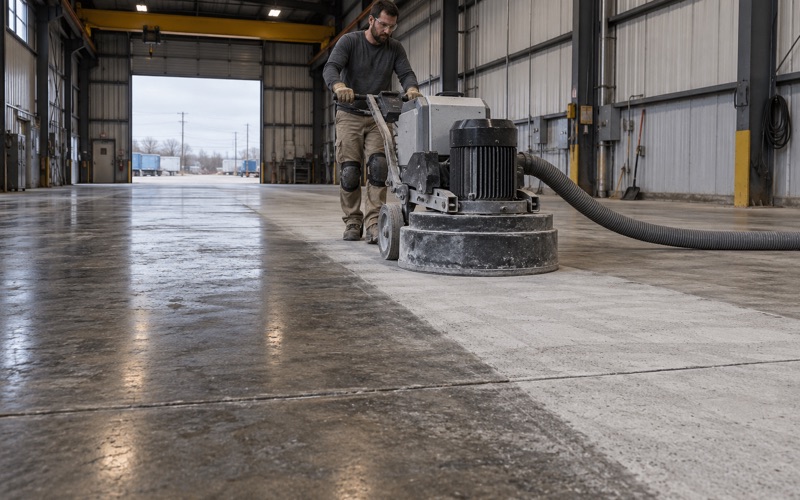
We open every slab mechanically, with a diamond grinder or a shot blaster, so the coating bonds to a real profile instead of a weak surface skin. Before a price is final, the written scope names the moisture test we will run and the reading the slab has to pass.
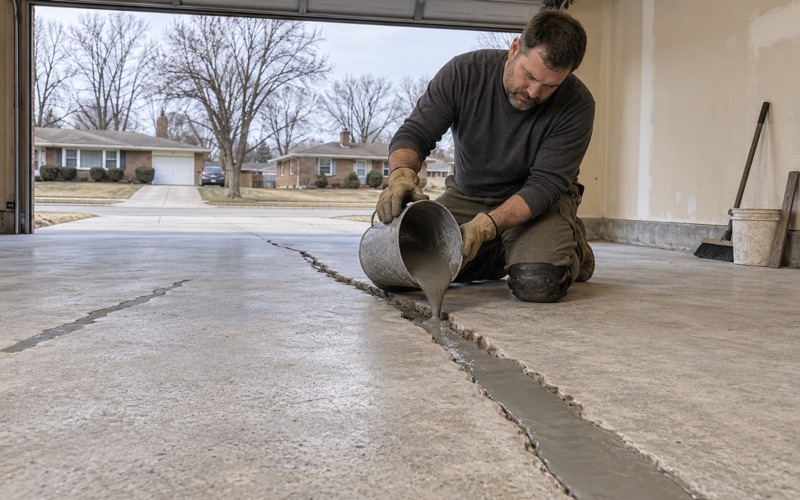
The proposal also lists the product line, the coat count and the finished thickness, which gives a facility manager something to measure the finished floor against. Where a slab is cracked, spalled or carrying old paint, we map it first and say plainly when repair or replacement has to come before any coating.
A Lubricant Blender on Ripley Street and the 1,320-Gallon Line
Lake Station, IN is home to a specialty fluids plant at Ripley and Schneider Streets. Pro-Chem-Co, founded in 1971, describes itself as a leader in the formulation, manufacture and service of specialty lubricants, and it supplies fluids to the steel and metalworking industries from what it calls a 350,000-gallon manufacturing facility with bulk storage.
We name it here as a local example, not a customer. We have never worked for Pro-Chem-Co, and we have not seen whether it keeps a spill plan or a coated containment floor. What it illustrates is a kind of operation where the floor under the tanks is part of a federal rule rather than a matter of looks.
Who counts as an SPCC facility
EPA’s Spill Prevention, Control, and Countermeasure rule, 40 CFR 112, reaches a non-transportation facility once its aggregate aboveground oil storage capacity passes 1,320 gallons. Only containers of 55 gallons or more count toward that total, and a container smaller than 55 gallons is exempt on its own.
That arithmetic catches more sites than people expect. Twenty-five 55-gallon drums add up to 1,375 gallons of capacity, which is already over the line before a single bulk tank is counted.
What a coating cannot do on its own
A coating does not make a facility compliant by itself. The facility’s own spill plan, and the capacity of its containment, decide that question, and we are not engineers.
Our job is narrower and more practical. We build a lining on the slab and curbs that matches what the plan says the area must hold, and we leave it in a condition that can be inspected and repaired against a written record.
Looking for epoxy-flooring closer to Griffith? See Epoxy-Flooring Services in Griffith.
Walls and Floor Must Hold Oil
Section 112.7(c) is the line that pulls the floor into the plan. It calls for appropriate containment or diversionary structures to prevent a discharge, and it says the entire containment system, “including walls and floor, must be capable of containing oil” and must keep a discharge from escaping before cleanup occurs.
The rule allows containment to be active or passive. Among the passive options it lists dikes, berms or retaining walls “sufficiently impervious to contain oil,” curbing or drip pans, and sumps and collection systems.
Why bare concrete is the weak link
Concrete is porous, and oil works into an uncoated slab rather than sitting on top waiting to be pumped out. Joints, cracks and the cold seam where a curb meets the floor are the usual paths out of a diked area.
That is why we map every crack and joint before we price a containment floor. We treat the curb-to-slab junction as its own detail, with its own fill and reinforcement, rather than something the floor coat is expected to bridge.
Bulk-tank areas: the largest container plus rain
For bulk storage tank installations, 112.8(c)(2) asks for secondary containment sized to the entire capacity of the largest single container, plus enough freeboard to contain precipitation. The diked area itself has to be sufficiently impervious to hold discharged oil.
On a dike, the lining covers the floor and the inside faces of the walls to the full containment height. A lining that stops short leaves the top of the wall bare exactly where a large release would reach, so we take that height from the facility’s plan rather than estimating it on site.
Rainwater in a diked area
An outdoor containment collects rain, and 112.8(c)(3) bars draining uncontaminated rainwater from the diked area into a storm drain except through a bypass valve kept sealed, with inspection and records each time it opens. Water can stand on the coating for days at a time.
That changes the product conversation. We look at systems that tolerate long water contact as well as oil, and we detail the floor toward the valve or sump where the existing slab allows. A floor coating is still not waterproofing or flood protection, and we never describe it that way.
Choosing a Containment Coating and Checking It After a Spill
Section 112.8(c)(1) says a container’s material must be compatible with what it stores, and the same logic is how we choose a lining. Motor oil and hydraulic fluid are a different exposure from a blended product carrying additives or solvents, and a lubricant blender may handle all of them under one roof.
Matching the lining to what is stored
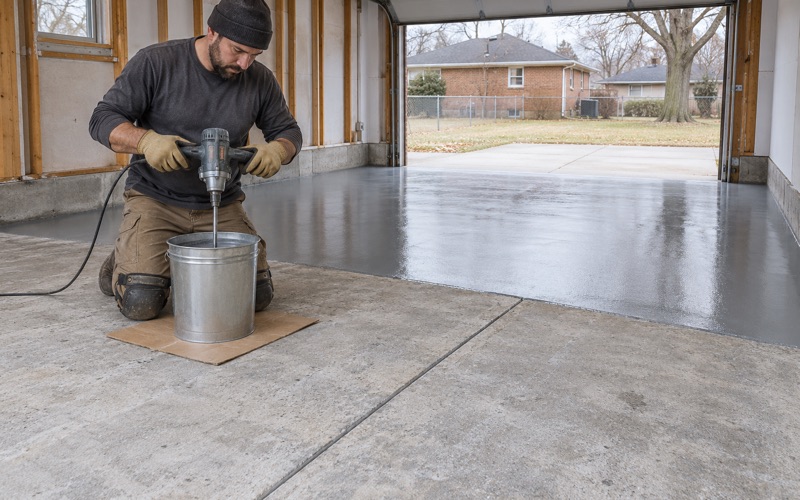
We start from the facility’s list of stored products and its safety data sheets, then match a resin family to that list. For most oil containment that means 100% solids epoxy built to a stated thickness, with a urethane cement system or a chemical-resistant topcoat where the stored products call for it.
We compare resistance data from more than one manufacturer instead of leaning on a single chart. Where a product on the list is unusual, we say so in writing and name the exposure the system has and has not been checked against.
Prep, profile and what the proposal names
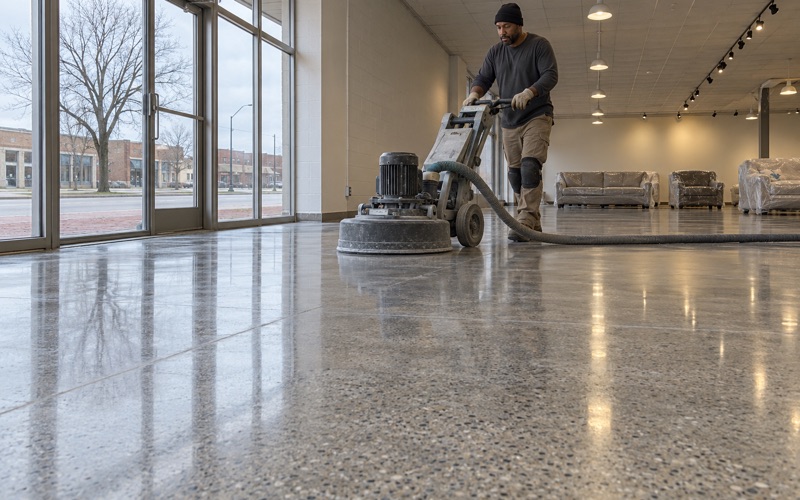
A containment lining is only as good as its bond. We grind or shot blast to an ICRI concrete surface profile suited to the system, never acid etch, and we capture the dust at the machine with a vacuum instead of washing it toward a floor drain or storm inlet.
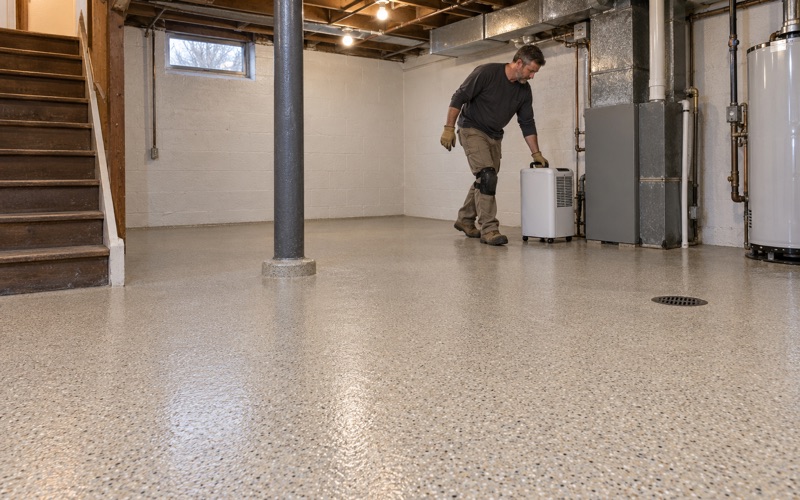
Moisture testing goes into the scope as well, by ASTM F1869 calcium chloride or ASTM F2170 in-situ relative humidity probes, with the target reading written down. On an indoor slab with high readings, a moisture-mitigation primer can come before the containment build. Because the system, coat count and thickness are written into the proposal, whoever keeps the spill plan has a document to check the finished lining against on the day the area goes back into service.
After a release
A spill is the moment the lining earns its place, and it is also when it needs a close look. Once a release is cleaned up, we suggest walking the containment for softening, blistering, discoloration or lifting at the edges, with extra attention to joints, the curb seam and the area around pipe penetrations.
Where a stored product has attacked the coating, the repair is a local grind-out and rebuild to the original thickness with the same system named in the original proposal. Keeping that proposal on file with the spill plan turns the repair into a matching job rather than a guess.
Drums, Totes and Used-Oil Corners in Lake Station Shops
The SPCC rule is not only about plants with tank farms. Truck stops, fleet yards and repair shops in town keep drums of lubricant, totes of hydraulic fluid and a used-oil tank, and the 55-gallon counting rule means a busy shop can cross 1,320 gallons sooner than its owner realizes.
Lake Station sits on the Calumet Shoreline sand ridge, with I-80/I-94, I-90 and US 20 all running through the city. For a fleet or truck operation along those routes, the useful first step is a plain count of every container of 55 gallons or more, including the used-oil tank, before anyone talks about a floor.
Below the threshold
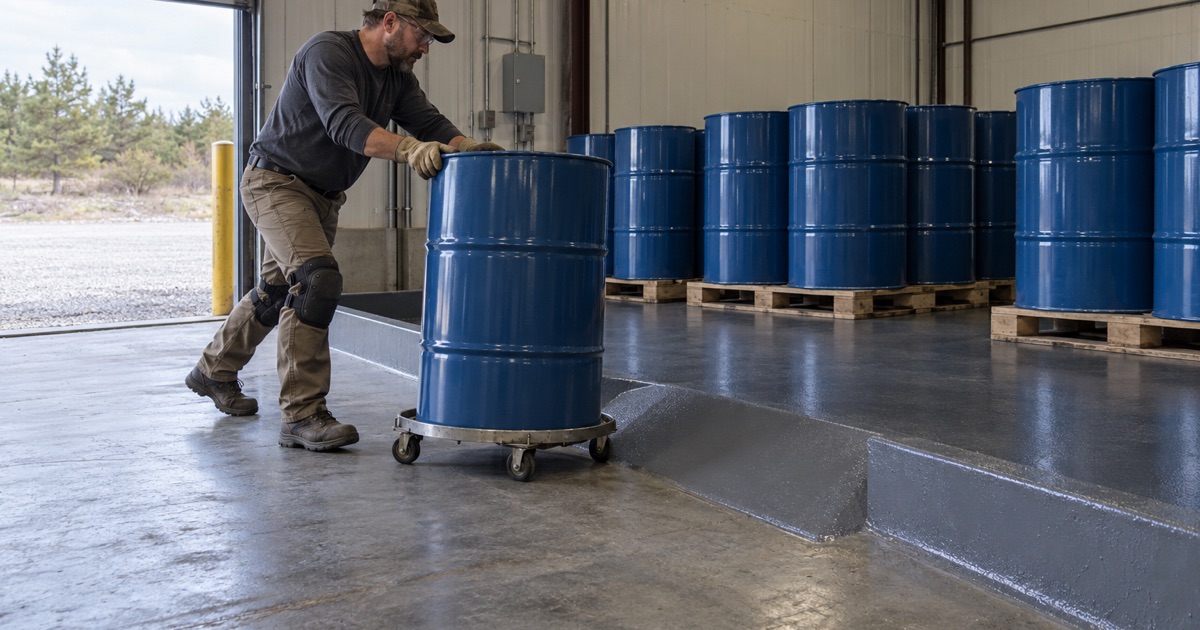
Plenty of shops and home garages sit under the line, and the rule does not reach them. A drum corner is still worth thinking through: a low curb and a coated pad give a spilled drum somewhere to stop, and a lining that resists the oils in use makes cleanup faster.
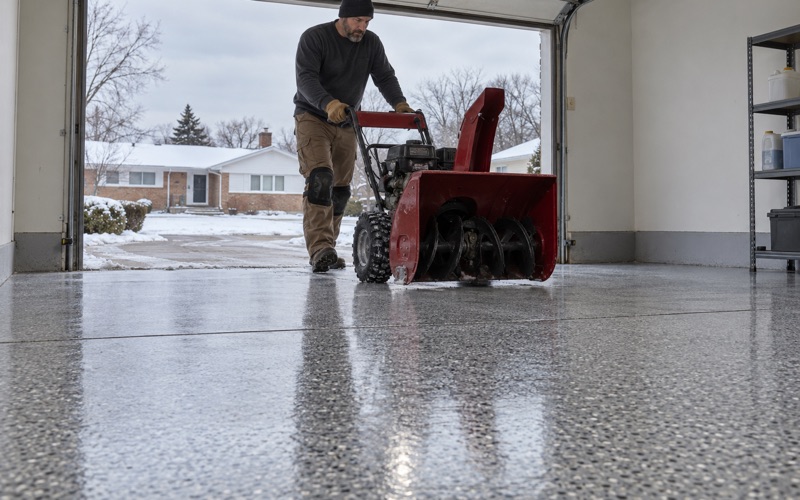
The city’s housing is mostly detached and owner-occupied, and 68.2 percent of its units were built before 1980. Many home garages here hold an older slab under a workbench, and for those jobs we are usually talking about a flake system built to handle winter brine and rock salt rather than a containment build.
Booking work in the city
Lake Station licenses contractors directly, and we check its requirements before a job is booked. The city asks for a contractor license application, a $5,000 bond recorded with the Lake County Recorder and $1,000,000 in insurance naming the City of Lake Station, and a first-time applicant brings proof of licenses from two other municipalities.
Permits come through the Building Department at 1969 Central Avenue, which takes cash or check only. Trucks must be lettered with the business name, and the permit is posted in the customer’s front window. Home jobs also get a written contract carrying the items Indiana’s Home Improvement Contracts Act lists, before any grinding starts, and we explain what the coating warranty excludes, starting with moisture.
Air quality and cure
Hobart Township sits inside the Lake County part of the Chicago 2015 ozone nonattainment area, and Indiana’s 326 IAC 8-14 caps floor coatings at 250 g/L and industrial maintenance coatings at 340 g/L. Those limits bind whoever applies the product, so we pick systems inside them from the start.
Cure follows slab temperature and dew point, not a date on the calendar. An unheated bay or garage in deep winter is told to wait, and a containment area going back into service gets its full cure before the first drum rolls back in.
- 20+ Years Coating Concrete
- Written Moisture Testing
- Free Estimates