Gary Epoxy Flooring brings more than 20 years of epoxy flooring in Lowell and the surrounding part of Indiana to a question most coating quotes skip: what happens to a floor that lives downwind of a spray gun. Finishing rooms, cabinet shops and garage workshops all collect overspray and solvent, and a coating that looks fine in a showroom can soften the first time someone wipes it down with thinner.
So we start with the slab, not the color chart. Every floor is opened with a diamond grinder or a shot blaster rather than an acid etch, cracks and old paint are mapped before anything is priced, and a moisture test goes into the written scope with the method and the passing number named. If a slab needs repair before it should carry a coating, the proposal says so.
The proposal also names the product line, the coat count and the finished thickness, so the floor on the ground can be checked against the paper. For a finishing room or a home spray corner, that paper also has to say how the floor will be protected and renewed, because no coating stays clean under a gun on its own.
A Cabinet Finishing Line on Morse Street and the Floor Beneath It
What the 2016 permit describes
Lowell, Indiana has a working finishing room of its own. Saco Industries, a family-owned cabinet maker established in 1978, is listed at 17151 Morse Street, and its 2016 IDEM operating permit describes a wood and particleboard surface coating operation for bathroom and kitchen cabinets.
That permit lists a spray booth, in service since March 1999, rated for up to 11.36 gallons of coating per hour through an HVLP system with a dry filter. It also lists an automated coating line approved in 2016 with its own 9.06-gallon-per-hour booth, a stackable flash oven and a jet dryer.
The permit also routes the booths’ exhaust through thermal oxidizers, which deal with solvent vapor in the air. None of that equipment touches what settles on the floor below the gun.
We point to that permit as a public record of what a production finishing room in Lowell looks like, nothing more. We have never worked for Saco, we have not seen its floors, and the permit expired on its face in August 2026, so we make no claim about what runs there today.
Downwind of the gun
An HVLP gun puts more of the coating on the part than older high-pressure guns, but no spray process is perfect. The mist that misses the work drifts with the booth’s airflow, and whatever slips past the filters or falls short of them settles on the floor.
Over a shift, that overspray builds into a tacky film, then a hard crust of lacquer, stain or sealer. On a bare or poorly bonded floor it fills pores and becomes part of the surface; on a coated floor it sits on top, and the question becomes what it takes to get it off.
Buildup also changes how the floor behaves underfoot. A crusted booth floor can turn slick or uneven, and dried overspray is a combustible residue that booth housekeeping exists to control, which is why the floor plan for a finishing room is a maintenance plan as much as a coating choice.
Looking for epoxy-flooring closer to Matteson? See Matteson Epoxy-Flooring.
Cleanup Solvents and the Finish That Has to Survive Them
Why thinner is hard on floors
The solvents that clean a spray gun are the same family that strips many finishes. Lacquer thinner, acetone and similar cleanup solvents get splashed, dripped and wiped across a finishing-room floor every day, and many ordinary floor paints and single-component sealers soften, haze or lift when that happens.
A softened finish is worse than a stained one. It grabs overspray, tracks under carts and shoes, and lets the next splash reach deeper, so a floor that was cheap to put down becomes expensive to keep.
Water-based coatings shift the picture without removing it. A shop that sprays waterborne finishes may still clean some equipment with solvent, and the floor then sees both.
Specifying for solvent resistance
For a booth or finishing-room floor we look at cross-linked systems: a 100% solids epoxy base with a polyaspartic or polyurea topcoat, or urethane cement where heat and heavy cleaning both apply. Those families hold up to solvent contact far better than one-part products, but we size the system to the solvents actually used in that room rather than to a brochure.
Cure conditions matter for solvent resistance too. An epoxy that cures cold or damp can develop amine blush, a greasy film that weakens how the topcoat bonds, so the full chemical resistance a product promises depends on curing it properly.
Resistant is not the same as immune. Prolonged soaking in a strong solvent will mark almost any coating, so the proposal tells the owner which spills to wipe up promptly and which cleaners to keep off the floor entirely.
We also say plainly what a coating cannot do. No floor finish is fireproof, and a coated floor does not make a spray booth compliant with anything; booth design, ventilation and fire protection belong to the owner’s engineer and the authority that reviews them.
VOC limits on the floor coating itself
Lowell sits in Cedar Creek and West Creek townships, outside the Lake County townships listed in the Chicago 2015 ozone nonattainment area. Indiana’s statewide rule, 326 IAC 8-14, still applies to the floor coating: 250 grams per liter for floor coatings and 340 for industrial maintenance coatings, with no thinning past the limit on site. We choose products inside those limits, because the rule binds whoever applies them.
Strippable Booth Coatings, Floor Paper and a Recoat Schedule
A sacrificial layer on top of the floor
The usual answer in a finishing room is to let something cheap take the overspray instead of the floor. A strippable booth coating is rolled or sprayed over the finished floor, collects overspray for a period, and is then peeled up in sheets with the buildup on it, leaving the permanent coating underneath.
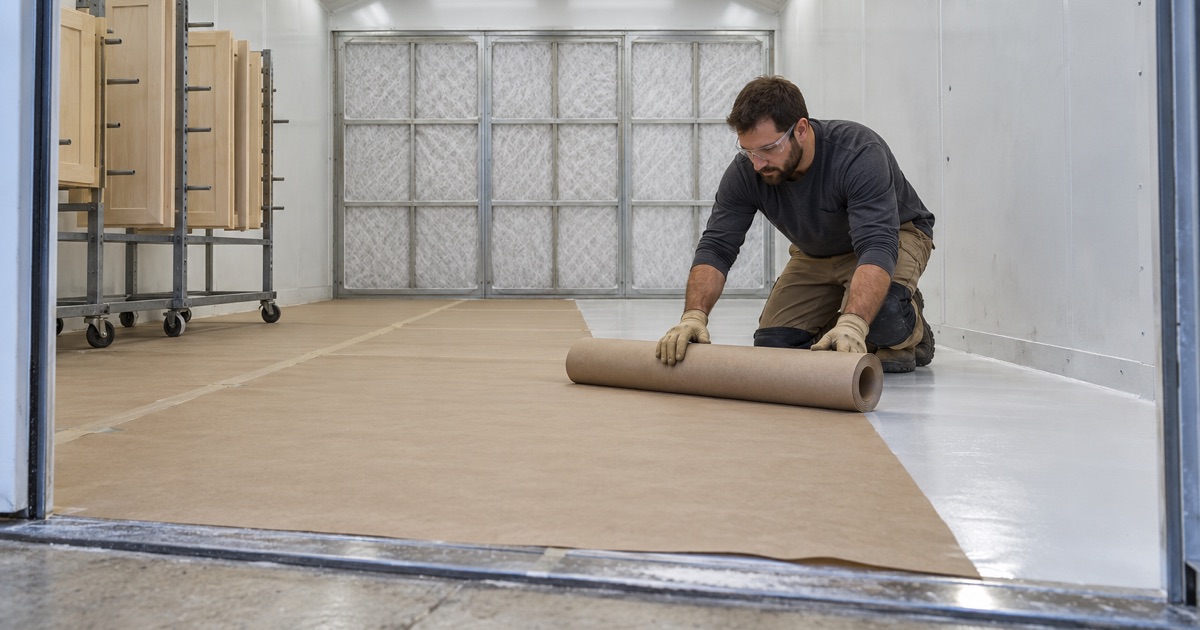
Floor paper does the same job more simply. It is laid in the overspray zone, taped at the seams, and replaced when it loads up, which suits a shop that sprays in batches rather than all day.
We apply the permanent system; the owner or their crew usually handles the peel-and-renew cycle. We walk through it at handover so the first strip does not catch anyone off guard, including how long a fresh peel coat needs before spraying resumes.
Why the base coat still matters
A peelable layer only works if the floor beneath it is smooth, sound and well bonded. A peel coat pulled off a dusty or delaminating floor takes chunks of the floor with it, so the grinding, crack repair and moisture testing underneath are what make the sacrificial layer practical.
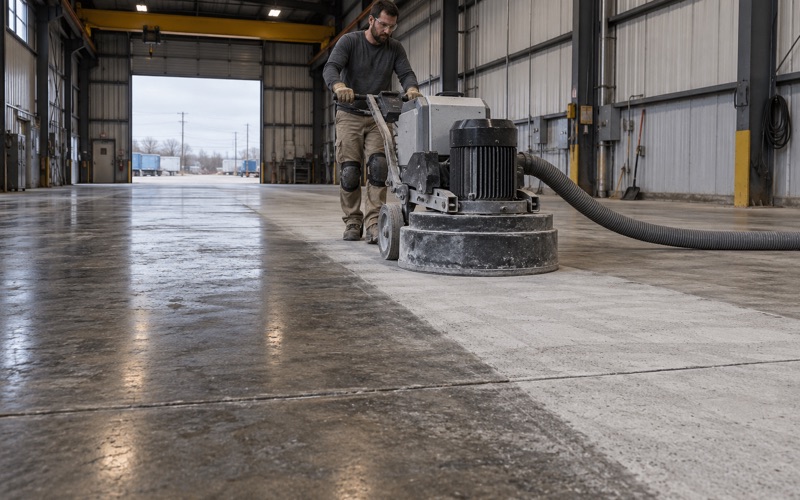
We grind a booth floor to an ICRI surface profile matched to the system and moisture-test the slab with ASTM F2170 probes or an ASTM F1869 calcium chloride test before the base coat goes down. On an older slab that has seen solvent spills, the grinding also removes contaminated surface material the coating would otherwise sit on.
Setting a recoat schedule
Even protected, a booth floor wears. Foot traffic in the same path, cart wheels and the scraping that goes with each peel change all thin the topcoat, so we suggest the owner plan a scuff-sand and recoat at an interval set by how the floor looks at each changeover, not by a fixed date. Keeping a simple log of peel changes and recoats helps the owner see when wear speeds up, which often means traffic or cleaning has changed.
A plant that cannot close for that work can have it phased around shifts, with overnight or weekend windows. Grinding dust is vacuumed at the machine, so none of it is rinsed toward a floor drain.
Spraying Cabinet Doors and Furniture in a Lowell Garage
Most of Lowell’s owner-occupied homes are detached houses, and plenty of those garages double as the place where someone refinishes a dresser or sprays a set of kitchen cabinet doors. The overspray and the thinner are the same as in a production booth, just in smaller quantities and with fewer controls.
Scaling the booth logic down
The small-scale version follows the finishing room’s rules. Coat the garage floor with a solvent-resistant system, mark out a spray corner, and cover that corner with floor paper or a strippable coating before each project, so the dried mist goes out with the paper instead of into the epoxy.
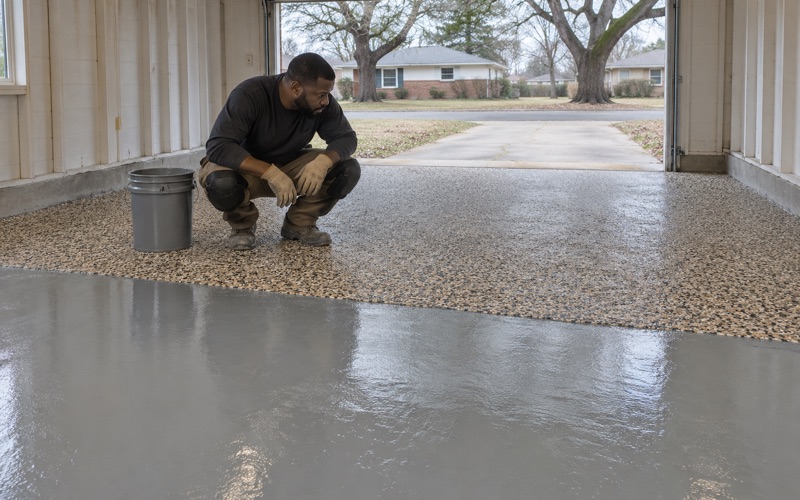
Keep the thinner and the rags on a tray rather than the floor, and never set an open can of solvent directly on the coating. A flake or quartz broadcast under the topcoat hides minor marking and gives a texture we specify by the broadcast and topcoat, not by a slogan.
Ventilation matters more than the floor here. A garage spray corner needs moving air and no ignition sources nearby, and that is a safety question for the homeowner, not something a coating solves.
A garage that also parks a car
A Lowell garage that houses a hobby booth in spring often parks a car through winter, when tires carry in brine and rock salt. We pick a system that handles both, and we tell owners of unheated garages to wait for warmer slab temperatures rather than coat in deep cold. A polyaspartic topcoat helps on both counts, resisting hot tire pickup as well as the occasional thinner spill.
Paperwork before the grinder starts
Home jobs get a written contract carrying the items Indiana’s Home Improvement Contracts Act lists, signed before any grinding begins. The warranty conversation happens up front too, and moisture is the first exclusion we name.
If a garage project involves new construction or structural work, the Town of Lowell Building Department at 501 East Main Street issues permits, and any permit needed must be bought before construction begins. We check the town’s current contractor licensing, bond and insurance requirements, and whether the scope needs a permit, before a job is booked.
Whether the gun belongs to a cabinet line or a weekend refinisher, the floor under it is judged the same way: how well it shrugs off the cleanup solvent, and how easily the overspray layer lifts away. That is the floor we plan for in Lowell, and the protective layer is written into the proposal alongside the coating itself.
- 20+ Years Coating Concrete
- Written Moisture Testing
- Free Estimates