Gary Epoxy Flooring has spent more than 20 years on concrete coatings, and epoxy flooring in Lyons brings us one floor problem worth explaining in detail: grit that is harder than the floor it lands on. Most coatings are judged by how they handle oil, salt or a dropped tool. A few are judged by what gets ground into them every shift.
A precision metal shop with a waterjet cutter is the clearest case we know. The machine’s abrasive does not stay where it was used: it rides out of the tank wet on parts, pallets and boots, leaves in buckets at every cleanout, and once dry it behaves like loose sandpaper underfoot. A gloss floor laid in that path dulls and scratches faster than anyone planned for.
This page follows that grit from the machine to the floor, explains why it beats an ordinary topcoat, and sets out the floor we would build beside a cutting table. It closes with the smaller version of the same problem: sand and abrasives in a home garage workshop.
A Stamping, EDM and Waterjet Shop on Lawndale Avenue
What the Directories Describe
Atlas Tool Works, also listed as Atlas Tool and Die Works, sits at 4633 Lawndale Avenue on the north side of Lyons. Industrial directory copy describes over 22 presses with capacity up to 220 tons, a complete in-house tooling and EDM department, and deburring and finishing done in-house. Its product listings include waterjet cutting and laser cutting, and an IndustryNet entry calls it a metal stampings, wire EDM, laser and waterjet cutting job shop.
A trade association profile adds that the family-owned company serves defense, aerospace and medical markets from a 75,000-square-foot plant in Lyons and dates its founding to 1918. Those details come from directories and that profile, not from the company’s own pages, which we could not read.
We have never worked for Atlas, and nothing here describes its floor, its layout or how it handles its own machines. We name the shop because a stamping, EDM and waterjet operation under one roof is the kind of place where abrasive grit starts its trip across a floor.
Where the Abrasive Goes: the Catcher Tank
A waterjet cuts with a high-pressure stream of water carrying abrasive, and below the table that stream lands in a catcher tank. OMAX, a waterjet maker, says the tank fills with sludge of spent abrasive garnet, material slugs and other debris, and tells operators to clean it before or when the sludge reaches the bottom of the garnet bins or slats.
The same guidance warns that spent garnet and catcher tank material can be heavy and that bacteria can build up in the tank water. Its cleanout steps end with removing the sludge from the tank bottom into a bucket or other container for disposal, and a sludge-vacuum vendor claims that shoveling sticky garnet out of a full tank can take days.
For a floor, that means two separate sources of grit. One is the slow, constant trickle that leaves on wet parts, pallets and work boots every shift. The other is the cleanout itself, when heavy, dripping buckets of sludge are carried or wheeled from the tank to wherever disposal happens.
Looking for epoxy-flooring closer to Lake Station? See Epoxy-Flooring in Lake Station.
Garnet Underfoot: Harder Than the Floor, Sharp at Every Edge
Seven to Eight on the Mohs Scale
Barton, a garnet supplier, places almandine waterjet garnet between 7 and 8 on the Mohs scale, and says the grains fracture into sharp edges in use. That makes spent abrasive harder than most floor aggregates, and those broken grains are sharp-edged.
A cured resin topcoat is much softer than that. Epoxy, polyurethane and polyaspartic films all resist ordinary wear well, but a hard, angular grain pressed under a boot heel or a pallet runner cuts the surface rather than polishing it.
Wet Paste First, Rolling Grit Later
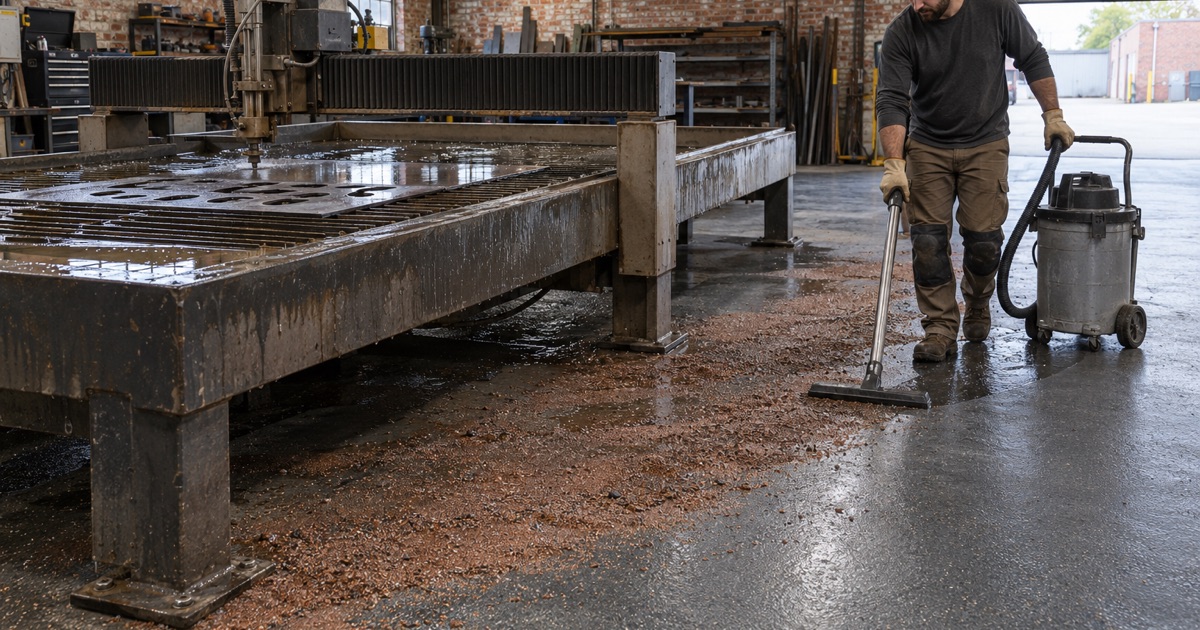
Near the machine, spent garnet usually arrives wet, as a gritty paste carried on parts and boots. Wet, it acts like a lapping compound under anything that slides or turns on it, and a high-gloss topcoat shows the swirl marks first.
Once it dries, the problem changes. Loose grains can spread well past the cutting area, roll underfoot like ball bearings on a smooth surface, and get swept into piles that scratch on the way. The floor then has a slip question as well as a wear question.
Why No Coating Is Immune
No resin floor stands up to garnet indefinitely, and we will not describe any system as if it did. What a good specification does is slow the wear, hide it where it happens, and put a replaceable layer on top so the wear lands there instead of in the base coats.
It also has to start with a slab that can hold that system. Before we quote, we map cracks, spalls and old paint and say plainly when a section needs repair or replacement first, because a textured floor over a failing patch comes up with the patch.
Building the Floor Beside a Cutting Table
A Broadcast Build Rated for Abrasion
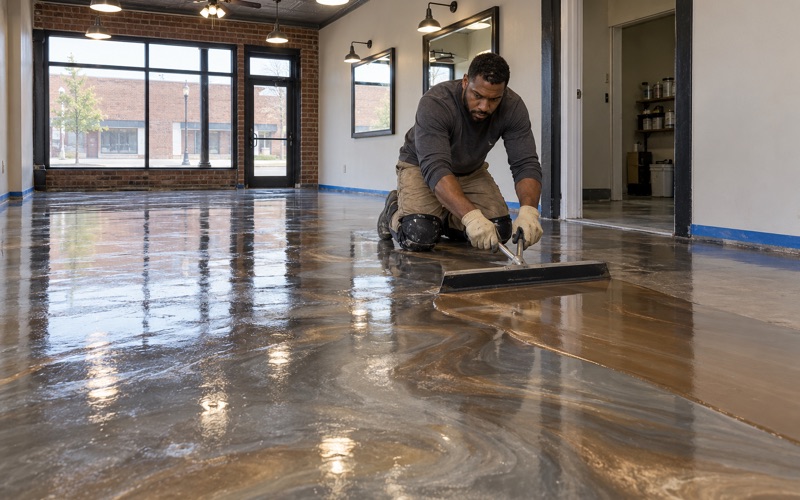
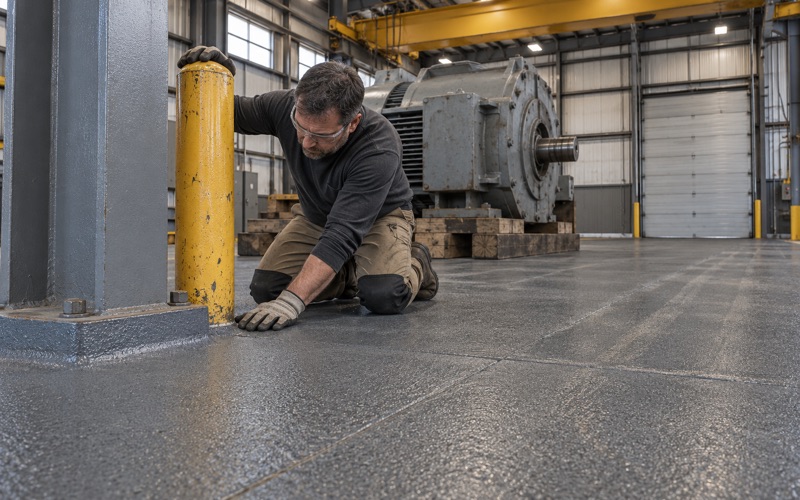
Beside a waterjet we would specify a broadcast-textured system rather than a smooth gloss coat. A typical build is a 100% solids epoxy body coat with quartz aggregate broadcast to refusal, a second body coat locking it in, and a topcoat chosen for abrasion resistance. The texture comes from the aggregate and the topcoat together, and the proposal says which of each, so slip resistance is specified rather than promised.
A matte or satin finish also hides fine scratching far better than high gloss. On a floor that will be scored no matter what, a finish that looks acceptable while worn is worth more than one that looks perfect on day one.
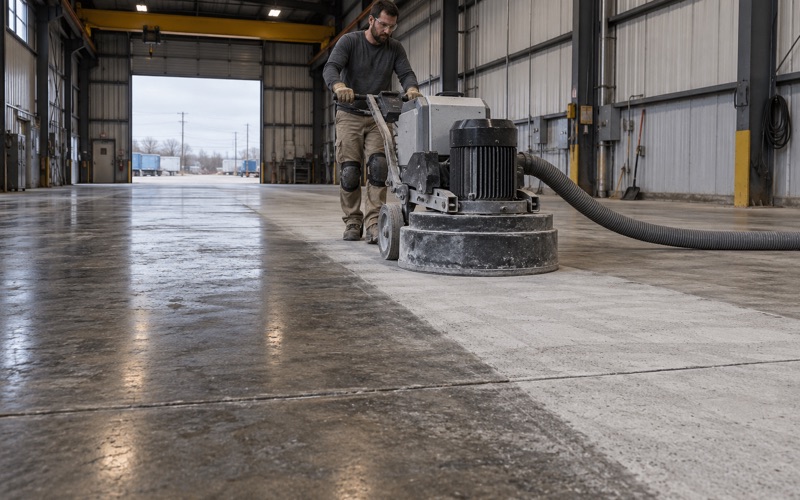
Every one of these floors starts the same way: the slab is opened with a diamond grinder or shot blaster to an ICRI CSP profile suited to the build, never with an acid etch. Grinding dust is pulled into a vacuum at the machine, which matters in a shop where nobody wants concrete dust settling on finished parts.
A Topcoat Meant to Be Worn Away
The top layer in a wet abrasive zone is treated as sacrificial. It takes the scoring so the broadcast and body coats underneath stay intact, and when it wears thin in the traffic paths it is abraded and recoated without grinding the whole system back to concrete.
We put that recoat on the schedule from the start, the way a shop plans tooling changes, and we name the product line, the number of coats and the finished thickness in the proposal so the original build can be checked. Recoats are planned around shifts, with overnight or weekend windows when the cutting area cannot stop, and cure times follow slab temperature and dew point rather than a fixed calendar.
A Squeegee Zone and a Bucket Route
Around the table itself we would mark a defined wet zone and clean it by squeegee and wet vacuum rather than by dry sweeping. A broom drags hard grains across the topcoat and lifts the fine fraction into the air, while a squeegee and vacuum lift the paste off the floor before it dries and spreads.
The cleanout route gets its own answer. The path from the catcher tank to the disposal point is better covered with heavy mats or steel plate than left as finished coating, since sludge buckets carried and dragged along it would wear any coating faster than foot traffic does. Mats can be lifted and hosed; a coating scored through to the slab cannot.
Sand and Grit in a Lyons Garage Workshop
A Smaller Version of the Same Grit
Lyons is a village of 10,817 people in Cook County, and 2,765 of its housing units are single-family detached homes. When the garage at one of those homes doubles as a workshop, it makes its own abrasive grit: sanding dust, worn sandpaper, grinding swarf and the sand that rides in on tires and boots.
None of that is as hard or as plentiful as waterjet garnet, but it works the same way on a gloss coating. Grit ground under a shoe sole or a dragged sawhorse leaves fine scratches, and sanding dust left on a smooth topcoat turns it slick.
Texture and Sheen for a Home Shop
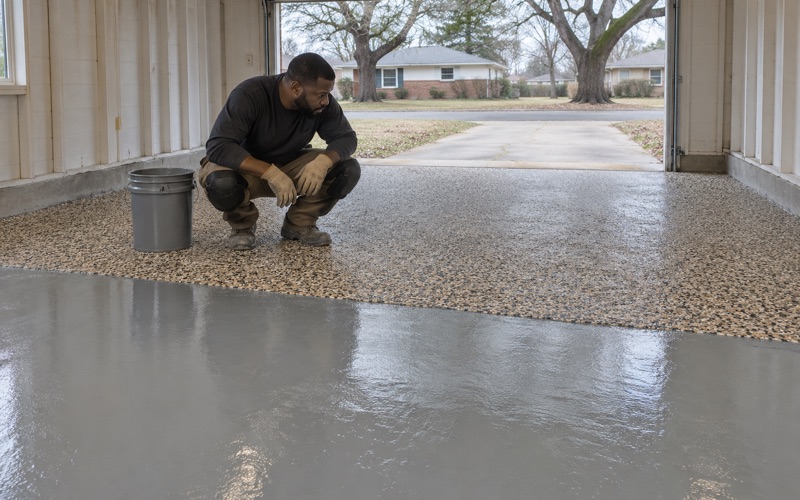
For a workshop garage we usually steer owners toward a vinyl flake or quartz broadcast with a satin polyaspartic or polyurethane topcoat rather than a smooth high-gloss or metallic finish. The broadcast hides scratching and gives footing when dust is down, and the topcoat can be scuffed and recoated when it wears thin without starting over.
Cleanup follows the shop rule in miniature. A shop vacuum picks grit up; a push broom pushes it across the coating. A mat under the bench and at the door catches much of what would otherwise spread across the floor.
Old Slabs and the Village’s Own Rules
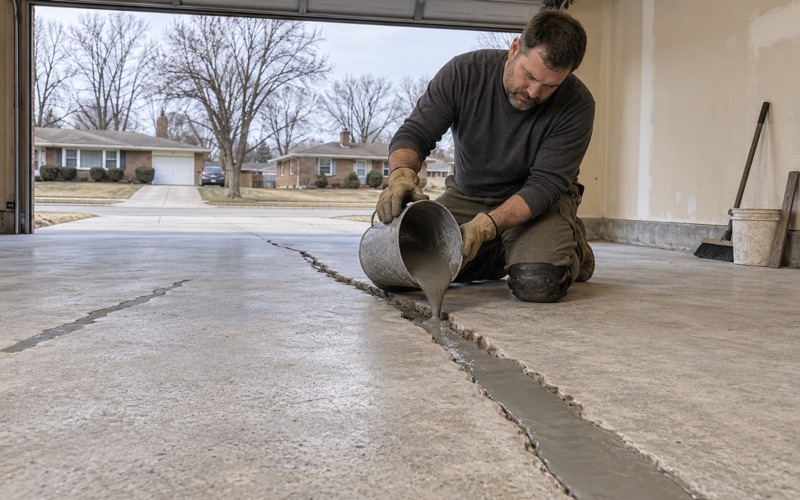
Of the village’s 4,390 housing units, 1,131 were built in 1939 or earlier and only 25 since 2010, so nearly every garage floor in Lyons is an existing slab, often one carrying an old coating or paint. That old film comes off with the grinder before anything new goes down, and a moisture test is written into our scope before the price is final, naming the method, such as ASTM F2170 in-situ relative humidity probes or the ASTM D4263 plastic sheet test, and the reading the system has to pass.
Moisture is also the first exclusion we name when we explain what a coating warranty does not cover, and we never present a floor coating as waterproofing. The Village of Lyons Building Department at 4200 Lawndale Avenue issues its own contractor license application, so we check the village’s current requirements before a job is booked.
The Chicago Portage National Historic Site in Lyons marks a route where loads were once carried overland, and a coated floor near grit is planned the same way, by its routes. We decide where the grit travels, what it crosses on the way, and which layer is meant to take the wear before choosing a single product.
- 20+ Years Coating Concrete
- Written Moisture Testing
- Free Estimates