Gary Epoxy Flooring approaches epoxy flooring in Markham with more than 20 years behind one habit: before we price a coating, we ask what the concrete has already been holding. A slab is porous. What sat on it for years can still be in it, and a fresh coat of resin does not make that history disappear.
Most of the time the answer is ordinary, such as oil drips, road salt or old paint. Sometimes it is something a new owner notices with their nose before their eyes, and that changes the order of the work. Smell has to be dealt with inside the concrete first, not covered over afterward.
So our scope starts with a walk of the floor, a moisture test written into the proposal with its method and passing number, and a map of cracks, spalls and anything the slab has soaked up. The coating decision comes after that, not before.
A Vacant Animal Clinic on 159th Street and a Porous Slab
3451 W. 159th Street
The building at 3451 W. 159th Street, in the Bremen Township part of Markham, was Markham Animal Clinic, listed for vaccinations, neutering, dental work and surgery on weekday hours. Yelp now marks the clinic closed. The property was later listed as a 3,025-square-foot Class C retail space, pitched as perfect for any starting, expanding or moving veterinary clinic.
We have never been inside, and we have no tie to the owner or to any tenant who might lease it, so nothing here describes that floor’s condition. The address matters because it is a clear local picture of a common situation: a building that housed animals for years, now waiting for someone new to move in and finish the floor.
The listing language is telling for anyone weighing that space. A second LoopNet entry called veterinary properties extremely sought-after investments, so the next occupant could easily be another practice. Whoever moves in inherits a slab with years of animal traffic, and that is worth checking before the build-out schedule is set.
Why concrete holds onto urine
Bare concrete is full of tiny pores and capillaries. Urine that lands on an unsealed slab, again and again over years, does not sit on top waiting to be mopped. It wicks down into the paste, and the salts and odor compounds it carries stay there after the liquid dries.
A building-science expert answering a homeowner’s question about cat urine in a basement floor put it plainly: concrete is like a sponge for some things, and that kind of contamination soaks down into the slab where no amount of scrubbing gets it out. When the problem has gone on for years, he doubted cleaners and scrubbing alone would fix it. That matches what we see on floors where animals were kept.
Humidity tends to bring it back. A floor that seems neutral on a cool, dry day can smell strongly in August, when moisture moving through the concrete carries odor up to the surface. That is one reason we do not judge a slab on a single visit.
Looking for epoxy-flooring closer to Country Club Hills? See Country Club Hills Epoxy-Flooring.
Finding It, Enzyme-Cleaning It, Grinding It Out
Locating the problem areas
In a former animal space, we check the places animals were actually held, walked and treated before we look at anything else. Kennel runs, exam rooms, the corners where crates stood and the path to the back door get the closest attention. Odor tends to be strongest at seams, low spots and wall lines, where liquid collected and had time to soak in.
A handheld ultraviolet light helps, since dried urine often shows under it where daylight reveals nothing. We treat it as a guide rather than proof and confirm suspect spots by wetting them, because water tends to wake the odor back up in contaminated concrete.
We note every suspect area on the same map we use for cracks and old coatings. That way the proposal shows which sections need cleaning only, which may need more, and which look sound.
A full wet dwell, not a quick spray
Enzyme cleaners break down the organic compounds in urine, but only while they stay wet and in contact with the concrete. Guides for using them on concrete describe saturating the area, covering it with plastic so the cleaner stays wet for its full dwell time, then rinsing and repeating. A spray-and-wipe pass reaches the surface and leaves the slab underneath untouched.
On a heavily used animal floor we plan for more than one round. The slab has to dry fully between cycles and before any coating, and we confirm that with the moisture test named in the proposal rather than by feel.
Patience matters more than brand. We follow the label on dilution and dwell, tape the plastic down at its edges so the cleaner does not dry in from the sides, and rinse thoroughly so no cleaner residue is left to interfere with the primer later.
When the concrete has to come out
Some spots do not clear, no matter how many cycles they get. The same expert, describing machine-shop conversions, said his crews would sometimes have to grind out part of the slab and patch it before they could properly seal the floor. We take the same view of odor that survives cleaning.
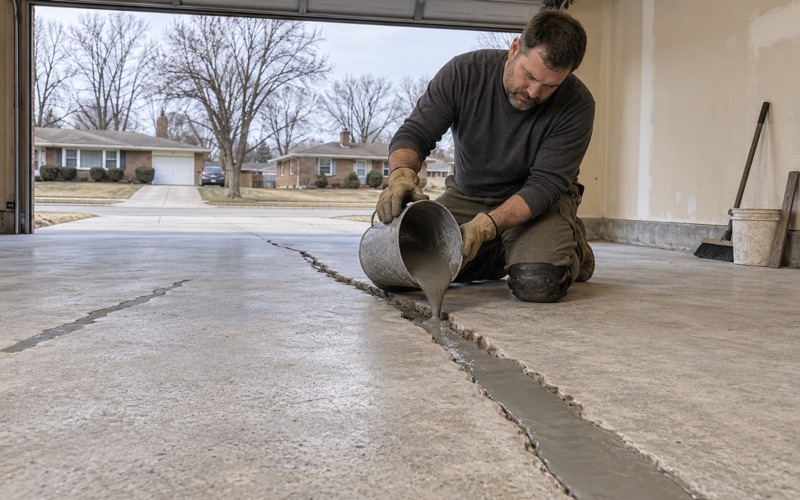
That can mean diamond grinding deeper in a contained area, or saw-cutting a section and replacing it with a patch material suited to the coating that follows. If an odor-holding area is large enough that patching stops making sense, we say so and talk about replacing that part of the slab before anyone spends money on resin.
A patch also changes the floor’s look, so we plan the finish around it. A broadcast system, whether vinyl flake or quartz aggregate, hides the outline of a repair far better than a thin solid color, which is worth knowing before a new tenant picks a finish.
Bond Is Rarely the Problem, Smell Is
What a coating can and cannot do
People often assume the risk with a contaminated slab is that the epoxy will peel. The expert’s view was the opposite: he did not expect adhesion trouble from urine the way there would be with oil. The worry is that the smell remains, and that whoever occupies the space later still notices it.
A fully bonded 100% solids epoxy, or a primer chosen for what is being sealed in, can cover a cleaned slab well. We will not sell any coating as a guaranteed odor seal, though, because a film over concrete is not a cure for what remains inside it. The cleaning and grinding solve the problem, and the coating finishes a slab that is already clean.
How we write it into the proposal
Every former animal space gets its prep spelled out line by line: where we found odor, how many enzyme cycles we plan, where we expect to grind and where a patch is possible. The proposal also names the product line, the coat count and the finished thickness, so the floor can be checked against the quote when it is done.
We explain what the coating warranty leaves out before anything is signed. Moisture is the first exclusion we name, and odor rising from the slab is not something our warranty covers. Before booking work here, we also confirm bond and permit requirements with Markham’s Building and Housing Department, since surety sellers cite a $10,000 license and permit bond under the city code.
Opening the surface the right way
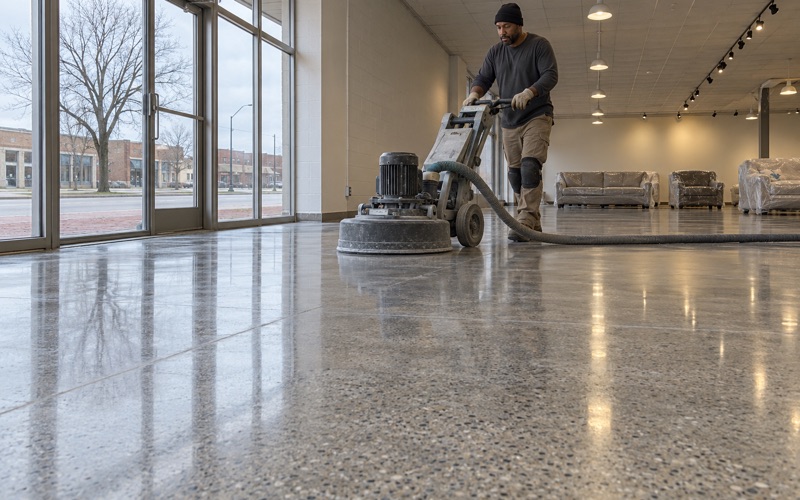
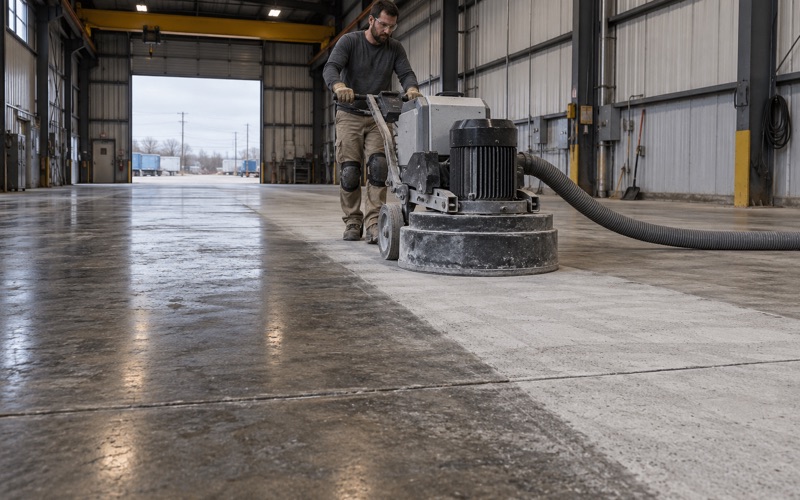
Once the slab is clean and dry, we profile it with a diamond grinder or a shot blaster, never an acid etch. Acid adds liquid to a slab we just spent days drying, and it leaves a weaker surface than a mechanical profile does. Grinding dust is pulled into a vacuum at the machine instead of being rinsed toward a drain.
Grinding is also one more inspection. A diamond pass exposes fresh concrete, and any area that releases odor again once opened goes back on the list for another cleaning cycle or a patch. We would rather find that before the primer than after the topcoat.
Dog Runs and Litter Corners in Markham Garages and Basements
The same problem at home
Markham is mostly owner-occupied detached houses, much of it built in the 1950s and 1960s, so garage and basement floors are the ordinary work here. Plenty of those slabs have hosted a dog crate, a litter box or a pet that spent winters in the garage. The scale is smaller than a clinic, but the concrete behaves the same way.
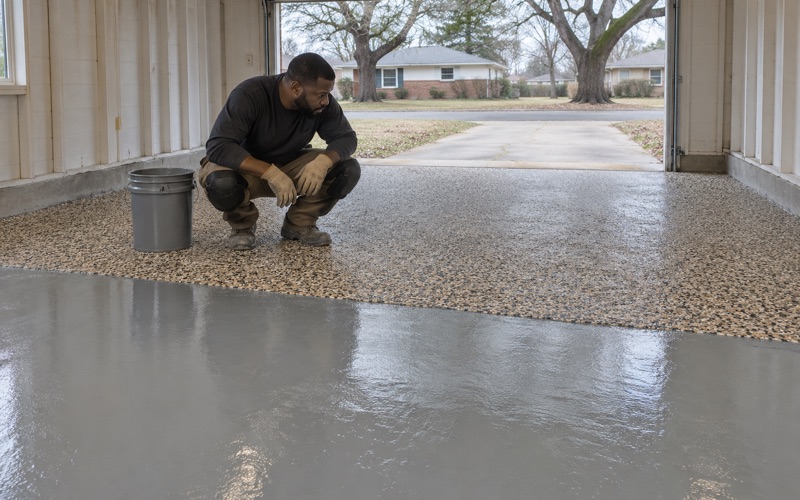
A litter corner in a basement or a dog run along a garage wall can hold odor that returns every humid summer. We test those spots, clean them with the same full wet dwell, and grind or patch where the smell persists before any flake or solid-color system goes down.
For a homeowner, the real question is often whether a few stained square feet by the wall justify grinding. Our answer depends on what the cleaning shows. If the smell is gone after a full dwell and a dry-down, we coat; if it returns, we cut it out, and the proposal prices each path.
What changes in the basement
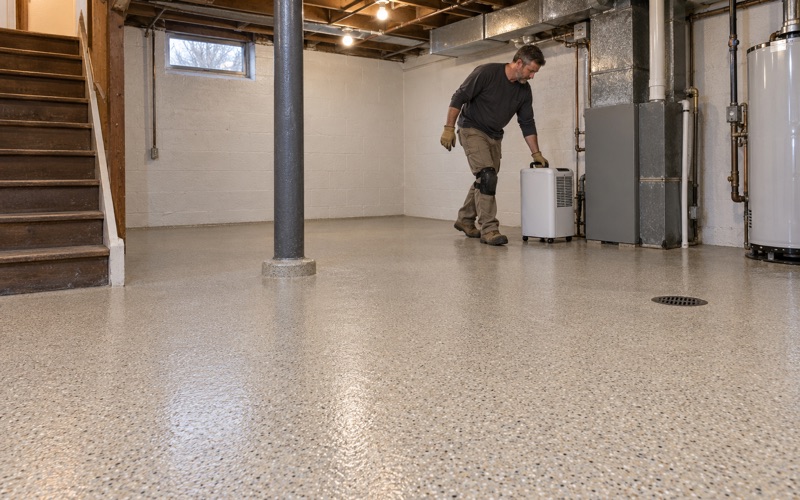
Basement slabs add moisture to the picture, and moisture both slows enzyme cleaning and undermines a coating. We run the moisture test in writing before a price is final. A floor coating is never sold as waterproofing, so a basement that still takes on water needs that fixed before we start.
The test is named, not improvised. Depending on the slab, it may be ASTM F2170 in-situ relative humidity probes or an ASTM F1869 calcium chloride test, and the proposal lists the number the floor has to pass. A slab still damp from enzyme rounds will fail it, and the schedule waits.
Winter garages and cure
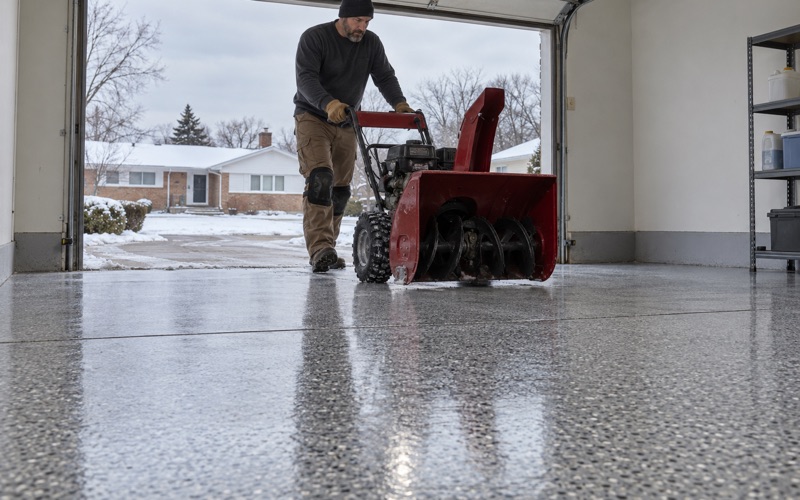
Garage jobs here run into the same winters as the rest of the Chicago area. We schedule cure by slab temperature and dew point rather than the calendar, and an unheated garage in deep cold is told to wait. A pet-odor repair that sits clean and dry through the winter is in a better place for spring coating anyway.
Salt is the other winter factor. A garage system here has to hold up to the brine and rock salt that ride in on tires all season, so we choose topcoats with that in mind as well as the odor repair underneath.
Whether the floor belongs to a vacant clinic on 159th Street or a one-car garage where a dog spent years of winters, the order holds. Find what the slab absorbed, clean it fully, cut out what will not clean, and only then choose the resin.
- 20+ Years Coating Concrete
- Written Moisture Testing
- Free Estimates