Gary Epoxy Flooring brings more than 20 years of work to epoxy flooring in Matteson, and the question we press hardest on here is one most buyers never ask: what happens to a coated floor when a car sits on it and does not move. A floor that only sees traffic wears in the lanes. A floor that holds a parked vehicle for days can pick up a print of the tread in the exact spot each tire rests.
That print is not dirt, and it usually does not mop off. It comes from chemistry inside the tire, and it shows most on the bright, clean finishes people choose when they want a floor to look its best. So before we talk color or gloss, we ask how long vehicles will stand on the slab and where their tires will sit.
The sections below cover the display floors where that matters most, what actually migrates out of a tire, how color, topcoat, mats and cure time change the outcome, and how the same problem follows a stored car into a home garage.
A Showroom Floor Where Cars Stand Still for Days
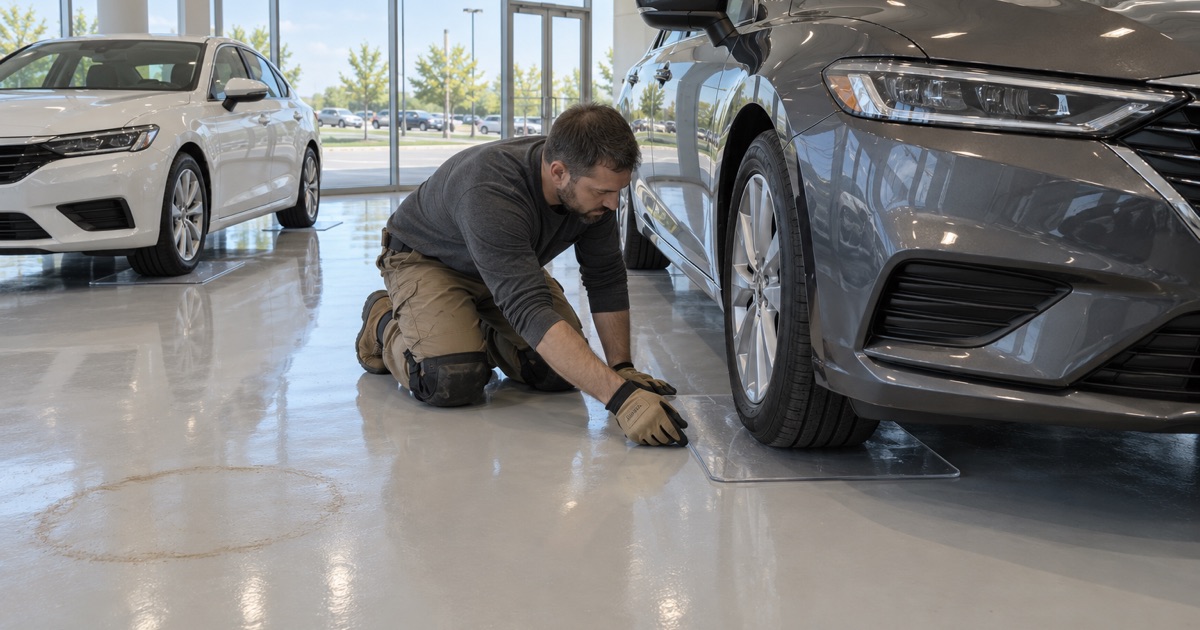
The Matteson Auto Mall covers 110 acres between I-57 and US Route 30, and the village dates it to 2001. A 2019 hazard-mitigation annex for the village called it the largest agglomeration of automobile dealerships in Illinois. That adds up to many vehicles standing on indoor floors in one district.
World Hyundai Matteson, at 5337 Miller Circle Drive, describes itself as conveniently located in the Auto Mall and calls itself the top-volume dealer there. We have no connection to World Hyundai or any other dealer in the mall, and we have not seen any of their showroom floors, their colors or their condition. We name the dealership only because it puts a real address on the kind of room this page is about.
Why a showroom is different from a garage lane
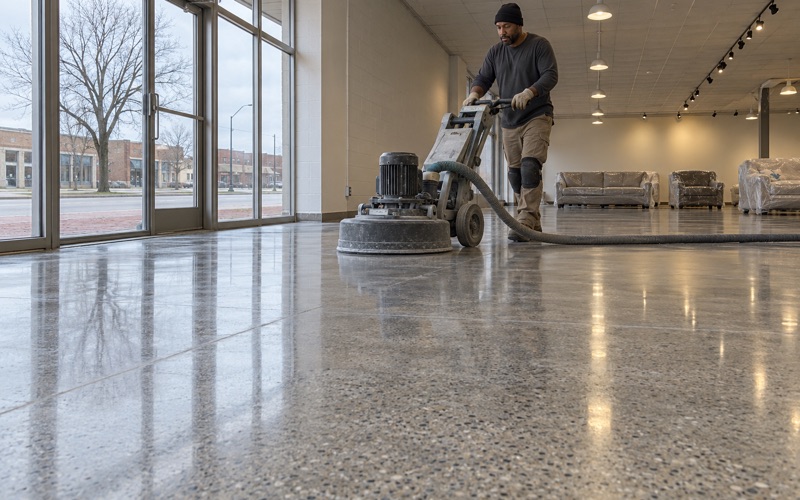
On a driveway or in a parking garage, a tire touches any given patch of floor for seconds or hours. On a display floor, a vehicle can be rolled into place and left standing on the same four contact patches for days, sometimes longer, while customers walk around it. Sales floors at the mall run long days, but the cars on them barely move.
That stillness is the condition a coatings maker singles out. Dulux Protective Coatings, an Australian manufacturer, published a technical note in November 2025 on tire staining of concrete floor coatings. It says the stain usually shows up when tires are at rest on the painted surface for some duration, in the tread pattern where the vehicle is parked.
A static stain, not a skid mark
The same note separates this stain from a skid mark, and so do we. A skid mark is rubber scraped onto the surface by a turning or braking wheel, and it sits on top. Tire staining forms slowly under a tire that is not moving at all, and it can look black, brown or yellow.
That difference matters when a floor is specified. Abrasion resistance and a hard topcoat help with scuffs. A slow chemical stain under a parked car is a separate problem that calls for a separate set of choices.
Looking for epoxy-flooring closer to Richton Park? See Epoxy-Flooring in Richton Park.
6PPD and IPPD: What Leaves the Tread and Why It Turns Brown
Tires are compounded with antiozonants so the rubber does not crack as it ages in air. Two of the common ones are 6PPD and IPPD. They are meant to work their way to the rubber surface over the life of the tire, which is how they protect it.
Migration out of the tread
The Dulux note names progressive release of 6PPD and IPPD as the usual cause of tire staining. When a tire rests on a coated floor, those compounds move from the rubber into the coating at the contact patch. Once there, they oxidize, which is why the color develops on the coating.
The note also says plainly that there is nothing a vehicle owner can do to change the rate of that release. The chemistry is built into the tire. What a floor owner controls is the surface the compounds land on and how long a tire is allowed to sit in one place.
What makes one floor stain more than another
The note lists the variables: the age of the tire, its tread compounds, how long it stays in contact, the tire’s temperature, and the coating’s generic type, state of cure and color. Some of those belong to the car. The last three belong to the floor, and they are where a coating decision can shift the odds.
On coating type, the note says epoxy and polyurethane are generally resistive to softening, while vinyls, chlorinated rubber, acrylics, alkyds and single-pack polyurethanes can sometimes be softened. That is a point about softening, not a promise against stains. No coating is stain-proof, and the manufacturer itself disclaims any warranty on tire staining.
Where we start on a display floor
Because the note ties staining to coating type and cure, we build display floors on catalyzed systems: a 100% solids epoxy body coat with a polyaspartic or polyurea topcoat. The proposal names the product line, the number of coats and the finished thickness, so the floor can be checked against the quote after it is down.
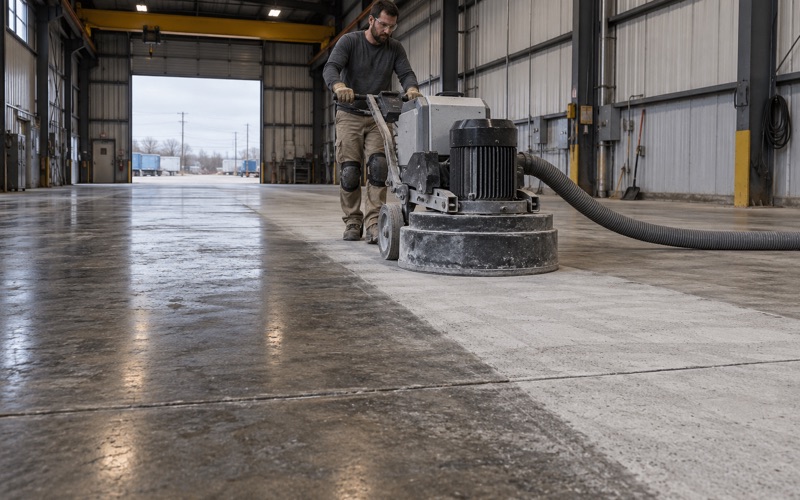
None of that works on a weak bond. Every slab is opened with a diamond grinder or a shot blaster to a measured profile, never acid etched, and cracks, spalls and old paint are mapped before we price. If a slab should be repaired or replaced before it is coated, we say that first.
Color, Topcoat, Mats and a Full Cure Before the First Car
Showrooms tend to favor light, glossy floors, because a bright surface makes paint and chrome look good. That preference runs straight into the note’s most direct finding: lighter colors tend to show staining to a greater extent. A white or pale gray floor puts every tread print on display along with the car.
Choosing color with staining in mind
We do not tell anyone to give up a light floor, but we do put the tradeoff in writing. A mid-tone gray, a darker field color, or a flake blend with dark chips hides a faint tread print far better than a solid pale finish. Some owners keep the light color across the walkways and run a darker band where the display vehicles stand.
The topcoat matters too. A tight, fully reacted aliphatic topcoat over the epoxy gives the migrating compounds a harder surface to meet than a soft or undercured film. It still is not immunity, and we never sell it as such.
Mats or sheet under display tires
The note recommends mats or an impermeable sheet where tires rest, and that is the most reliable step we know. A small tire mat or a clear sheet under each display wheel breaks direct contact between rubber and coating. It costs little, and it can move with the car each time the floor is rearranged.
The same note says not to park hot or wet tires on a coated floor. A car driven in from the lot on a summer afternoon carries warm rubber onto the slab, and heat is one of the listed factors. Letting tires cool before they go onto the display spot, or setting them on mats right away, removes that variable.
The cure comes before the first car
The note warns that catalyzed coatings are only partly cured several days after application, and that vehicles should not be parked on them before the cure is essentially complete, typically around seven days. That figure is the manufacturer’s guidance, not a code requirement, and the right interval for any floor depends on its product and conditions.
Our cure schedules follow slab temperature and dew point, not the calendar. A cool slab cures slowly, and a floor that looks hard to the touch on day two can still be soft enough underneath to take a stain. We tell an owner the date a vehicle can go back on, and we would rather move that date than rush it.
The Car That Waits Out Winter in a Matteson Garage
Matteson is a village of homes as much as dealerships. Census counts show about 7,600 housing units, close to half of them built in 2000 or later, and most are owner-occupied detached houses. Some of them keep a car in the garage from late fall to spring.
The same chemistry at home
A collector car, a convertible or a second vehicle parked for the winter is a showroom display on a smaller stage. Its tires rest on the same four spots for months. If the coating is light colored or was never fully cured, the tread can print onto it by spring.
The fixes carry over directly. A darker color or a dense flake blend, a well-cured epoxy and polyaspartic system, and a pair of tire mats or a sheet of plastic under the wheels before the car is put away all lower the risk. We would much rather a homeowner hear that before choosing a bright floor than discover it in April.
Newer slabs and the moisture question
A newer house does not mean a dry slab, and moisture is the condition most likely to lift a garage coating. A moisture test is part of our written scope before the price is final, and the proposal names the test method and the reading it has to pass. Moisture is also the first warranty exclusion we explain, before anything is signed.
We capture grinding dust at the machine with a vacuum rather than washing it toward a floor drain. And we never sell a floor coating as waterproofing or flood protection.
Permits and paperwork in the village
Matteson is entirely in Cook County, within Rich Township, and the village’s Community Development department handles building services: it licenses contractors, issues permits and performs inspections. We check its current contractor registration and permit requirements before a job is booked, since the village adopted new code editions in December 2021.
Whether the floor sits under a row of new cars at the Auto Mall or under one stored sedan off a quiet street, the decision runs the same way. Ask how long the tires will stay put, pick the color and topcoat with that answer in front of you, put something between rubber and coating, and give the cure the days it needs.
- 20+ Years Coating Concrete
- Written Moisture Testing
- Free Estimates