Gary Epoxy Flooring has put down epoxy flooring in Midlothian and across the south suburbs for more than 20 years, and some of the most demanding floors we see are the ones that live behind a food counter. Sugar, cream and a quick mop at closing time ask more of a slab than tire traffic ever does.
This page follows one problem from start to finish: what dairy does to concrete when it lands on the floor and stays there. The answer shapes how we would build a floor for a scoop shop, a small restaurant line or a garage that holds a spare freezer.
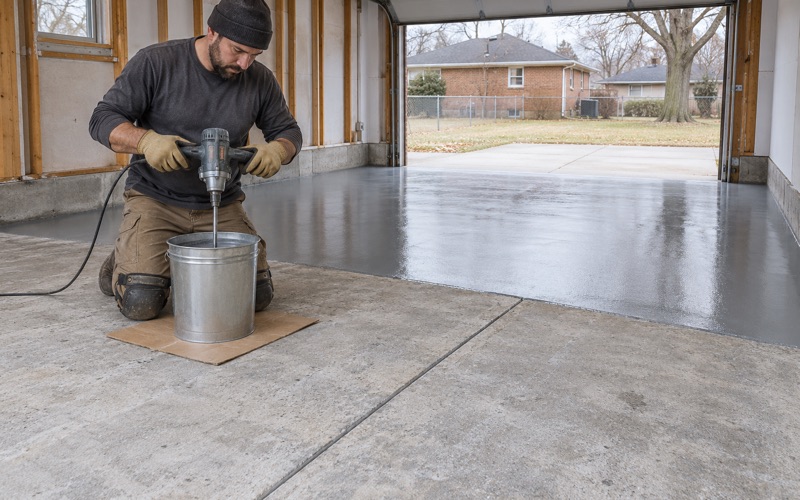
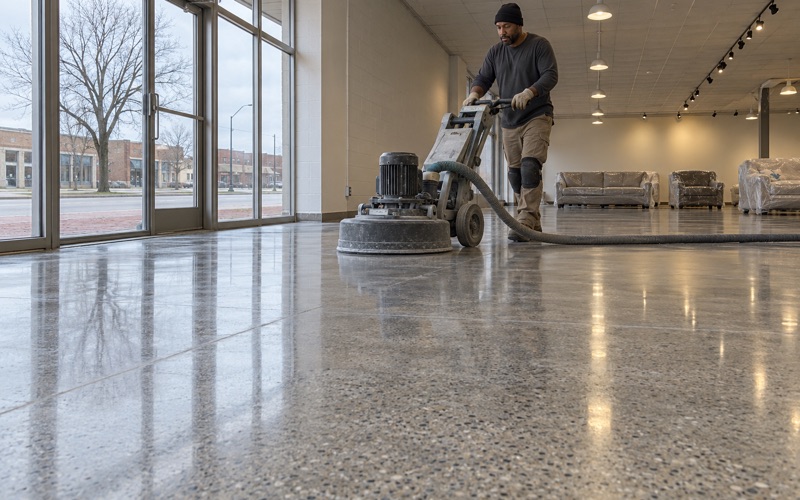
Our approach does not change with the size of the room. We open the slab with a diamond grinder or a shot blaster rather than acid, test it for moisture before the price is settled, and write the product line, coat count and finished thickness into the proposal so the result can be measured against it.
A Neveria on 147th Street and the Milk It Serves
Noon to nine, every day
Paleteria y Neveria La Paloma Blanca sits at 3350 W. 147th Street in Midlothian, a Cook County village that is a southwestern suburb of Chicago. The shop’s own Instagram lists its hours as noon to 9:00 p.m. daily, and its ordering site names milk-based ice cream among its products, alongside the paletas a paleteria is known for.
We use the shop as a picture of the kind of counter this page is about, not as a job of ours. We have no tie to it, and we have not seen how it makes its paletas or what is underfoot behind its freezers, so nothing here describes its floor.
Nine hours of scooping a day, seven days a week, is a lot of time for drips to reach the floor. That is the condition worth planning for in any shop like it.
Where the lactic acid comes from
Milk-based ice cream does not stay frozen once it leaves the cabinet. It drips off scoops, runs down cones, collects around dipping cabinets and falls from freezer doors as they swing open, and every one of those drops carries milk and sugar to the floor.
Milk that is not wiped up does not simply dry. It sours, and souring milk is milk whose sugar is turning into lactic acid, so a drip left in a corner or under an equipment leg becomes a small, steady acid spill.
The sugar does its own damage. As the water evaporates it leaves a tacky film that grabs grit from shoes, and a floor that feels sticky underfoot is usually one where residue has had time to build up in the low spots.
Counters along the Route 83 corridor
La Paloma Blanca is not the only counter space on this stretch. A listing for 3356 W. 147th Street, a few numbers down the block, described about 2,912 square feet previously configured for a hospitality use, with an open interior and substantial counter space, on a road that doubles as IL Route 83 and carries more than 18,000 vehicles a day.
We found no industrial park inside the village, so most commercial floors here belong to storefronts like these along 147th Street, Cicero, Kedzie and Pulaski. When a counter space sits empty between uses, that is the easiest moment to redo the floor behind the counter, before equipment goes back in.
Looking for epoxy-flooring closer to Evergreen Park? See Epoxy-Flooring Services in Evergreen Park.
Why Bare Concrete Loses to Lactic Acid
What the dairy trade press says
The clearest statement we have found comes from farm, not retail, flooring. Writing in Progressive Dairy in August 2012 about milking parlor floors, Mike Kramer put it bluntly: “Lactic acid will attack unprotected concrete, as will chemical cleaners.”
A dairy barn sees far more milk than any scoop shop, so we treat that line as an explanation of the chemistry rather than a rule for retail floors. It is trade guidance, not a building or health code requirement, and it was not tested on any shop floor in Midlothian.
How the surface wears away
Concrete is alkaline, and acid reacts with the cement paste that binds the sand and stone together. Kramer describes the attack as wearing away the protective surface layer, which leaves the aggregate standing proud and the pores more open than before.
An opened surface soaks up the next spill faster and holds sugar in its texture, so the floor gets harder to clean at the same time it is getting weaker. Behind a busy counter that cycle runs every day, slowly enough that nobody notices until the slab looks rough and stays stained.
Cleaners are part of the same story. The article names chemical cleaners right alongside lactic acid, and a strong cleaner used on bare concrete every night adds its own wear to the acid’s.
What the same article recommends
For parlor floors, Kramer wrote that “flexibilized epoxies or urethane cements are the most commonly accepted materials to use,” with acid brick as another alternative. Those are the same families we price for a counter that takes dairy every day.
Neither one makes a floor immune to acid. A sealed, chemically resistant surface buys time, so a spill can be wiped before it does harm, and that only works if someone actually wipes it.
Behind the Dipping Cabinet: Sealed, Resistant and Wiped Up
Choosing the system
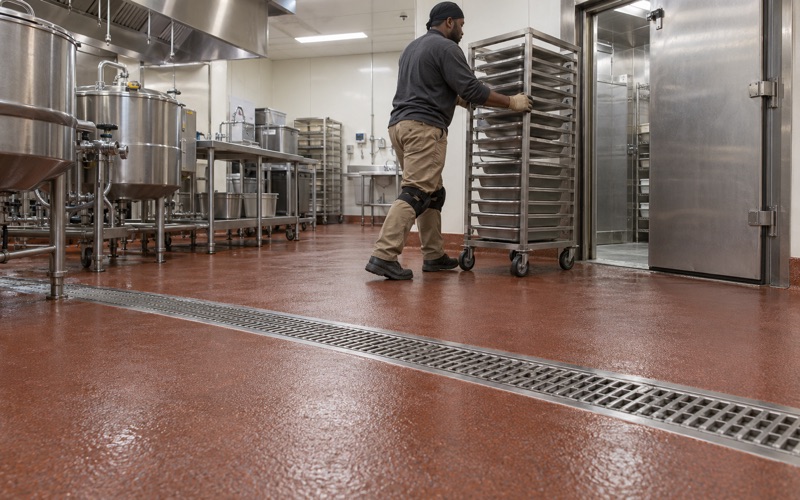
For the working side of an ice cream counter we usually start with urethane cement, because it tolerates hot water washdowns and food acids well, or a 100% solids epoxy body coat under a chemically resistant topcoat where the room stays mild. Before either goes into a proposal, we compare the product data sheet with the cleaners and sanitizers the shop already uses.
The proposal then names the product line, the number of coats and the finished thickness. That gives the owner something concrete to check the installed floor against, instead of a promise about how tough it will be.
Grip without a sticky trap
A floor behind a counter has to give staff footing when it is wet, but every bit of texture is also a place for sugar to lodge. We set slip resistance through the quartz aggregate broadcast and the topcoat named in the scope, aiming for a profile that still lets a mop glide, and we show a sample before anything is ordered.
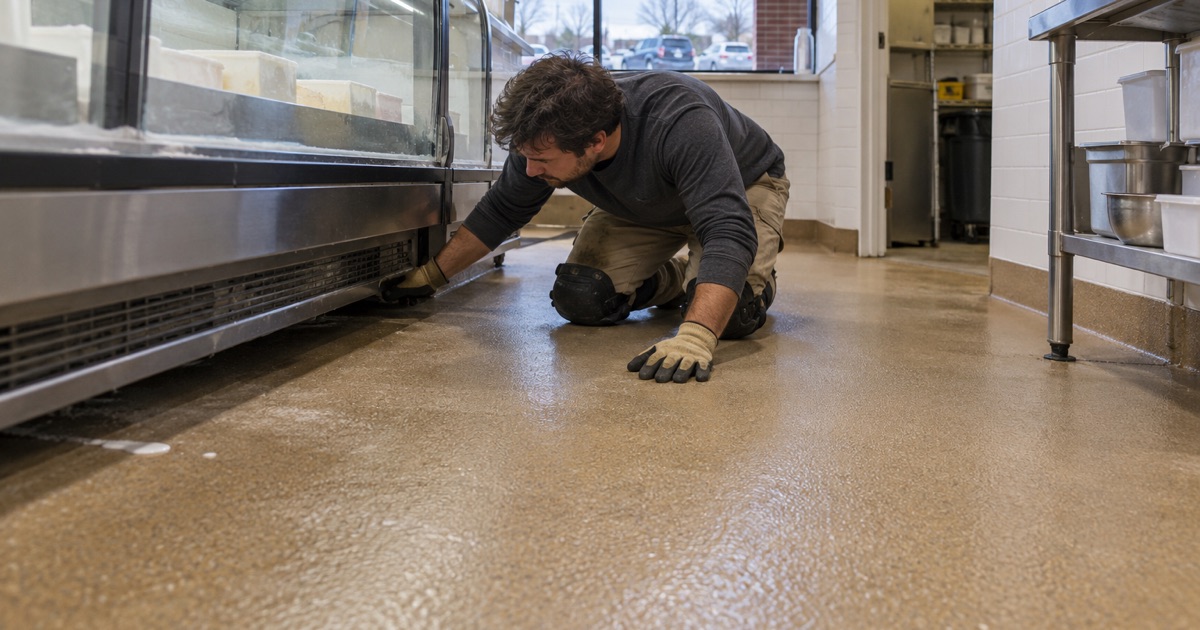
Where the floor meets the wall and the base of each cabinet, a square corner collects whatever the mop pushes ahead of it. An integral cove carried a few inches up the wall closes that joint, so the edge of the room cleans the same way the middle does.
The daily habit that protects the floor
No coating replaces the wipe. Milk left overnight on a sealed floor still sours and still leaves sugar behind; the difference is that it sits on top of a closed film rather than soaking into concrete, so it comes up with a damp cloth instead of a scrub brush.
That is also why we never sell a coating as a guarantee against stains or as any kind of food-safety approval. It is a surface that rewards prompt cleanup, and the cleanup stays with whoever runs the counter.
Getting the work done in a corridor storefront
Every contractor working in Midlothian carries an annual village license, a $100 trade or $300 general license backed by a $10,000 bond and a $1 million liability certificate naming the village, and every license expires December 31. Inspections run Monday through Friday with one business day’s notice, so we confirm all of that with the Building Department at 14801 S. Pulaski Road before a date is set.
A shop open seven days a week rarely wants to close for long. We grind with the dust captured at the machine by a vacuum, work in sections or over the slowest days, and set reopening by slab temperature and dew point rather than a calendar promise.
The Paleta Freezer in a Midlothian Garage
The same chemistry plays out at home on a smaller scale. A garage chest freezer packed with paletas for a summer party, a second fridge holding milk, or a cooler that leaks on the way in from the car all put dairy and sugar on a garage slab, often in a corner nobody looks at for weeks.
Spills behind and under the freezer
Freezers tend to sit against a wall, so a defrost leak or a melted box of ice cream runs underneath where it cannot be seen. On bare concrete that leaves a sour, sticky patch and a stain; on a coated floor it is a matter of rolling the freezer out and wiping.
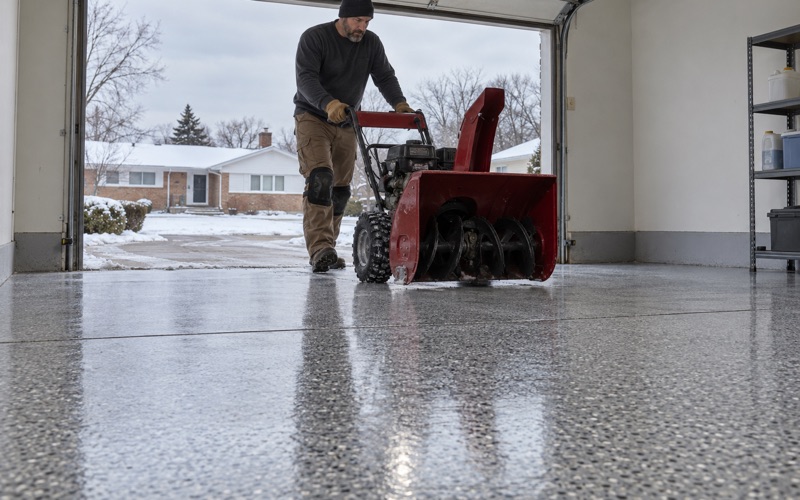
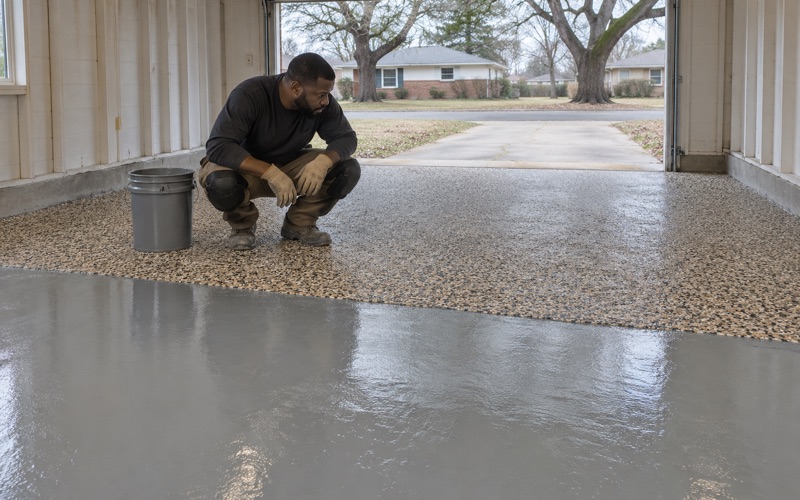
For a garage we usually build a 100% solids epoxy base with a vinyl flake broadcast and a polyaspartic topcoat. The same system is chosen to stand up to the brine and rock salt that ride in on tires all winter, and to resist hot tire pickup where the car parks.
Mapping the slab before the quote
Garage slabs carry their own history: old paint, patching compound, oil stains and the cracks that come with years of winters. We map all of it before quoting and say plainly when a section needs repair or replacement before it should be coated.
Moisture and the winter schedule
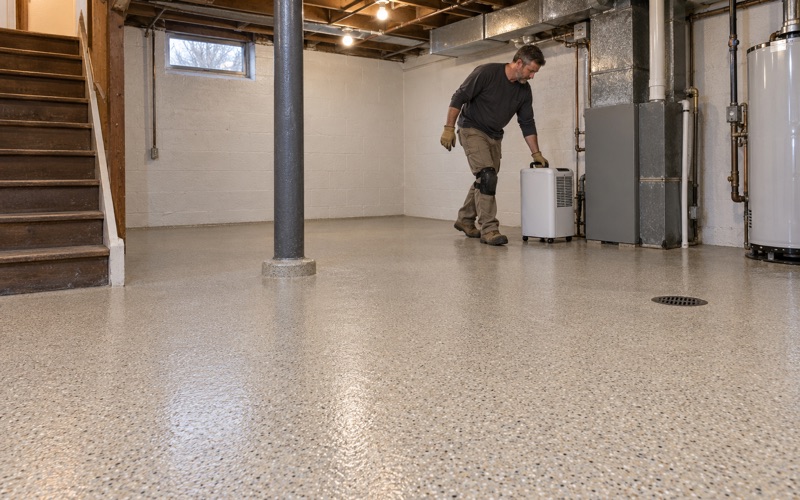
The model residential code, at R506.2.3, lets a detached garage slab go without the vapor retarder it calls for under heated rooms, so moisture rising from below is a fair question in any garage. We test before the price is final, with ASTM F1869 calcium chloride kits or ASTM F2170 in-situ relative humidity probes, and the proposal names the method and the reading the slab has to pass.
Moisture is also the first exclusion we explain in any coating warranty, before the job is sold. And because cure follows slab temperature and dew point, an unheated garage in the middle of winter is told to wait for spring rather than coated on schedule.
From a neveria counter on 147th Street to a chest freezer in a two-car garage, the question is the same: will spilled milk sit on a closed surface, or on bare concrete that lactic acid can eat into? When it is bare concrete, our answer starts with grinding the slab open, testing it and writing down exactly what will cover it.
- 20+ Years Coating Concrete
- Written Moisture Testing
- Free Estimates