Gary Epoxy Flooring has spent more than 20 years on concrete coatings, and our work on epoxy flooring in Mokena keeps coming back to one plain test: can a wet mop clear the floor completely? In most garages that question is about road salt and spilled oil. In any room where firearms are fired, cleaned or reloaded, it is about dust nobody can see.
Fine particles settle into whatever floor they land on. Carpet holds them in its fibers and a broom lifts them back into the air, so the floor around shooting and gun work has to give that dust nowhere to hide and has to clean up wet. A sealed, seamless resin coating with a closed cove at the wall is built for exactly that routine.
The limit of that job belongs up front. A coating is a cleanable surface and nothing more: it does not seal lead in, take it away or make a room safe on its own. What it does is make the cleaning that removes dust practical, day after day.
A Basement Firing Range and the Rooms Beside It
The new police headquarters on 191st Street
The Mokena Police Department opened its new headquarters at 10300 W. 191st Street on May 29, 2024, leaving a 5,000-square-foot converted fire station on Front Street. Studio GC Architects, which designed the building, lists it at 34,296 square feet and states that the basement has a 3,945-square-foot firing range, along with a shelled expansion and storage space.
We have not seen the range’s floors, finishes or cleaning routine, and we have no connection to the village or the department. The building matters here for a simpler reason: it puts a working indoor range inside Mokena, and the federal guidance written for such ranges has a good deal to say about floors.
What NIOSH says about the range and its neighbors
In April 2009 NIOSH published an alert on preventing lead and noise exposure at indoor firing ranges, Publication 2009-136. Its floor guidance is short and direct: carpeting should not be used anywhere inside a firing range or in rooms adjacent to the range.
The second half of that sentence is the part people skip. The concern does not stop at the shooting lanes; it reaches the rooms next to them, where shooters walk out, sit down, clean their weapons and change before heading home.
Depending on the plan, those rooms might include a classroom, a cleaning or armory room and the corridor leading off the range. Each is a floor where dust carried off the lanes on shoes and clothing can come to rest.
Lead dust, unspent primer and why carpet is out
NIOSH gives two reasons. Lead dust that builds up in carpet is a health hazard, and unspent primer that builds up in carpet is a fire hazard.
Fibers hold onto both, and what settles deep in the pile is hard to reach with routine cleaning. The same alert notes that dust from dormitory carpet used by FBI students carried lead brought back from the range, which shows how far a soft floor can move the problem from where it began.
A hard floor does not make dust disappear either. What it changes is that the dust stays on top, where a detergent wash can pick it up instead of working it deeper with every footstep.
Looking for epoxy-flooring closer to Summit? See Epoxy-Flooring in Summit.
Wet Cleaning, No Broom and a Line for Shoes
Detergent, never a broom
NIOSH says floors and horizontal surfaces inside a range should be cleaned routinely with a detergent, or with a cleanser designed for lead decontamination in tough cases. On the opposite habit it is blunt: “Dry sweeping should never be used in the firing range.”
A broom throws fine dust back into the air, where it can be breathed or drift onto another surface. The alert also describes a NIOSH evaluation of a police department range elsewhere where users cleaned by dry sweeping, which is precisely the habit the guidance sets out to end.
A floor a mop can actually finish
Wet cleaning only works when the surface lets it. Bare concrete is porous, and tile grout, open joints and the corner where floor meets wall all hold residue that a mop slides past.
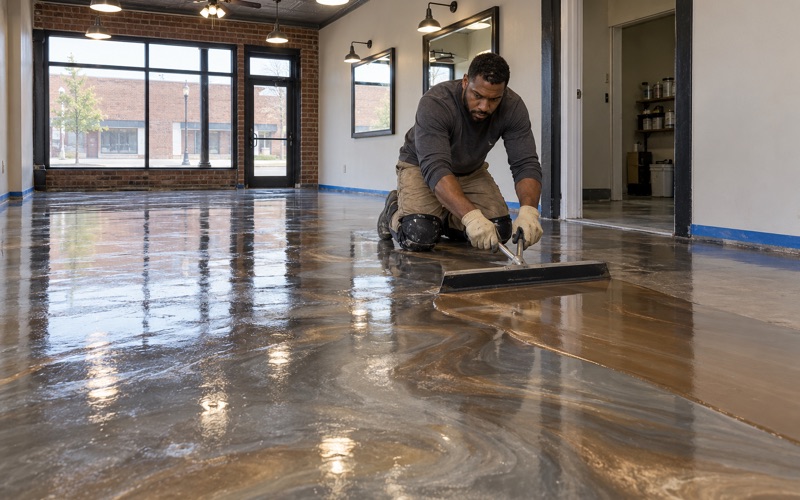
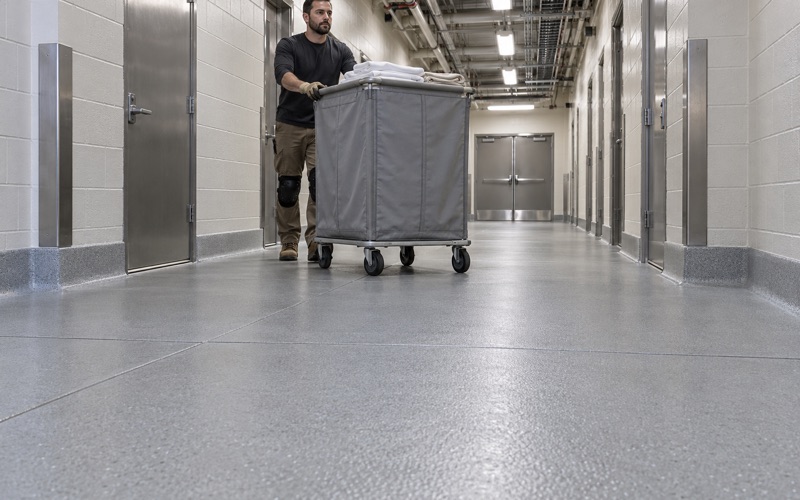
A seamless resin system answers each of those. A 100% solids epoxy base finished with a polyaspartic or polyurea topcoat leaves no open pores at the surface, and an integral cove run up the base of the wall turns that corner into a smooth curve a mop can follow.
Texture is the trade-off. A coarse quartz aggregate broadcast improves footing but gives a mop more to work around, so for rooms like these we specify a fine broadcast and enough topcoat to keep the surface easy to clean, and we write that choice into the proposal rather than promising grip in general terms.
Where the range shoes stop
NIOSH tells shooters to leave the shoes worn on the range at the range, or bag them before leaving, so lead is not tracked into cars and onto home floors. It also advises changing clothes and shoes before leaving the range facilities.
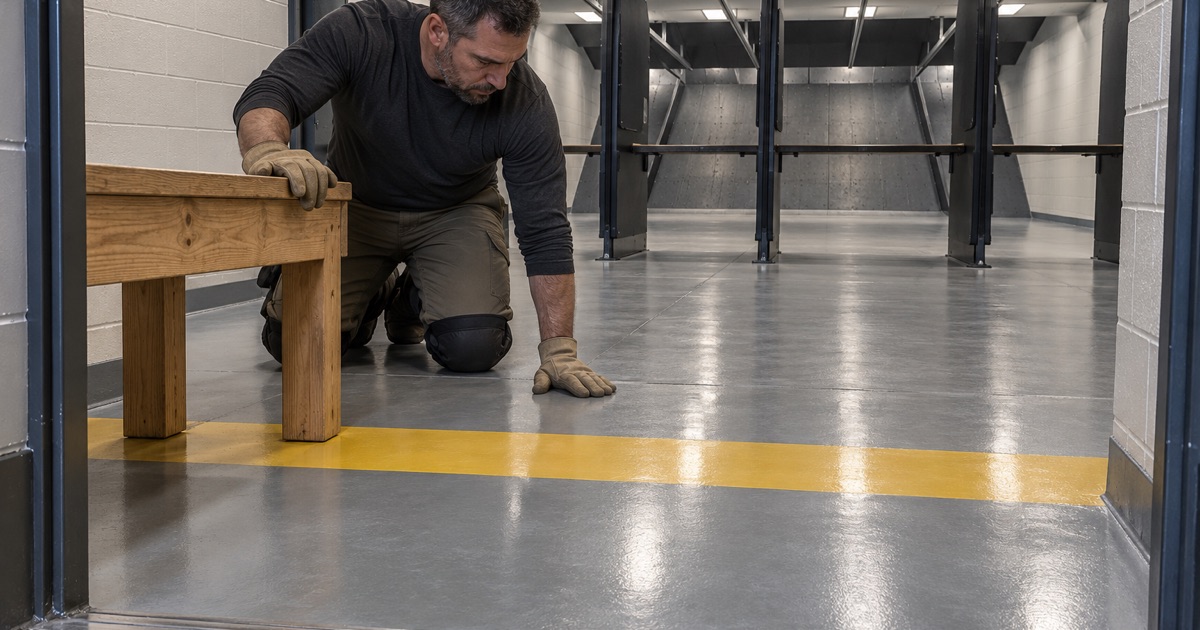
A floor can make that rule easier to keep. A color change in the coating at the range door, or a contrasting band across the threshold, gives everyone a visible place where range shoes come off, and the hard surface on both sides keeps whatever is shed there within reach of a mop.
Reloading Benches and Gun-Cleaning Corners in Mokena Homes
The same reasoning, scaled down
The NIOSH guidance is written for ranges, but its logic carries into a house. A reloading bench handles primers and powder, and a gun-cleaning corner collects the residue that comes off a firearm as it is scrubbed, so both are spots where carpet and a broom are the wrong tools.
For a home bench we suggest the same three habits in miniature. Keep carpet and rugs out from under it, put down a sealed floor that wipes clean wet, and keep the shoes worn to the range at the garage or bench rather than walking them through the house.
Dropped primers are the home version of the alert’s fire concern. On a coated floor a stray primer sits in plain view and can be picked up, instead of disappearing into a rug where it can collect with others.
What the slab under the bench looks like here
Most home benches end up in a garage or a basement, and in Mokena that usually means a relatively young slab. Census figures put 66.1 percent of the village’s housing in buildings from 1990 or later, and 30.3 percent from the 1990s alone, so the typical residential floor here is a 1990s or 2000s garage slab.
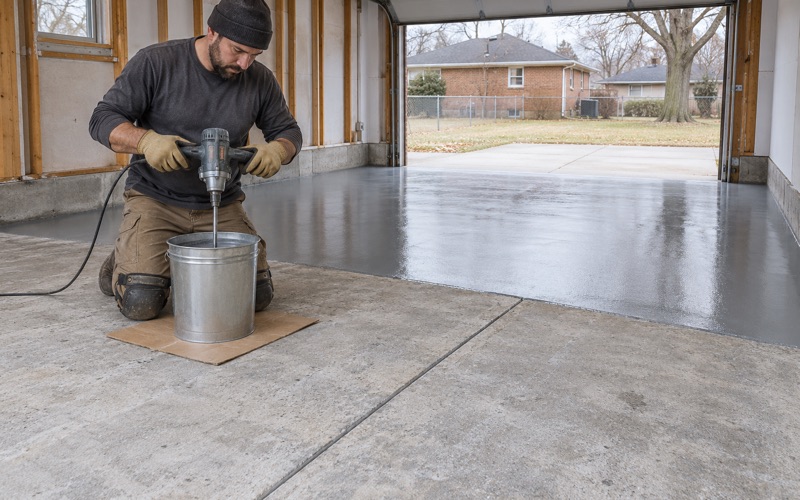
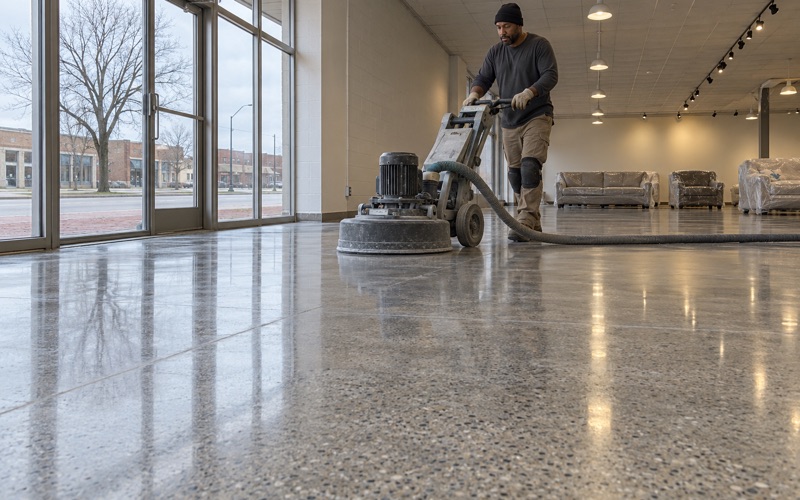
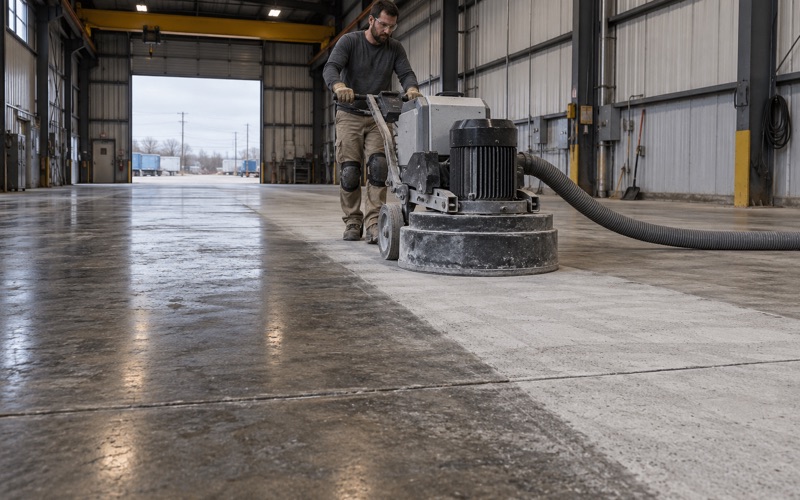
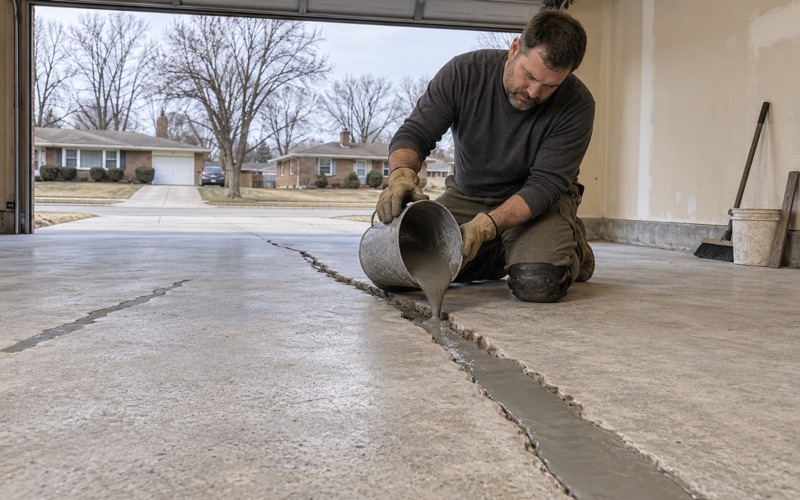
Young does not mean sound. We map cracks, spalls and old paint before pricing and say plainly when a slab needs repair before it should be coated, then open the surface with a diamond grinder or shot blaster rather than an acid etch, capturing the dust in a vacuum at the machine.
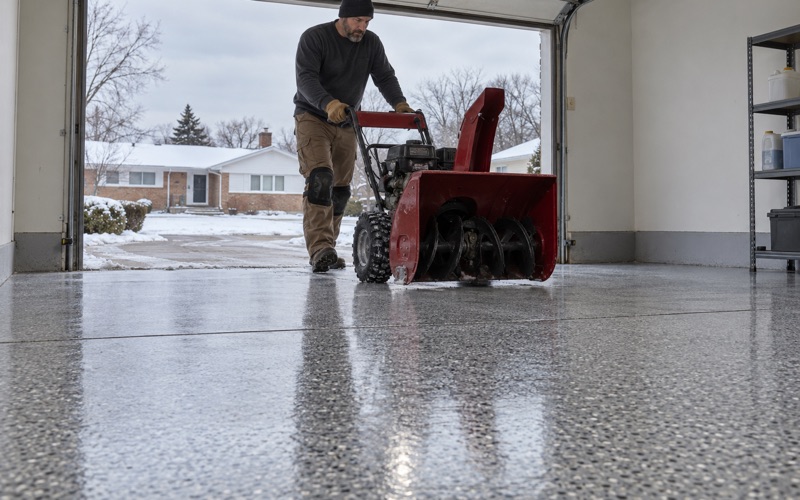
Garage benches face one more issue: the brine and rock salt that ride in on tires all winter. We choose the system with that salt in mind, since the same floor has to handle a parked car’s slush and a cleaning bench’s wet wipe-downs.
Basement benches and moisture
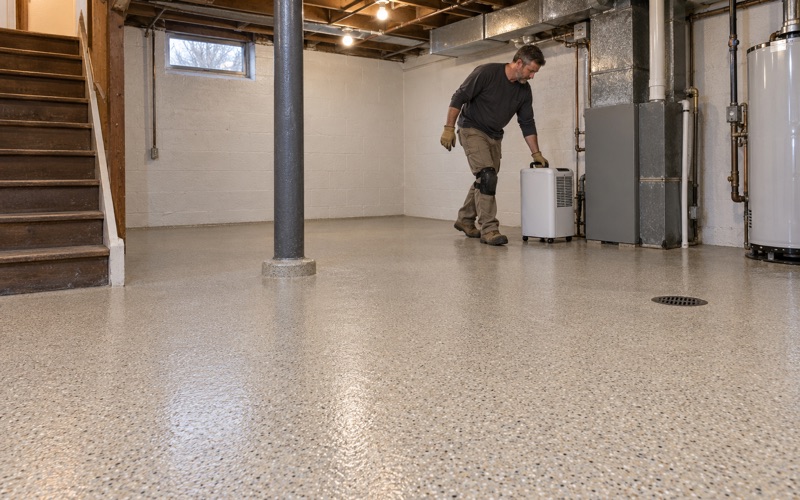
A basement bench sits on a slab that can carry moisture up from below, and a coating laid over that moisture can lift. Our written scope includes a moisture test before the price is final, and the proposal names the method, such as ASTM F2170 in-situ relative humidity probes or ASTM F1869 calcium chloride testing, plus the reading it has to pass.
Moisture is also the first exclusion we name when explaining what a coating warranty leaves out. We never sell a floor coating as waterproofing or radon reduction, in a basement or anywhere else.
Registration, Proposals and Cure Timing in Mokena
Registering with the village
The Village of Mokena asks contractors to register with its Community Development Department at 11004 Carpenter Street before working in town. Registration carries a $150 fee, general liability and workers’ compensation coverage of $500,000 each occurrence, and a $10,000 surety bond, and we confirm every item before a job is booked.
The village’s permit list exempts finish work such as painting, tiling and carpeting, but it does not name floor coating either way. For anything unlisted it tells applicants to contact Community Development before starting, so we ask rather than guess.
What the proposal spells out
Each proposal names the product line, the number of coats and the finished thickness, so the installed floor can be checked against the quote. For a bench area or a room beside one, it also shows where the cove runs, which broadcast is used and where any shoe line falls.
Timing the cure to the slab
Cure follows slab temperature and the dew point spread at the surface, not a date on the calendar. An unheated garage in deep winter is a job we will tell you to postpone, because resin laid on a cold, damp slab can blush and lose its grip.
A basement bench is usually easier on that front, since the space stays closer to room temperature year-round. Either way, nobody should set a reloading press or a cleaning mat on the new floor until the cure the proposal lists is complete.
The police station on 191st Street is a public building we have no part in, but the rule written for rooms like its basement range is easy to borrow. Wherever guns get cleaned or rounds get loaded in a Mokena home, the floor underneath should be one a detergent mop can finish and a broom never needs to touch.
- 20+ Years Coating Concrete
- Written Moisture Testing
- Free Estimates