Gary Epoxy Flooring has more than 20 years behind it, and on epoxy flooring in Palos Heights the question this page answers has nothing to do with parked cars: can a garage or basement slab double as a pickleball court? It can host a game, but a coating built to shrug off tire marks and road brine is not built to be played on. Those are two different jobs, and the gap between them is mostly about friction.
A showroom garage finish is judged by how it looks and how it wears. A playing surface is judged by how a shoe behaves on it: whether a player can stop hard, push off sideways and turn on the ball of the foot without the floor either letting go or grabbing. Get that wrong in either direction and the court plays badly.
We would rather tell you that before any grinding starts than after a floor is down. Below we cover where the standard for sports floors comes from, why a coated slab falls outside it, and which finish we actually recommend when a homeowner wants lines on the floor.
Weekday Morning Pickleball at the Recreation Center
The Palos Heights Recreation Center at 6601 W. 127th Street runs Open Gym and pickleball Monday-Friday 6:00 a.m. to 11:30 a.m. Drop-in play is listed at $5 for residents and $8 for non-residents, Fitness Center members play free, and a yearly pickleball membership costs $135 for residents or $240 standard. Court directories list two indoor courts with permanent lines and portable nets.
The current building reflects an expansion and renovation that opened in August 2016 after a November 2014 referendum, adding about 24,800 square feet and renovating about 24,500 more. It brought a new gymnasium, a fitness center and an elevated track, and the city rents the gym and rooms year round.
Open gym ID cards are required, and basketball may be limited to half court during those hours. The rest of the building opens at 5:30 a.m. on weekdays, including a fitness center with a 1/12-mile indoor walking track.
A schedule like that is how a hobby turns into a habit, and a habit eventually looks for practice space at home. The two-car garage or the open end of a basement is the obvious candidate. We have no connection to the city’s program and have not seen or tested the gym’s floor, so nothing on this page describes that surface.
What Pickleball Asks of a Floor
Pickleball is a game of short bursts. Much of the action happens near the kitchen line, the non-volley zone in front of the net, where players shuffle sideways, stop, reset their feet and lunge for a dink, often several times in one rally.
Each of those moves puts a sideways load on the shoe. If the floor lets the shoe skate, the stop arrives late; if it locks the shoe in place while the body keeps turning, the strain goes up into the knee and ankle. A good court surface sits between those two outcomes, which is the idea behind the friction window in the next section.
Looking for epoxy-flooring closer to Worth? See Epoxy-Flooring in Worth.
The Friction Window and What ASTM F2772 Measures
Most people assume more grip is always safer. Indoor sports floors are specified the other way: there is a range, with a ceiling as well as a floor, because players have to stop and also pivot. A surface below the range lets shoes slide out; a surface above it grabs a shoe that is trying to turn.
The 80-to-110 Sliding Range
ASTM F2772, the Standard Specification for Athletic Performance Properties of Indoor Sports Floor Systems, was developed in 2009. One of its properties is the sliding effect, which a Sport Court fact sheet describes as the floor’s optimal level of grip and slide in all directions, allowing safe and easy movement or pivoting. The minimum performance level that sheet lists is a sliding value between 80 and 110.
That sheet comes from a flooring manufacturer, and we have not read the current edition of the standard itself, so we treat the range as the published benchmark rather than as a number we measure. A separate safety-supply article gives the same range for the 2011 edition and says it is measured with a pendulum and a rubber slider.
Why the Ceiling Matters as Much as the Floor
A floor that is too grippy fails quietly. Nothing looks wrong, the shoe feels secure in a straight line, and the problem shows up only when a player plants and rotates, because the sole stays put while the foot, knee and hip keep moving. That is why the range has an upper number at all.
Shoes shift the result too. Indoor court shoes usually have flatter, softer soles than running shoes, whose deeper tread meets a floor differently, so the same surface can feel quite different under each. We ask what footwear will actually be worn before we suggest a finish.
Shock Absorption, and Why a Coated Slab Falls Short
F2772 also covers shock absorption, vertical deformation and ball bounce. The fact sheet sets shock absorption at no less than 10 percent and states that VCT, carpet, concrete and linoleum all fall below that mark and do not meet Class 1 standards for a sport floor.
Ball bounce is measured against concrete itself: the sheet asks a sports floor to return at least 90 percent of the rebound a ball gets on concrete. So a slab is not a poor surface for bounce; for a home pickleball floor, the open question is footing and cushion, not bounce.
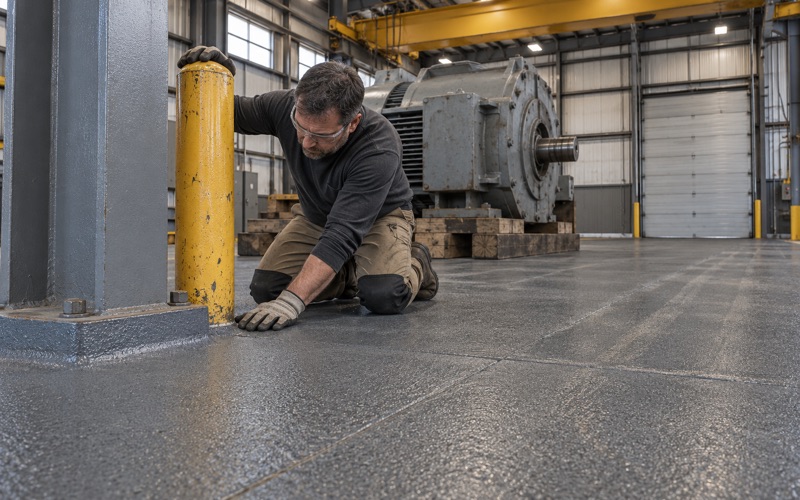
An epoxy coating is a few thin layers bonded to the concrete, so the slab underneath sets the cushion. No coating we install has been tested to F2772, and we will not describe one as a sports floor. What a coating can change is the texture underfoot, which moves the sliding behavior up or down, and that is where finish choice matters.
Gloss, Broadcast and Court Coatings Across the Window
Garage systems are tuned for cars, brine and dropped tools, not for lateral footwork, and the common ones lean toward opposite ends of the scale. We have not run a pendulum test on any of them, so read what follows as how the textures behave underfoot, not as measured sliding values.
High Gloss at the Slick End
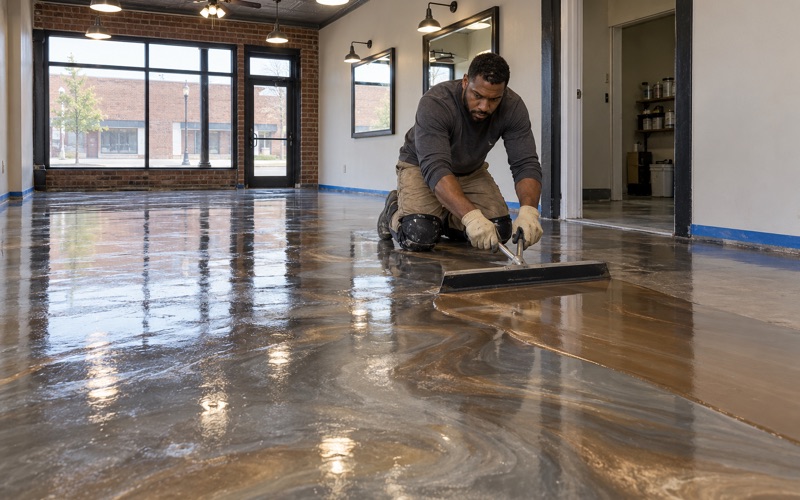
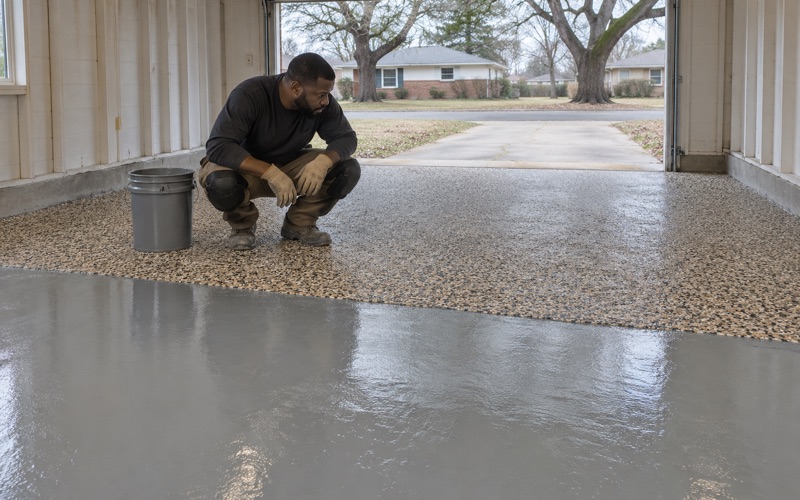
A 100% solids epoxy with a clear polyaspartic topcoat and no added texture is the glassy floor people picture in a showroom. Clean and dry, it feels firm, but a court shoe has little to key into, and a few drops of sweat change the feel quickly. For play, that is the slick end of the scale.
Heavy Broadcast at the Grabby End
A full broadcast of quartz aggregate, or a vinyl flake system with a gritty topcoat, sits at the other end. That surface is excellent at keeping a work boot planted on a wet garage floor. Under a court shoe trying to pivot, though, it can hold the sole while the player turns, and its sharp texture is hard on balls, shoe soles and skin in a fall.
Textured Court Coatings in the Middle
The honest answer for a home court is a product made for courts: a textured acrylic court coating, or interlocking sport tile laid over the slab. Court coatings carry a fine, even texture designed for footwork, and some sport tiles add a little give that bare concrete lacks. Neither is a showroom garage finish, and we will tell you when one of them fits your plan better than epoxy.
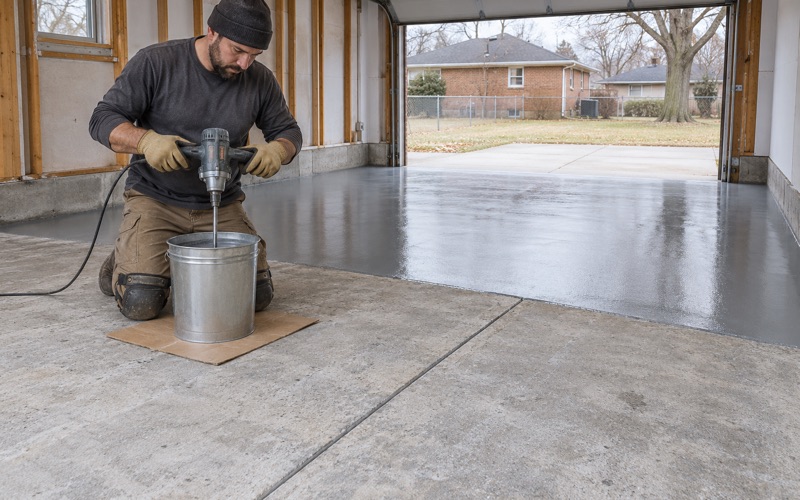
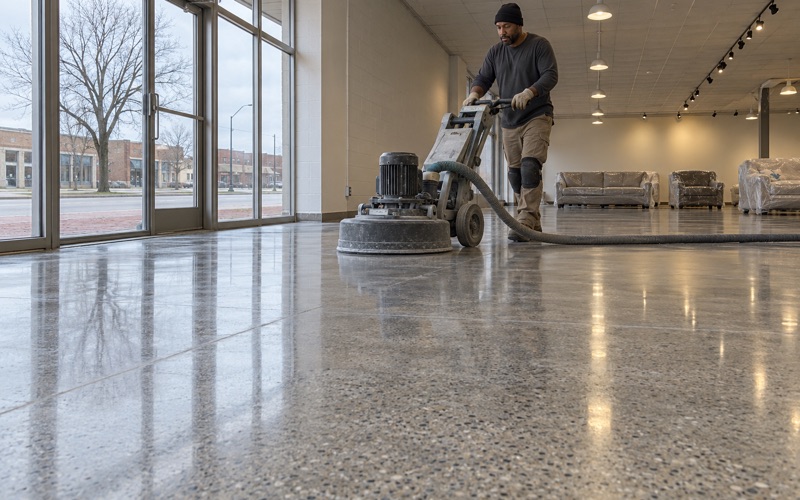
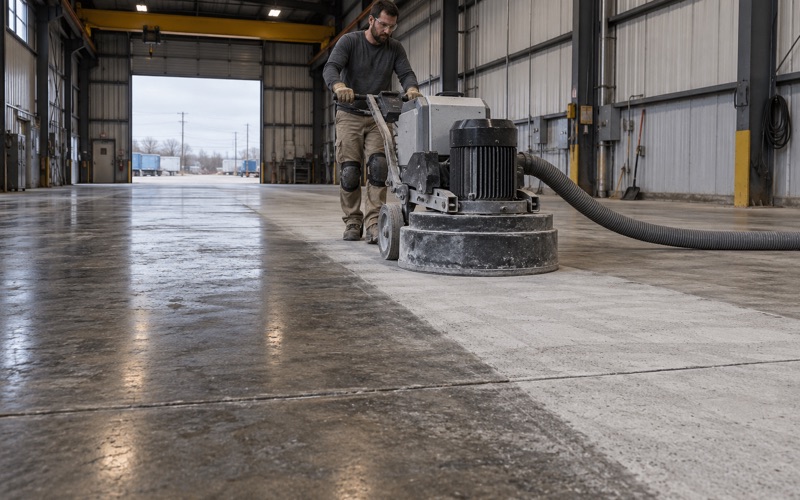
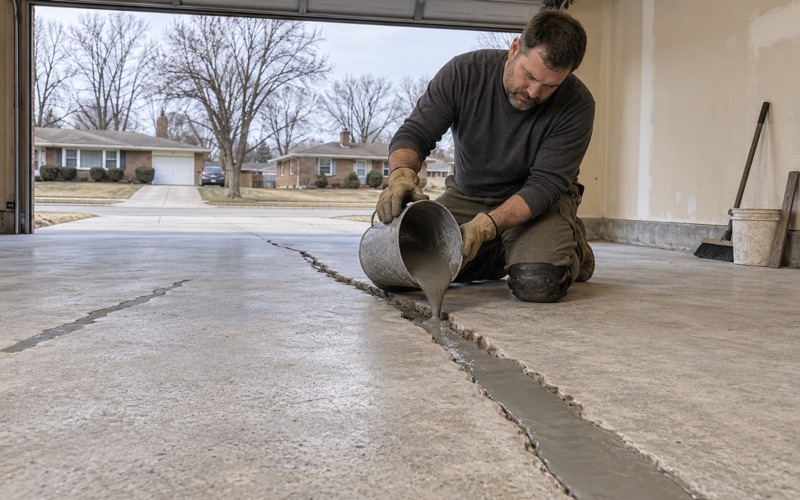
Where we come in is often the slab itself. A court coating or tile still needs a flat, sound, dry base, and that is the same preparation work we do before any coating: cracks, spalls and old paint mapped first, and the surface opened with a diamond grinder or shot blaster rather than acid.
Laying Out a Court in a Palos Heights Garage or Basement
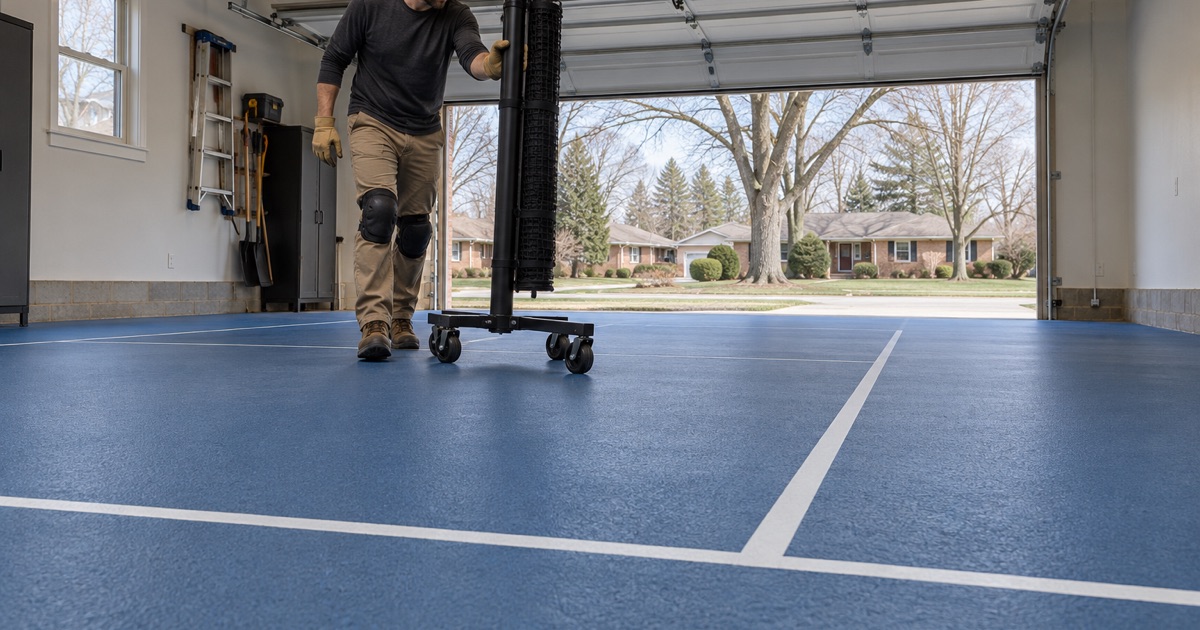
A full pickleball court, plus room to move past its lines, needs more open floor than most two-car garages or basements offer. Many home setups end up as practice zones instead: a half court, a strip for kitchen-line drills or a wall for dinking. Decide which one you want before choosing a finish, because the playing area sets where texture and lines go.
Lines to Spec, Painted on the Right Surface
Court lines should be measured from the published court dimensions and painted with a line paint that bonds to the surface beneath it. On a court coating, that means the coating maker’s line paint; on an epoxy floor, it means taping and coating the lines into the system so they do not peel under shoe traffic or sit as a raised, slick stripe.
A garage that has to stay a garage is a compromise worth stating plainly. If the car parks there in winter, the floor needs to handle rock salt and brine riding in on the tires, and a court texture may wear faster under that than a garage system would. Some owners keep a coated garage floor and roll out sport tile on game days.
Owned Homes, Association Garages and New Slabs
Most homes here are owner-occupied, 93.4 percent by census count, so a court project is usually a homeowner’s own decision. About 22 percent of homes, though, are attached townhouse-type units, and a garage inside an association may come with rules about what can be painted, stored or bolted down. Check those before you plan nets and lines.
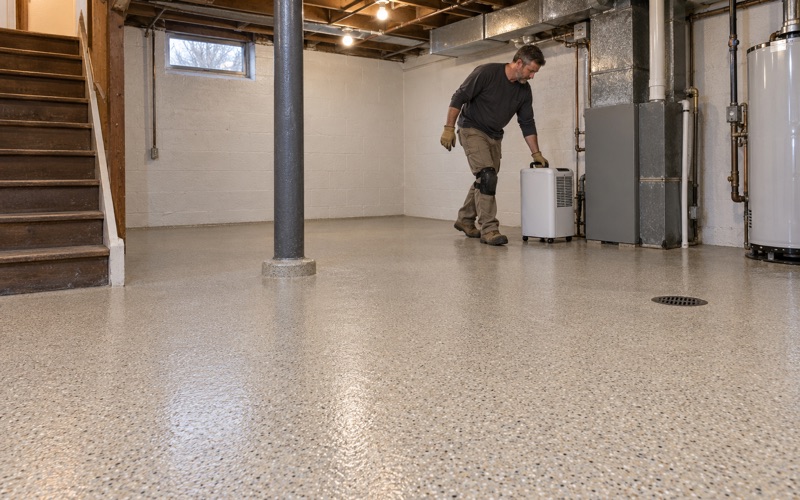
The city also reports teardown-and-replacement permits and new houses on vacant lots, so some slabs here are fresh pours rather than decades-old concrete. A new slab still needs its moisture tested before anything goes on it, and the proposal names the test method and the number it must pass. Cure follows slab temperature and dew point, not the calendar.
If a project needs a city permit, Palos Heights accepts contractor registration only in person or by mail and hands permits over in person, never by email, and we plan for that before booking. Whatever we end up installing, the proposal names the product line, coat count and finished thickness, so the floor in your garage can be checked against the paper, court lines included.
- 20+ Years Coating Concrete
- Written Moisture Testing
- Free Estimates