Gary Epoxy Flooring has spent more than 20 years on resin floors, and epoxy flooring in Palos Hills keeps coming back to one plain question: can the floor be mopped wet, every day, without coming apart? For a room where small children eat, play and have accidents, that question matters more than color or gloss.
Some floors answer it badly. A click-together plank has seams every few inches, and water that finds those seams can reach a core that was never meant to get wet. A poured resin floor has no seams at all, so a soaked mop and a spray bottle are routine instead of a risk. Click flooring suits plenty of dry rooms; it is a poor match for one that is mopped wet every day.
This page walks through why that difference matters for toddler rooms, playrooms and mudrooms, what one laminate seller’s own care guide says about water, and how we prepare and quote a seamless floor that is meant to be cleaned wet.
A Youth Room Built for 2-Year-Olds
The Palos Hills Community Center at 8455 W. 103rd Street is where the city runs its Playschool and its programs for 2-year-olds, and the Parks and Recreation page lists Tot Stuff Play School among its offerings. It is a useful example of the kind of room this page is about, though we have no connection to the city and have never worked on the building.
Rooms like this are hard on floors in a particular way. They are not exposed to forklifts or hot tires, but they are cleaned more often than almost any other room in a building.
What the 2017 minutes recorded
City council minutes from February 2, 2017 note that January had been safety month for the Playschool and the 2-year-old programs. The same report thanked Public Works for re-doing the Community Center’s youth room, which got a fresh coat of paint and a laminate floor to greet the children and their parents.
That is the whole record we read. Whether the laminate is still in that room today, and how the staff clean it, we do not know, and nothing here suggests the floor has had any trouble. The room matters to us only because it shows what a toddler space is asked to do.
How a toddler room actually gets cleaned
A room for 2-year-olds is cleaned wet, and usually more than once a day. Sippy cups tip over, snack time leaves crumbs and juice behind, and potty training brings accidents that have to be cleaned up right away. At the end of the day the surfaces children touch, the floor included, get a sanitizing wipe-down.
None of that is unusual, and none of it can be skipped. A floor in that room has to take a wet mop, a cleaner that sanitizes, and the occasional puddle that sits for a few minutes before anyone notices it. The floor choice should start from that cleaning routine, not from how the room looks on the day it opens.
Looking for epoxy-flooring closer to Bridgeview? See Bridgeview Epoxy-Flooring.
What Laminate Makers Say About Water and Wet Mops
Laminate is popular for good reasons: it is affordable, quick to install and convincing as wood. Its weak point is water, and at least one seller states that limit in blunt terms.
One seller’s care guide, quoted
BuildDirect’s laminate care guide, dated April 17, 2019, tells owners to never wash or wet mop the floor with soap, water, oil soaps, detergents, vinegar or any other liquid cleaner. The stated reason is that liquid can cause swelling, warping, delamination or joint-line separation, and that doing it will void the warranty.
The same guide says never to let liquids stand on the floor, to blot spills with a damp cloth as soon as they happen, and to avoid steam mops and wet mops of any kind. It also lists strong ammoniated or chlorinated cleaners among the products not to use. That rules out the bleach-based sanitizers many people reach for first.
Terms vary by product
That is one seller’s guide, not a rule every laminate follows. Other makers’ instructions allow a lightly damp mop, set a time limit on how long spills may sit, or permit wet mopping only on lines sold as water resistant, and even those still call for standing water to be removed promptly.
So the honest advice is to read the care sheet and warranty for the exact product before deciding how a room will be cleaned. If that paperwork forbids a wet mop and the room needs one every afternoon, the floor and the room are working against each other.
We apply the same rule to our own floors. Before a playroom or mudroom job is sold, we explain what the coating warranty covers and what it leaves out, and moisture rising through the slab is the first exclusion we name.
Joints, Cores and a Floor You Can Sanitize
The difference between laminate and a resin floor is not mainly about toughness. It is about where water can go once it lands on the surface.
Where the water goes
A click-joint plank is a thin decorative layer over a fiberboard core, locked to its neighbors along every edge. Water that pools on the surface works into those joints, and a core that absorbs it can swell and lift the plank edges. Spills that linger near seams are the ones a care guide is trying to prevent.
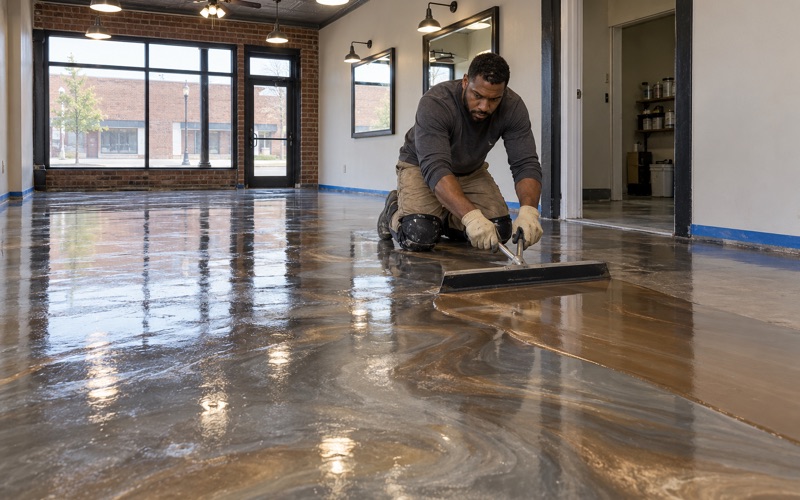
A poured coating is one continuous film bonded to the concrete underneath. There are no seams for a spill to sink into, so liquid stays on top until it is mopped up. That is why a resin floor, or a sealed resilient sheet floor, can be wet-mopped and sanitized as part of the daily routine.
What a coating can and cannot do
A seamless floor makes sanitizing easier, but the coating itself is not a disinfectant and does not kill germs. Cleaning still does that work. What the floor does is give the cleaner a smooth, nonporous surface with no cracks or gaps for spills to hide in.
We also check the chemical resistance of the topcoat against the cleaners the room will actually use. Before we recommend a system, we ask which sanitizer is on the shelf and how often it goes on the floor, then pick a topcoat rated for that routine.
Grip without a rough feel
Little feet need traction, and hands and knees need a surface that does not scratch. We set slip resistance through the broadcast and the topcoat we use, a fine aggregate in a clear coat rather than a slogan, and keep it smooth enough to mop clean in one pass.
Edges where the floor meets the wall
A seamless field still meets walls, door frames and cabinet bases, and those edges are where mop water collects. On a resin floor we can run the coating a few inches up the wall as an integral cove base, so the corner is one continuous surface rather than a joint behind a strip of vinyl.
Doorways get the same attention. Where the new floor meets carpet or tile in the next room, we finish the edge with a ground key or a flush transition so a wet mop does not catch on a lip and push water under it.
Playrooms, Mudrooms and Basement Kid Spaces in Palos Hills
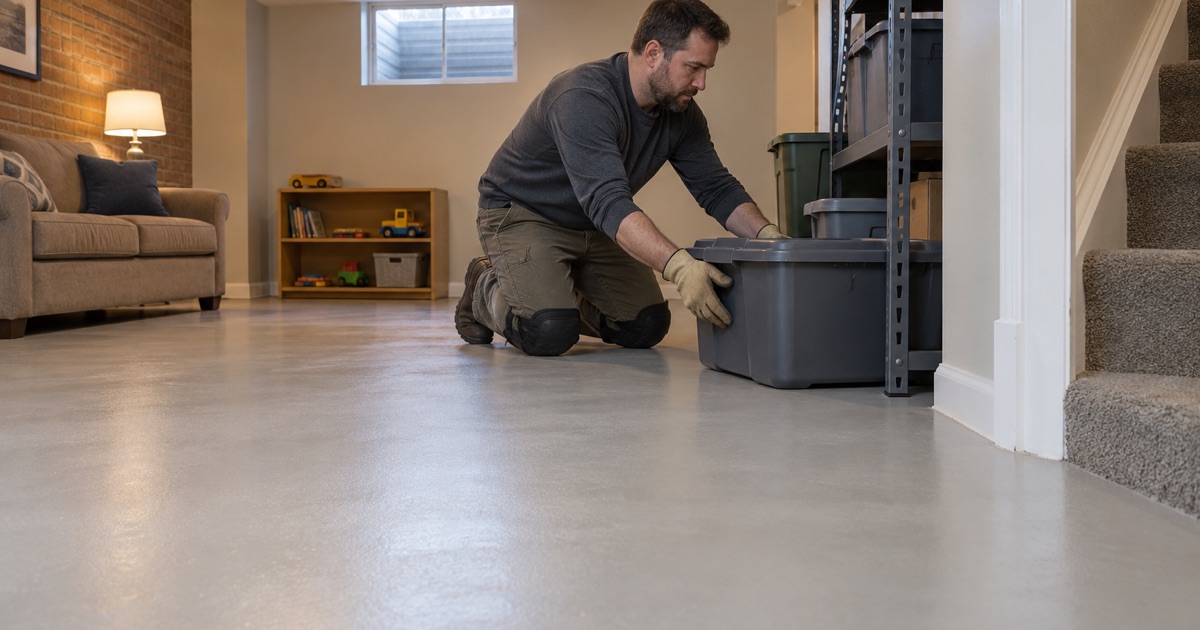
Many of the floors we are asked about here are not in public buildings. They are basement playrooms, mudrooms by the back door and laundry corners that double as play space. Most building in the city took place from the late 1970s through the early 1990s, so many of those rooms sit on slabs poured decades ago.
Testing the slab before the price is final
A basement slab can carry moisture up from below even when it looks dry. Our written scope includes a moisture test before the price is final, and the proposal names the method, such as ASTM F2170 in-situ relative humidity probes or ASTM F1869 calcium chloride testing, along with the reading the slab has to pass.
When a reading is too high, we say so and add a moisture-mitigation primer or advise against coating at all. A floor coating is never sold as waterproofing, and a slab with a water problem gets that problem addressed first.
Preparing the concrete properly
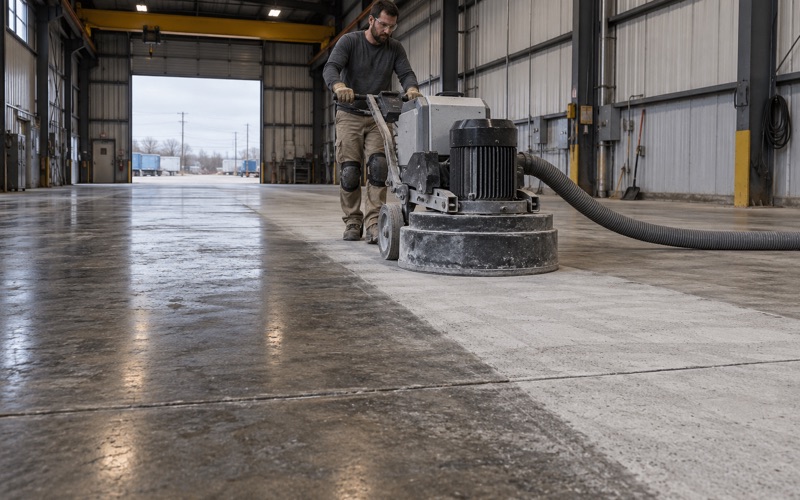
We open every slab with a diamond grinder or a shot blaster to the surface profile the coating calls for, never an acid etch. Grinding dust is pulled into a vacuum at the machine rather than washed toward a floor drain. Cracks, spalls and old paint are mapped first, and if a slab needs repair before it should be coated, we say so.
For a playroom we often recommend a 100% solids epoxy body coat with a vinyl flake broadcast and a polyaspartic topcoat. The proposal lists the product line, the number of coats and the finished thickness, so the floor can be checked against the quote once it is done.
Registration, bonds and shared walls
The City of Palos Hills Building Department registers contractors, and a general contractor posts a $25,000 surety bond and carries liability insurance to register. We confirm those requirements before booking a job. In the city’s 945 owner-occupied attached homes, a basement slab may share a wall line with a neighbor, so we plan dust control and work hours with that in mind.
Cure timing follows slab temperature and dew point, not the calendar. A playroom coating needs a firm cure before small children, toys and a wet mop return to it, and we give each family a written return schedule based on the product and conditions in their basement.
- 20+ Years Coating Concrete
- Written Moisture Testing
- Free Estimates