Gary Epoxy Flooring brings more than 20 years of resin work to epoxy flooring in Richton Park, and this page is about a stain most people never connect to a bag of lawn food. Iron-bearing fertilizer is one of the few things sold in bags that can mark bare concrete for good, and it does its damage the moment water reaches it.
Our usual approach to a garage or shop floor holds here too. We open every slab with a diamond grinder or a shot blaster instead of acid, and the quote names the product line, coat count and finished thickness so what goes down can be measured against what was promised.
What a sealed floor cannot do matters just as much. No coating guarantees that a floor will never mark, and we say so up front. What a dense, nonporous surface does is buy time, holding spilled granules on top where a broom can reach them before water turns them into rust.
A Central Avenue Garden Department and the Iron in Lawn Food
The Supercenter at 22401 Central Avenue
Richton Park’s Walmart Supercenter at 22401 Central Avenue, at Sauk Trail, opened on June 1, 2016. The village’s own press release that day called the 182,000-square-foot store the single-largest retail development in the history of Richton Park, with 340 jobs between staff transferred from Matteson and new hires.
Walmart’s store pages list a Patio & Garden department at that address, and map listings show a garden center there as well. A garden department of that kind is a natural place for a household here to pick up a bag of lawn fertilizer, a spreader and the rest of a season’s yard supplies.
We have no connection to the store, and we have not seen its floors, its fertilizer shelves or how it handles a spill. It appears here because it is the village’s landmark retail development and it sells the kind of product this page is about, not because anything is wrong with it.
What a fertilizer maker says about iron and concrete
Milorganite, a fertilizer maker, puts it plainly on a page written for golf course and athletic field managers: most iron fertilizers will stain concrete surfaces such as walkways, cart paths and deck areas. The same page adds that the rust stains can persist for a long time.
That maker sells its own product as non-staining, so it has a reason to say so, but the warning matches what homeowners describe on DIY forums after spreading an iron-bearing lawn food: rust-colored speckles on nearby concrete.
The mechanism is simple enough. Iron in the granules oxidizes once it is wet, and bare concrete is porous, so dissolved iron wicks a little way into the surface instead of sitting on it. A cleaner can lift what is on top, but what has soaked into the pores is far harder to reach.
Looking for epoxy-flooring closer to Chicago Ridge? See Epoxy-Flooring Services in Chicago Ridge.
Torn Bags, Spreaders and the First Drop of Water
How granules end up on the floor
Fertilizer rarely reaches a floor on purpose. A bag splits along a seam when it is dragged off a shelf, a corner tears on a car trunk latch, or a spreader hopper is filled indoors and a handful bounces off the rim.
A spreader parked after use carries its own load. Granules lodge in the hopper, the gate and the wheel treads, and they drop out a few at a time onto whatever concrete the spreader sits on until next weekend.
Water is what turns a spill into a stain
Dry granules on concrete are a housekeeping problem. The trouble starts when water arrives first, whether it is a hose rinsing the garage, rain blowing in under an open door, snowmelt dripping from a car or a mop sent across the floor to clean up.
The instinct to wash a spill away is exactly backward with iron fertilizer. Water starts the iron reacting and spreads it, so a dozen loose pellets can become a dozen orange spots, and a wet mop can drag that color into a streak.
Sweep dry first, then wipe
The cleanup order we give every customer is the same: sweep or vacuum the granules up dry, bag them, and only then damp-wipe the spot. On a sealed floor that order usually works, because the granules never had pores to sink into and the broom collects nearly all of them.
On bare concrete the same sweep still helps, but any granule that was already damp may have left its mark. That difference, a surface that holds the problem on top versus one that drinks it in, is the whole case for coating a floor where lawn products live.
A sealed floor does not make the cleanup optional. A granule left under a wet tire for days can still discolor a topcoat, which is why we pair the coating with the sweep habit rather than selling it as a substitute for one.
Building a Floor That Keeps Granules on the Surface
Preparation decides how well the seal holds
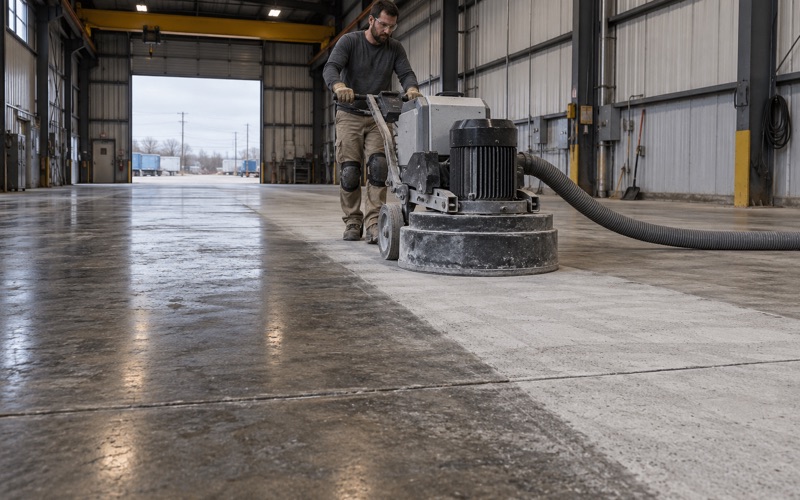
A coating only keeps fertilizer out of the concrete if it stays bonded, so the work starts with the slab. We profile the surface mechanically to an ICRI concrete surface profile the primer can grip, capturing the dust at the machine with a vacuum rather than washing it toward a drain.
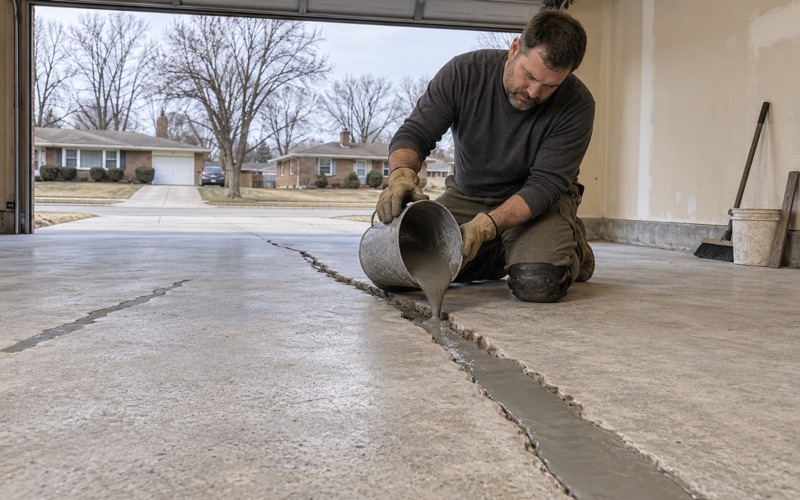
Old paint, cracks and spalls are mapped at the first visit. Fertilizer and water collect in exactly those low, open spots, so an unfilled crack becomes the one place on an otherwise sealed floor where a stain can still form. If a slab needs repair first, we say so.
Moisture comes next. We test it before the price is final, by ASTM F2170 in-situ relative humidity probes or ASTM F1869 calcium chloride testing depending on the slab, and the proposal names the method and the number it has to pass, because a coating lifted by vapor from below stops sealing anything.
A dense, nonporous system
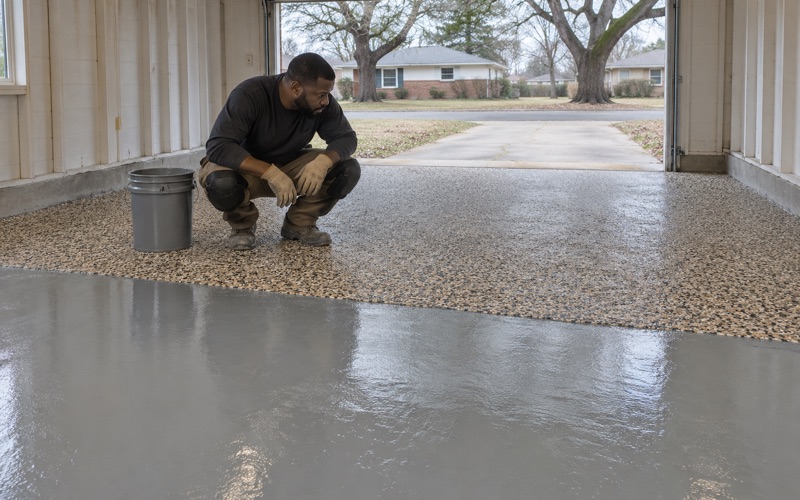
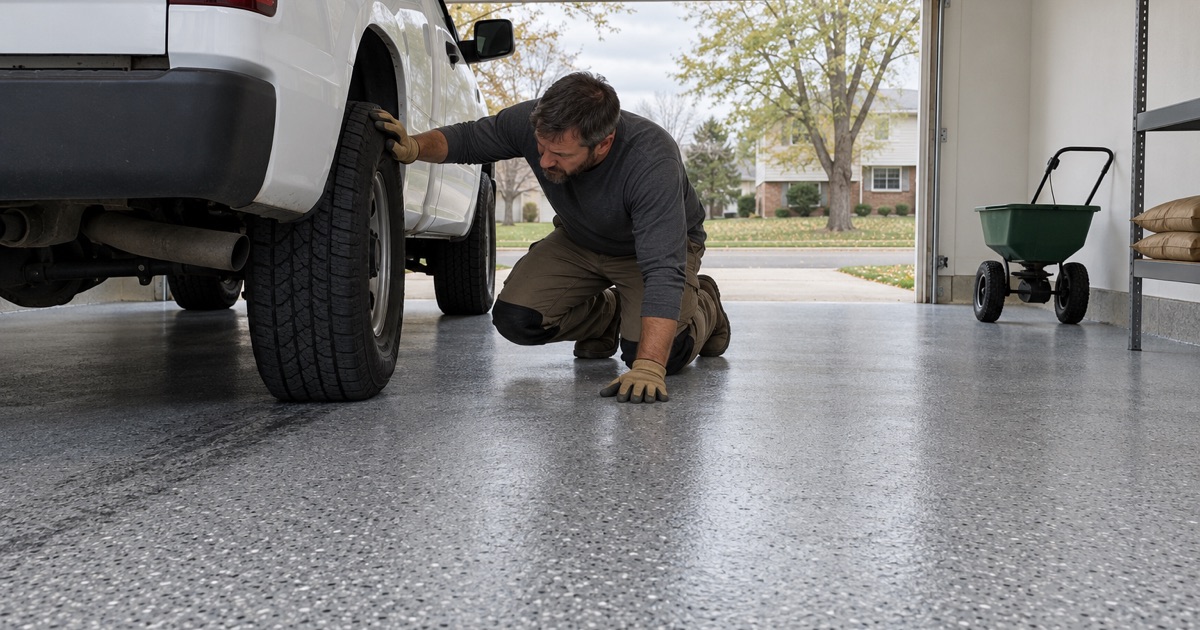
For a garage that stores lawn products, we typically build a 100% solids epoxy base coat, broadcast it with vinyl flake, and finish with a polyaspartic topcoat. The topcoat is the part granules actually touch, and a tight, glossy film gives them nothing to lodge in.
Texture is a trade-off here. A heavy quartz aggregate broadcast adds grip but also adds ridges that hold fine granules, so near a fertilizer shelf we usually keep the texture modest and specify the slip resistance by the broadcast and topcoat named in the proposal.
A color that forgives what is left
Even with good habits, a spot will eventually get past the broom. A darker base or a busy flake blend in tans, browns and grays hides a faint orange mark far better than a solid light gray, which shows every speck the day it lands.
We talk through color with that in mind rather than picking from a showroom chip alone. A floor that hides what remains is a different thing from a floor that never marks, and only the first is something we offer. Our warranty exclusions, moisture first, are explained before the job is sold.
Lawn Food, Spreaders and the Richton Park Garage Floor
Where the bags actually live
Among Richton Park’s owner-occupied homes, 83.4 percent are detached houses, so many households here have a lawn to feed and a garage to keep its supplies in. The usual spot is a shelf along the side wall or the back corner, with the spreader parked underneath.
That corner is where the trouble tends to concentrate. A bag set directly on the slab wicks up any water that runs across the floor, a spreader drips granules every time it is moved, and the area is often the last part of the garage anyone sweeps.
A few habits help on any floor. Keep opened bags in a lidded bin or on a shelf off the concrete, fill the spreader outside on the lawn, and knock it clean over the grass before rolling it back in.
Timing the work around a lawn season
Cure schedules follow slab temperature and the dew point spread at the surface, not the calendar. An unheated Richton Park garage in deep winter is told to wait. The best window is usually a stretch of mild weather before the spring feeding starts, so the shelf and spreader can move back onto a fully cured floor.
Before the work, we clear the corner completely and sweep up any granules already on the slab. Rust already in the concrete may show through a clear or light coat, so an older stain is either ground out or noted in writing before coating begins.
Permits and paperwork in the village
The Village of Richton Park Building Department at 4455 Sauk Trail requires a permit for all concrete work and says cosmetic jobs such as painting and carpeting need none. A floor coating is not named either way, so we ask the department before the job is scheduled rather than guess.
Contractors working in the village register each year with a certificate of insurance and a license and permit bond, and we confirm that registration before booking. Illinois does not license flooring or coating contractors, so the village registration, the written scope and the proposal’s named products are what a homeowner can actually hold us to.
Garden departments like the one on Central Avenue sell lawn food by the bag every spring, and plenty of it ends up on garage shelves across the village. Our part is a floor that keeps the granules on the surface long enough for a dry sweep to collect them, in a color that makes peace with whatever the broom misses.
- 20+ Years Coating Concrete
- Written Moisture Testing
- Free Estimates